Heart Disease

Hearts 168457_154905807894473_110794108972310_320156_2061498_n“The human heart is the most deceitful of all things,
and desperately wicked. Who really knows how bad it is?”

Jeremiah 17:9, NLT

We are the wounded. What exactly has caused it isn’t always known.  A death, divorce, depression and disability are great triggers.  Some of us are chronically ill, others are mentally ill.  We struggle to hold a job, and to go to church. There are some who are reading this who are controlled by addictions.  And a few of us consider suicide on pretty much a regular basis.

We’ve been hospitalized and stigmatized, and sometimes even institutionalized. And at times we endure massive attacks of fear and anxiety.  We are not easily understood, and we hear the whispers.  Our paranoia can often saturate what what we are thinking, (I think its more like a “marinade.”  Our brains just soak it up.)  Most of us are ‘walking wounded.’ We limp physically, and figuratively with equal pain.

“For thus says the LORD: Your hurt is incurable,
    and your wound is grievous.”

Jeremiah 30:12, ESV

If we are honest (and God insists on a rigorous honesty) we realize that we are a mess!  The prophet Jeremiah had a tremendous understanding of the human condition, and was never beguiled by the lie of pride, arrogance and selfishness.  He declares that we are diseased down to the core, like a rotten apple.

At times we continue in our favorite style of darkness.  And havoc sporadically rips through us and we become “disaster areas.”  How very sad, and profoundly tragic.

But you must understand this powerful fact.  Jesus Christ has been sent by the Father to save and cleanse all who come to Him.

“At that time a fountain will be open for David’s descendants and for the people of Jerusalem to cleanse them of their sin and uncleanness.”

Zechariah 13:1, NCV

“Children, it’s time for a bath,” and what God has done provides us the only way to “get better.” Some of us have carried staggering burdens for decades.  But I must be truthful. Our afflictions may continue to disturb us.  If you are bipolar or depressed, it just could be you’ll remain so.  But I know first-hand that our Father will give us an extra ration of grace.

In the Old Testament, family patriarchs could give an additional portion to a son he especially loved.  All were blessed, but some more so. That peculiar proclivity of our Father is why some of us with deep wounds can follow closer than others who are healthy.

“For I am the LORD, your healer.” Ex. 15:26

flourish2

“The treatment a wound gets decides whether time will bring healing or bondage.”

&

ybic, Bryan

kyrie elesion. (Lord, have mercy on each reader)

cropped-christiangraffiti1-2

Combat’s Hidden Toll: 1 in 10 Soldiers Report Mental Health Problems

Soldiers Report PTSD Symptoms and Other Mental Health Problems
 
By KIM CAROLLO
ABCNews Medical Unit
June 9, 2010

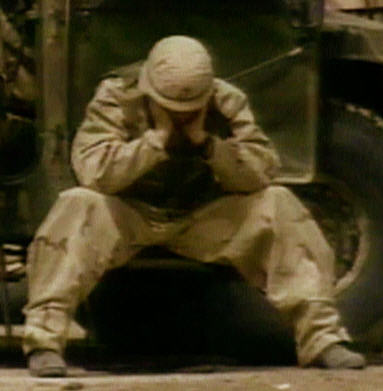
Even though he’s retired from active military duty, CSM Samuel Rhodes still suffers from deep emotional wounds.

“I had to take this afternoon off from work today because of anxiety,” he said. “And sometimes, if I’m going through a really tough time, I think about suicide.”

He spent nearly 30 years in the Army and recently spent 30 straight months deployed in Iraq where he, like many soldiers, witnessed some of the horrors of war.

“In April 2005, it started to eat me up because I started losing one soldier after another,” Rhodes said. “We lost 37 soldiers that were in my unit.”

He was in charge of the brigade of 37 soldiers, and as time wore on, the loss of life wore him down.

“In April 2007, it came full circle. I considered suicide as an option. I felt guilty about losing those soldiers, even though I had no control over it,” he said.

“And I was sleepwalking. I had to tie myself to my cot to prevent it,” he added.

Later, during his 24th month in Iraq, he was found unconscious, and doctors diagnosed him with exhaustion. At that time, the combat stress doctor told him he was also suffering from post-traumatic stress disorder.

“He started explaining it to me, and I realized he was right,” Rhodes said.

And according to a new study conducted by researchers at Walter Reed Army Institute of Research, Rhodes’ mental health problems are common among soldiers returning from Iraq.

Between 2004 and 2007, researchers gave out anonymous surveys to four active duty brigade combat teams and two National Guard combat team three months and 12 months after deployment. The surveys screened soldiers for PTSD, depression, alcohol misuse and aggressive behavior and asked them to report whether these problems impacted their ability to get along with others, take care of things at home or perform their job duties.”A high number of those that had symptoms of PTSD and depression also reported some aspect of impairment,” said Jeffrey L. Thomas, one of the study’s co-authors. “The range was about 9 to 14 percent.” Depression rates ranged from 5 percent to 8.5 percent.

But by using a less stringent definition of PTSD, they found between 20 and 30 percent of soldiers showed symptoms of PTSD, while they found between 11.5 to 16 percent of them were depressed.

Full article, please go to:  http://abcnews.go.com/Health/MindMoodNews/10-soldiers-fought-iraq-mentally-ill/story?id=10850315&page=2

When Post-Traumatic Stress Disorder Gets Bad

Stress destroys lives
Traumatic stress destroys lives

Combat veterans, sexual assault survivors, and other victims of trauma are vulnerable to a condition called Post-Traumatic Stress Disorder (PTSD). People with PTSD suffer from a range of symptoms that interfere with their capacities to enjoy normal life.

People who suffered suicidal conditions, particularly conditions that were chronic, recurrent, or included one or more attempts, may also be victims of PTSD. According to its definition, PTSD may result when a person suffers an event or situation that is outside the range of normal experience, exceeds the individual’s perceived ability to meet its demands, and poses a serious threat to the loss of life.

Suicidal people meet the formal criteria for PTSD. Severe and prolonged suicidal pain is not something that most people suffer. People in suicidal crises feel that they are at the breaking point of what they can cope with. Since 30,000 people die by suicide each year in the United States, it is a condition that posesses a serious threat to the loss of life.

Many of us are haunted by memories of acute crises, acts of self-injury, or extended periods of severe depression. Like citizens of a besieged city, we lived through periods of time in which we had a realistic and unrelenting fear that we would soon be dead. We suffer PTSD simply from having been suicidal, independently of whatever particular traumas may have contributed to our becoming suicidal, such as abuse during childhood or exposure to the violent death of someone else. Our “suicide PTSD” is also distinct from whatever traumatic events may happen as a result of being suicidal, such as involuntary hospitalization or job discrimination. Undoubtedly, most of us suffered many types of traumatic events in our lives, and these events and their consequences need to be addressed in recovery. But the suicidal crises themselves may be events that induce PTSD.PTSDgraph

The PTSD literature for veterans and sex assault survivors lists conditions that are commonly found among survivors of those types of trauma. Survivors typically have only some of these symptoms, and the severity of a particular symptom may vary from individual to individual. Survivors of different types of traumatic events often have a different range of symptoms. A remarkably large number of these conditions are common among people with long-term histories of suicidal pain:

  • Problems with memory. Persistent, intrusive, and vivid memories concerning the traumatic situation. Events of daily life may trigger distressing memories related to the trauma. Memory lapses for parts of the traumatic situation. Many suicidal people are troubled by strong images, such as the feeling that they have bombs inside their bodies or a knife over their heads, and in recovery continue to be bothered by the memory of having had these images.
  • Avoidance of things associated with the traumatic experience.
  • Denial on the seriousness of the experience.
  • Persistent anxiety.
  • Fear that the traumatic situation will recur. The trauma is often an event that shatters the survivors’ sense of invulnerability to harm.
  • Disturbed by the intrusiveness of violent impulses and thoughts.
  • Engagement in risk-taking behavior to produce adrenaline.
  • A feeling of being powerless over the traumatic event. Anger and frustration over being powerless.
  • A feeling of being helpless about one’s current condition.
  • Being dramatically and permanently changed by the experience.
  • A sense of unfairness. Why did this happen to me?
  • Holding oneself responsible for what happened. Feeling guilty.
  • The use of self-blame to provide an illusion of control. Sexual assault survivors often blame themselves: “If I hadn’t been at that location, worn those clothes, behaved in that way, then it wouldn’t have happened.” This pattern is also found in the survivors of a completed suicide. “If I had only done x, the suicide would not have happened,” can be used to try to cope with the fear that suicide will happen again in the family–i.e., it is preventable if I just manage things differently. The suicidal are often full of self-blame. As in the other cases it is partly due to an internalization of social attitudes that blame the victim or family, and also due to the effort to gain mastery over the situation. To imagine we could have done more is more tolerable than total helplessness.
  • Pushed into the corner
    Pushed into the corner

    An inability to experience the joys of life.

  • Feelings of being alienated from the other people and society in general. “I am different. I am shameful. If they knew what I was like, they would reject me. I don’t belong in this world. I’m a freak, an outcast.”
  • When people with PTSD try to return to normal life, they are plagued by readjustment problems in the basic elements of life. They have difficulties in relationships, in employment, and in having families.
  • A lack of caring attachments. A sense of a lack of purpose and meaning.
  • Some chronically traumatized people lose the sense that they have a self at all.
  • Veterans report the feeling that they never really made it back from the war. Formerly suicidal people feel they never really made it back to normal life.
  • One Viet Nam veteran with PTSD said, “I don’t have any friends and I am pretty particular about who I want as a friend.”
  • PTSD was aggravated for Viet Nam veterans because they returned to a country that had negative attitudes toward them. For sexual assault survivors, stigmatization is the “second injury”.
  • When Viet Nam veterans returned home people were angry at them. They had shamed the country, they had done something wrong, they were potentially harmful to others, it was dangerous to be with them. Sexual assault survivors may receive angry responses–on the grounds that they have done something that shames the family. Suicide attempters often experience great anger from family and care providers.
  • A deep distrust of co-workers, employers, authorities.
  • Left with unexpressed rage against those who were indifferent to their situation and who failed to help them.
  • In personal relationships there are problems of dependency and trust. A fear of being abandoned, betrayed, let down. A belief that people will be hurtful if given a chance. Feelings of self-hatred and humiliation for being needy, weak, and vulnerable. Alternating between isolation and anxious clinging.
  • Trauma often causes the victim to view the world as malevolent, rather than benign.
  • No sense of having a future, or, the belief that one’s future will be very limited.
  • Feel that they belong more to the dead than to the living.
  • The feeling of having a negative “Midas touch”–everything I get involved with goes bad.
  • Loss of self-confidence, and loss of feelings of mastery and competence.
  • A resistance to efforts to change a maladaptive world view that results from the trauma.
  • A mistrust of counselors’ ability to listen.
  • People who suffered traumatic experiences as children, teenagers, or young adults may simultaneously become prematurely aged and developmentally arrested. A part of them “feels old”. Another part feels stuck at the age they had when the trauma occurred.
  • PTSD can be worse if the sufferer experiences the trauma as an individual rather than as a member of a group of people who are suffering the same situation. Unlike earlier wars in which units went overseas together and returned together, in Viet Nam each soldier had an individual DEROS (Date of Expected Return from Overseas). This reduced unit cohesiveness; each soldier experienced the war from an individual point of view. Suicidal people experience their near-death situation with extreme isolation. They see their conditions as being completely unique – “terminal uniqueness”. They have no sense of identification with others.
  • The severity of PTSD symptoms tends to increase with the severity and duration of the trauma.
  • The use of alcohol or drugs to cope with the PTSD symptoms.
  • Attempts to do things to gain a feeling of mastery over the traumatic situation, e.g., become a volunteer on a hotline.These kinds of conditions may be found again and again in the chronically suicidal. Upon reflection, it should not be surprising that we should suffer PTSD. Many of us suffered from suicidal pain for years – and years – and years. The idea of dying is terrifying. We recoil at thoughts of dying by automobile accident, plane crash, murder, cancer, AIDS, drowning, suffocation. The idea of dying violently simply by forces generated from within ourselves is in some ways almost too horrible to apprehend. How could anyone survive such a prolonged siege of pain and terror – and remain unaffected?  Survivors of traumatic experiences are often told, “It’s in the past. Forget about it and get on with your life,” “Why can’t you just forget about all that, and enjoy life like a normal person?” If we could simply “get on with life”, they would have done it. PTSD helps explain why it is so hard for the chronically suicidal to recover. Because we were suicidal, we subsequently suffered many of the conditions associated with post-traumatic stress disorder. These conditions are serious problems in their own right; they are formidable barriers in the recovery process.We can heal from the original trauma, and we can heal from the PTSD conditions that have plagued us since the trauma. The basic steps of PTSD recovery programs provide helpful guidelines: 
  1.  
    1. an environment that is physically and emotionally safe
    2. treatment for addictive behaviors
    3. patience: PTSD recovery takes time
    4. caring attachments
    5. restore sense of mastery
    6. rest and relaxation
    7. recall the traumatic event(s) in small steps
    8. gradually assimilate painful feelings and memories
    9. fully experience fear, anger, shame, guilt, depression
    10. grieve one’s losses

In a support group we have a chance to talk about our suicidal histories without the fear that we will be taken to a hospital for doing so. We can talk about the isolation, the fears, the pain, the confusion, the acts of self-injury, the behavior of others that was stigmatizing, denying, abusive, the horrible sense of estrangement that exists when you are in a terrible situation and there is no one who understands what you are going through, the hatred and contempt for oneself and the world, the debilitating sense of personal weakness. We see that we are not alone. We do not have the seriousness of our condition minimized, denied, or belittled. With time, the pain abates and the troublesome PTSD symptoms diminish.

By David L. Conroy, PhD. Reprinted with permission.  http://www.metanoia.org/suicide/ptsd.htm