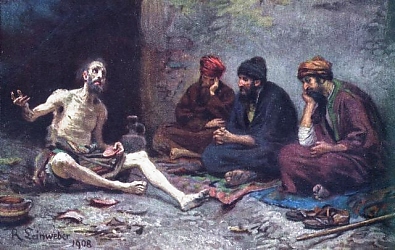
Elijah Had Issues as Well

elijah
Elijah and the Angel

“Then Elijah walked for a whole day into the desert. He sat down under a bush and asked to die. “I have had enough, Lord,” he prayed. “Let me die. I am no better than my ancestors.”

1 Kings 19:4

Poor Elijah.  He was bold and heroic, taking on the enemy at Mt. Carmel.  A mighty victory was amazing, but here he is, completely defeated and overpowered by his own fear and doubt.  How defeated was he?  We hear him begging to be allowed to die. 

He was overwhelmed.

You could say that Elijah was saturated with fear.  He could not resist taking on the conflict.  It seemed to him that everything was now directed at him.  He couldn’t take one step forward.  So, he folded.  Everything was affecting him on a personal level, and he was not built to take the load.

Many of God’s children come to this point.

He was shorting out.  His internal circuits were not designed for this.  He crumbles under the weight.  As we read the text, it all seems to be a bit off.  We shake our heads and wonder about strange Elijah.  We see him incapacitated by his doubt and fear.  But it doesn’t seem to us to be an issue.  The prophets of Baal wouldn’t deceive the Israelites anymore. After all, he had just achieved a fantastic victory that should propel him to the next encounter.

“Elijah was a human being just like us.”

James 5:17

The servants of the Lord are vulnerable.  As we step into the flow of God’s presence we will come “face-to-face “with things that are beyond us.  Often we will find ourselves pushed beyond our limits, backed in a corner and stripped of our weaponry.  Our enemies now turn to face us without fear of reprisal.

Our Father deals gently with a wounded servant.

Elijah had been crippled.  He had nothing more to give.  We can shake our head, and pass him by as a casualty of a spiritual war. But the funny thing is that God tells his story, he has been added to the narrative of scripture.  His falterings, and failings has become our focal point.  Elijah, with all his issues must be faced, and we must look at him.

We see the tenderness and gentleness of God as He deals with His bruised servant. God loves His broken believers. (1 Kings 19:12-13).

His Spirit is oh so gentle.

He comes whispering.  He lifts Elijah at Elijah’s pace.  A painful rebuke, and there isn’t a harsh word of correction, it is not even considered.  Our Father deals carefully with a wounded servant.  Elijah would go on to serve Jehovah.  Elijah would be a changed man.

God had mended him.

bry-signat (1)

(Background: 1 Kings 18-19)

The Micro and the Macro: An Understanding

10piper
John Piper, Pastor of Bethlehem Baptist Church, Minneapolis. Writer and Speaker, DesiringGod.org

Originally dated, July 14, 2008 | By: John Piper 

One of the reasons God rarely gives micro reasons for his painful providences, but regularly gives magnificent macro reasons, is that there are too many micro reasons for us to manage, namely, millions and millions and millions and millions and millions. God says things like:

  1. These bad things happened to you because I intend to work it together for your good (Romans 8).
  2. These happened so that you would rely more on God who raises the dead (2 Corinthians 1).
  3. This happened so that the gold and silver of your faith would be refined (1 Peter 1).
  4. This thorn is so that the power of Christ would be magnified in your weakness (2 Corinthians 12).

But we can always object that there are other easier ways for God to accomplish those things. We want to know more specifics: Why now? Why this much? Why this often? Why this way? Why these people?

The problem is, we would have to be God to grasp all that God is doing in our problems. In fact, pushing too hard for more detailed explanations from God is a kind of demand that we be God.

horseshoe-anvil-clipartThink of this, you are a blacksmith making horseshoes. You are hammering on a white hot shoe and it ricochets off and hits you in the leg and burns you. In your haste to tend to your leg you let the shoe alone unfinished. You wonder why God let this happen. You were singing a hymn and doing his will. Your helper, not knowing the horseshoe was unfinished gathered it up and put it with the others.

Later there was an invasion of your country by a hostile army with a powerful cavalry. They came through your town and demanded that you supply them with food and with shoes for their horses. You comply. Their commander has his horse shod by his own smith using the stolen horseshoes, and the unfinished shoe with the thin weak spot is put on the commander’s horse.

In the decisive battle against the loyal troops defending your homeland the enemy commander is leading the final charge. The weak shoe snaps and catches on a root and causes his horse to fall. He crashes to the ground and his own soldiers, galloping at full speed, trample him to death. This causes such a confusion that the defenders are able to rout the enemy and the country is saved. Now you might say, well, it would sure help me trust God if he informed me of these events so that I would know why the horseshoe ricocheted and burned my leg. Well maybe it would help you. Maybe not.

God cannot make plain all he is doing, because there are millions and millions and millions and millions of effects of every event in your life, the good and the bad. God guides them all. They all have micro purposes and macro purposes. He cannot tell you all of them because your brain can’t hold all of them.

Trust does not demand more than God has told us. And he has given us immeasurably precious promises that he is in control of all things and only does good to his children. And he has given us a very thick book where we can read story after story after story about how he rules for the good of his people. Let’s trust him and not ask for what our brains cannot contain.


http://www.desiringgod.org/Blog/1307_why_god_doesnt_fully_explain_pain/

Need Immediate Help? Call 1-888-NeedHim

Facing Down Your Dragon

Psalm 38:17

Over 85 million Americans live in chronic pain. That’s amazing. Maybe you’re one of them and maybe you just want to understand — perhaps you have a friend or family member who is hurting. They’re facing their dragon and that can be a challenge.

Pain can be constant, or, it can be intermittent. It shows up unpredictably. One never knows when. But believe me, it is terribly real, even if it’s not continual. I look at my dragon in the eye far too often. Way too often.

There are different kinds and various levels to it. Healthcare people often use the Numerical Rating Scale (NRS). Pain is ranked by numbers between 1-10, the higher the number the greater the pain.

Christians are part of that 85 million. We’re not immune just because we believe in Jesus. Some of us will hurt.

Coping with Chronic Pain

  • Learn all you can about your particular issue. I’m constantly looking and hopefully learning all I can, I want to be an expert. Research things. Google and Wikipedia can be deep reservoirs of knowledge.
  • Learn how to worship and pray in a brand new way. Things have changed now and seeking Him becomes a challenge, and, it can be easier.
  • Insomnia
  • Depression or anxiety, or both.
  • Fatigue, or stress.
  • Mood swings.
  • Doctors and meds.

I have to warn you, severe pain can make your dear one irrational. Pain can get so intense that you will find it impossible to relate to the sufferer. I once had a fierce battle with Complex regional pain syndrome (CRPS) in both forearms. Most doctors rate this as one of the worst types of pain to have.

Morphine didn’t help. Lynnie (my wife) could only watch and pray as the dragon kept attacking me, over and over. She watched me writhe in pain and she was pretty much helpless.

I was very angry, wildly rude and terribly mean. I was frustrated because I couldn’t communicate how bad the pain was. Over and over I tried to share how I was feeling, but words were not enough.

Some advance the idea that you need to find enough faith to be healed, but what about having enough faith to live in constant pain?

“Pain is no evil, unless it conquers us.”

     Charles Kingsley

God Keeps Your Tears in a Bottle

by Linda L. Kruschke

I have cried many tears in my life.

If you have never cried, you can stop reading right now. But if you have shed tears for yourself or for others, or if like me you have shed some without even knowing why or where they came from, take heart. God knows the tears you have shed. Psalm 56:8 says so. Here are several translations of that wonderful verse:

Record my lament;
       list my tears on your scroll —
       are they not in your record? (NIV)

You have taken account of my wanderings;
         Put my tears in Your bottle
         Are they not in Your book? (NASB)

You keep track of all my sorrows.
      You have collected all my tears in your bottle.
      You have recorded each one in your book. (NLT)

Write down my poem of sadness.
      List my tears on your scroll.
      Aren’t you making a record of them? (NIRV)

I love the image of God keeping all my tears in a bottle. I can envision shelves filled with bottles in Heaven, each with a name on it, and an accompanying scroll documenting every tear and lament. Or maybe it is just one huge bottle with all of our tears mingled together.

Today tears are being shed in dark rooms where children are being held as sex slaves, in Africa as people remain homeless and without food and water, in the United States as many remain jobless, in hospitals and on the streets where the mentally ill are forgotten, in homes around the world where people are spiritually lost and have no hope.

We live in a fallen and painful world.

Tragedies happen and humans are not always kind to one another. And so tears are shed. It is hard to fathom God collecting every single one, but He does. He notices and He records each tear and each lament.

The more I think about it, I like the idea that God has mingled all our tears together. The Psalm does refer to God’s “bottle” in the singular. And if He has collected every tear in that bottle, then mingled with our own are the tears of Jesus. In John 11, the apostle records this event: “Jesus wept.” (John 11:35.)

In this passage, Jesus weeps when He learns of the death of Lazarus.

When they see Him weeping, the people say “See how he loved him!” John 11:36. But I don’t think Jesus was weeping because Lazarus was dead – He knew He was going to raise Lazarus from the dead. Rather, I think He wept because of the compassion He felt for humanity as we weep over our own tragedies and losses. It is us that He loved so much that it brought Him to tears.

So if you weep today, remember that God is collecting your tears in His bottle, and mixing them with the tears of our dear Savior. Not only that, but God will deliver you from the final trial that lead to tears by redeeming your soul.

Psalm 116:8-9 (NIV).

Linda’s blog is at anotherfearlessyear.net  Please check out all she has to say and listen to her heart.
You may copy and use or distribute this post freely in its entirety please.
We’re a member.

p