Limits of Mental Illness

748

Mental illness is so limited,

It cannot cripple love, 

It cannot shatter hope.

It cannot corrode our faith.

It will never destroy peace.

It cannot.

It will never kill friendship, 

It cannot suppress memories. 

It cannot invade the soul.

It cannot steal eternal life.

It cannot conquer eternal life.

It cannot conquer your spirit.

Amen.

flourish2

P.S. I have received some criticism over the contents of this post. The argument is that mental illness is very destructive, and that I’m misleading others by suggesting it isn’t. My thinking at this time is that if we dwell on the past and how it affects the present moment. I believe some of us have a mental illness. But I also believe more strongly so that Christ redeems us completely. “Because he lives,” goes the old hymn, “I can face tomorrow.”

In the “heat of the moment” our situation can seem overwhelming. Our illness can be completely devastating. And yet the Holy Spirit is yet to fully redeem us, we still must view this coming event as something triumphant and total.

This life is not the end. What a relief it will be to completely shake off all our darkness!

“Behold, the dwelling place of God is with man. He will dwell with them, and they will be his people, and God himself will be with them as their God. 4 He will wipe away every tear from their eyes, and death shall be no more, neither shall there be mourning, nor crying, nor pain anymore, for the former things have passed away.”

Revelation 21:3-4

1brobry-sig4


Walking With the Lord Jesus, [Humility]

jesuschrist_mary_marymagaleneandthedisciples_20130319

When Jesus who was the fullness of God in bodily form came, He came as a lowly slave. We see Him stripping down, filling a basin, and scrubbing dirty feet. He actively made Himself a broken and humble servant. It was deliberate and conscious.

(Read Philippians 2. It will blow you away!)

I think we learn this from Him. The disciple never exceeds his master. He made it very clear that we were to follow Him in this. It’s processed by us when we are very firmly aware that the One who knows us. To be loved by Him is enough (or is it?)

Exceptional effort is made by the Holy Spirit to help us understand. There is a repeated thought given to us in various permutations. In one of my favorite verses King David, standing in front of God, and his people, declared,

“But who am I, and who are my people, that we could give anything to you? Everything we have has come from you, and we give you only what you first gave us! 15 We are here for only a moment, visitors and strangers in the land as our ancestors were before us. Our days on earth are like a passing shadow, gone so soon without a trace.”

1 Chronicles 29:14-15

“We don’t remember what happened in the past, and in future generations, no one will remember what we are doing now.” This is the cheery assessment found in Ecclesiastes 1. This view irks us big time. Especially if we have invested so much in our wealth, gifts, experiences and accomplishments.

“Our days on earth are like grass;  like wildflowers, we bloom and die.  The wind blows, and we are gone— as though we had never been here.”

Psalm 103:15-16

In the New Testament, the emphasis is only stronger. Remember when James and John tried to get the corner on the authority and honor of being on “the right and left?” (My, but they were ambitious lads!)

“When the ten other disciples heard what James and John had asked, they were indignant. 42 So Jesus called them together and said, “You know that the rulers in this world lord it over their people, and officials flaunt their authority over those under them. 43 But among you it will be different. Whoever wants to be a leader among you must be your servant, 44 and whoever wants to be first among you must be the slave of everyone else. 45 For even the Son of Man came not to be served but to serve others and to give his life as a ransom for many.”

Mark 10:41-45

The subject and emphasis on is becoming obscure— “just like Jesus.” I suppose my main contention is this– our understanding of discipleship has too much “me, and not enough Him.” This can be a gentle error of a young believer.

There are two certain issues here:

  • The first is authentic discipleship. What does it really look like?
  • The second is a decided and eager servanthood. Who are we really serving?

Both ideas are often missing in our churches, and in our teaching. Somehow we are not communicating the real transferable concepts. Their simplicity evades us. Jesus declared that even children would understand His word. We want deep, but He said that it’s pretty straightforward.

I intend to return to this fairly soon. Again, I appreciate any constructive criticism, your own thinking on this, and your prayers.

*1brobry-sig4


Little Pieces of Obedience

abraham_isaac_1

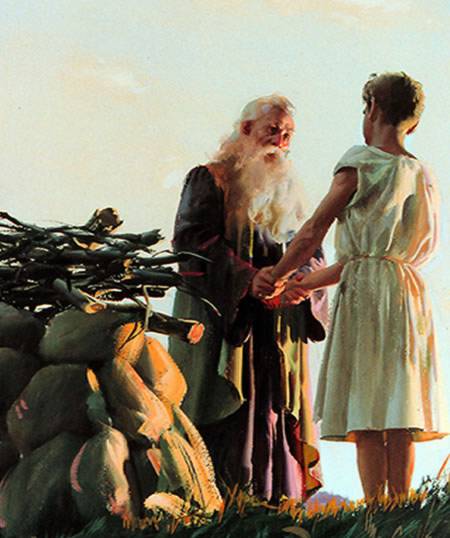
“It was by faith that Abraham offered Isaac as a sacrifice when God was testing him. Abraham, who had received God’s promises, was ready to sacrifice his only son, Isaac, 18 even though God had told him, “Isaac is the son through whom your descendants will be counted.”[ 19 Abraham reasoned that if Isaac died, God was able to bring him back to life again. And in a sense, Abraham did receive his son back from the dead.”

Hebrews 11:17-19, NLT

The faith of Abraham is understood by believers everywhere. This simple man followed God to a obscure mountain in Judea. He came fervently, and yet logically to the command of the Lord. Abraham’s confident assurance would carry him to Mt. Moriah were he would sacrifice his son. He would prefigure God’s own sacrifice of Jesus Christ, His only Son.

There were many steps Abraham had to take: the knife, the rope, the firewood, the donkey. There was a dozen details to arrange. Abraham would have had to plan ahead of time to prepare. I’m relatively certain he had ample time to consider what he was doing. The enormity of it all would’ve been staggering.

Hebrews reveals that ‘faith’ was what enabled Abraham. It was faith followed by a dozen little acts of obedience that strengthened him to follow God’s instructions. Abraham would obey God, through faith, by doing many little things. All would lead up to the ‘big thing,’ the offering up of his only son.

Heavy doors swing on small hinges.

I believe that no act is too small. Tiny actions make for big ones. It seems that several times during our daily grind we face little choices that often determine a far greater meaning. I’ve been told that there are flowers in alpine valleys that no man will ever see. Their sole beauty is visible only to God. Obedience is often like this. But the Lord knows.

God meets every act of obedience to Him with a smiling grace.

Hebrews 11 is known as the believer’s ‘hall of fame’. In its verses we’re pounded by the idea that the faith is visible only through obedience. What we do is as significant as what we believe. It has always been so.

“…but the people who know their God shall be strong, and carry out great exploits.”

Daniel 11:32, NKJV

A little obedience prepares us for bigger ones. If we won’t obey in the small ones, how will we in the big ones? The prophet Daniel spoke of a remnant that would do astonishing things, and that the core of their fame would come from knowing God. This is faith made visible. The ‘great exploits’ spring out of faith in a strong God. To be regarded in this way would be wonderful, but faith needs those little acts of obedience to be able to do the great ones. 

We must reclaim the reality that the details of our lives are not trivial.

Repeated Sin

I must tell you this right from the start! You must believe it before we can go any further.

(I want to apologize for my brother pastors who may have told you otherwise.)

1 John 3:6-9 

Over and over, we sin the same sin until it has become habitual. It is exactly the opposite of godliness (that’s why we call it ungodliness.) It’s truly the other side of the proverbial coin. It haunts everyone who sincerely wants to follow Jesus.

Let’s understand these things. I’ve listed seven consequences of repeated sin.

  1. It creates hypocrisy and self-hatred.
  2. It nullifies witness, and the work of missions.
  3. It cancels out real praise, worship, and Bible reading.
  4. It destroys real fellowship between other believers.
  5. Any personal ministry is degraded and turned upside down.
  6. It blinds others, and deceives them to who we really are inside.
  7. It always engenders guilt and unworthiness, especially toward God.

I once lived in a house that had a severe mold problem. The previous owner, in an attempt to make things liveable, painted over the offending walls. He meant well, of that I am sure, but the problem of the mold was never dealt with properly. No matter how much you slathered on the paint, the mold was still alive and well. It simply worked its way to the surface. Sin is like this.

Paul’s letter to the Romans, chapter 7, gets to the root of our “mold.” If we read it carefully (as we should) we’ll start to grasp what it means to walk biblically.

Paul floats different concepts our way. Law, sin, nature. Each word must be processed.

“Law” is something that is always true. (Think of the Law of gravity.) “Sin” or falling short. The Greek word is pretty descriptive–it means “an arrow that misses the target.” “Nature,” or the intrinsic character of something.

We use these words so seldom that they seem archaic and outdated; but not so. Understanding these three opens up the entire realm of spiritual holiness. When we realize that the Word explains our situation so clearly we become convinced that holiness is possible. We begin to hope again.

Tolerating repeated sin is a terrible form of “spiritual suicide.” It always breaks fellowship with the living God. But as a believer, God doesn’t break fellowship with us, rather He comes closer and patches up our self-inflicted wounds. But even then we will not understand Him.

The Father’s heart is for us to be heart-holy. This is His perfect plan for us. 

1 Peter 1:4-6

But there is an all powerful remedy to our sickness-plague of repeated sin. Almost always we stare at this ugliness, it seems we’re fixated on it. Often there are two approaches we take regarding repeated sin. 1) We ignore and flail out a life of “holiness.” We minimize this. 2) We become hyper-aware of our sin and guilt. We maximize sin to the point where we lose all joy and peace.

“Looking at the wound of sin will never save anyone. What you must do is look at the remedy.”

D.L. Moody

I need to stop teaching now. Rereading this has made me slightly frustrated about what I’ve written. If any of this has helped, I’m glad. I’d like to close this with a Billy Sunday quote. He explains the seriousness of repeated sin. 

“I’m against sin. I’ll kick it as long as I’ve got a foot, and I’ll fight it as long as I’ve got a fist. I’ll butt it as long as I’ve got a head. I’ll bite it as long as I’ve got a tooth. And when I’m old and fistless and footless and toothless, I’ll gum it till I go home to Glory and it goes home to perdition!” 

 Billy Sunday