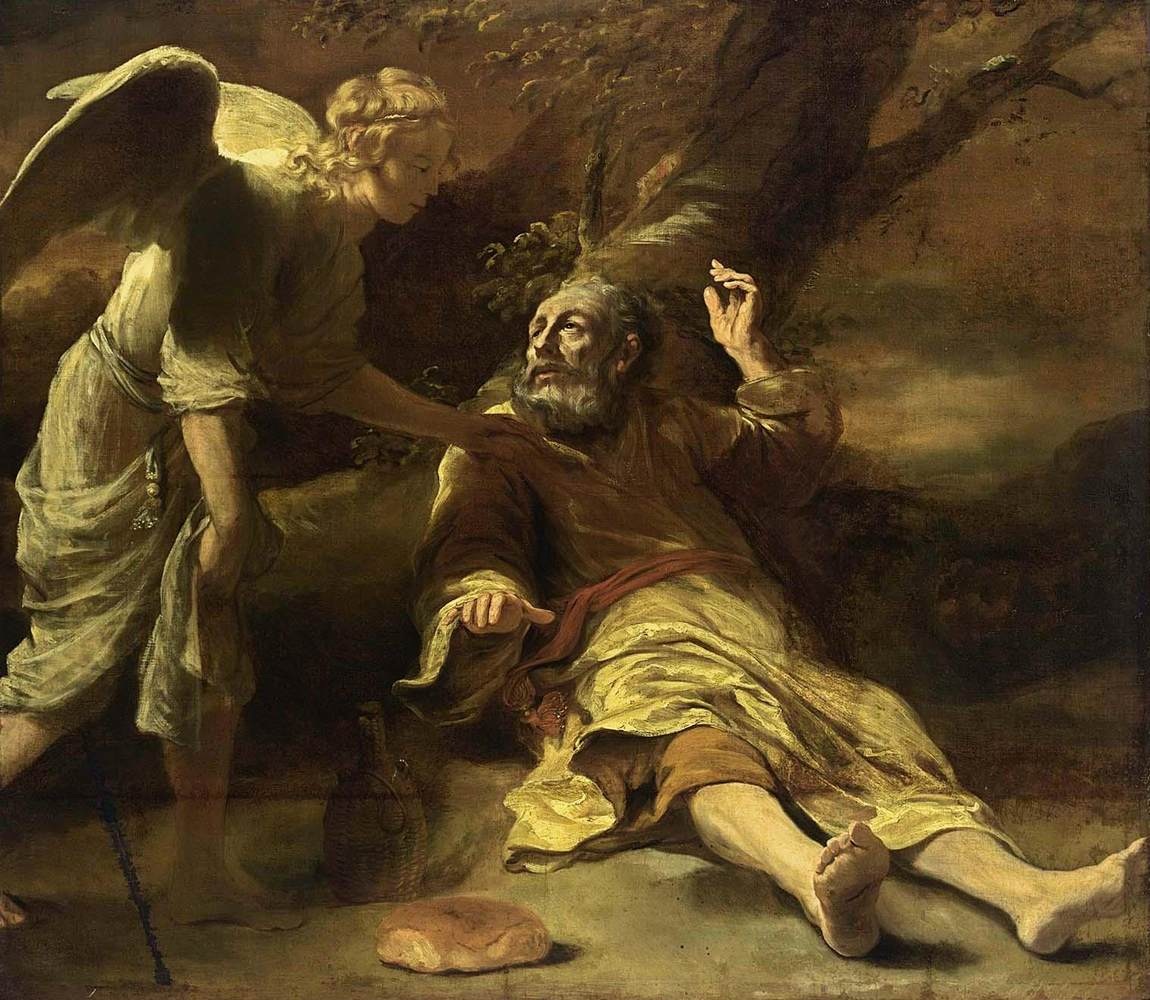
Elijah Had Issues as Well

elijah
Elijah and the Angel

“Then Elijah walked for a whole day into the desert. He sat down under a bush and asked to die. “I have had enough, Lord,” he prayed. “Let me die. I am no better than my ancestors.”

1 Kings 19:4

Poor Elijah.  He was bold and heroic, taking on the enemy at Mt. Carmel.  A mighty victory was amazing, but here he is, completely defeated and overpowered by his own fear and doubt.  How defeated was he?  We hear him begging to be allowed to die. 

He was overwhelmed.

You could say that Elijah was saturated with fear.  He could not resist taking on the conflict.  It seemed to him that everything was now directed at him.  He couldn’t take one step forward.  So, he folded.  Everything was affecting him on a personal level, and he was not built to take the load.

Many of God’s children come to this point.

He was shorting out.  His internal circuits were not designed for this.  He crumbles under the weight.  As we read the text, it all seems to be a bit off.  We shake our heads and wonder about strange Elijah.  We see him incapacitated by his doubt and fear.  But it doesn’t seem to us to be an issue.  The prophets of Baal wouldn’t deceive the Israelites anymore. After all, he had just achieved a fantastic victory that should propel him to the next encounter.

“Elijah was a human being just like us.”

James 5:17

The servants of the Lord are vulnerable.  As we step into the flow of God’s presence we will come “face-to-face “with things that are beyond us.  Often we will find ourselves pushed beyond our limits, backed in a corner and stripped of our weaponry.  Our enemies now turn to face us without fear of reprisal.

Our Father deals gently with a wounded servant.

Elijah had been crippled.  He had nothing more to give.  We can shake our head, and pass him by as a casualty of a spiritual war. But the funny thing is that God tells his story, he has been added to the narrative of scripture.  His falterings, and failings has become our focal point.  Elijah, with all his issues must be faced, and we must look at him.

We see the tenderness and gentleness of God as He deals with His bruised servant. God loves His broken believers. (1 Kings 19:12-13).

His Spirit is oh so gentle.

He comes whispering.  He lifts Elijah at Elijah’s pace.  A painful rebuke, and there isn’t a harsh word of correction, it is not even considered.  Our Father deals carefully with a wounded servant.  Elijah would go on to serve Jehovah.  Elijah would be a changed man.

God had mended him.

bry-signat (1)

(Background: 1 Kings 18-19)

Repeat Offenders

“Father, every family has a rascal someone who breaks the rules a juvenile delinquent of untold frustrations and sleepless nights a repeated offender and bearer of sad woe the problem child who needs the most discipline.

Is this why you love me most persistently? When you correct me, is it because I’m the one most contrary?

Or is it that you love me so much?”

 I wrote this thinking about Hebrews 12 and God’s purpose of chastening. I don’t pretend to understand this dynamic completely–all I can say is that my childhood was punctuated by much difficulty. But now, as a father (my two children are now grown), fatherhood has become far easier than my dad had with me.

7 “As you endure this divine discipline, remember that God is treating you as his own children. Who ever heard of a child who is never disciplined by its father? 10 For our earthly fathers disciplined us for a few years, doing the best they knew how.

But God’s discipline is always good for us, so that we might share in his holiness. 11 No discipline is enjoyable while it is happening—it’s painful! But afterward there will be a peaceful harvest of right living for those who are trained in this way.”

Hebrews 12:7, 10-11

I really think we understand our Heavenly Father when we spend quality time with Hebrews 12. We are given insight into His care and into our own issues. It is a good thing He gives us— it enriches our spiritual lives.

It’s never nice to be corrected.

It’s not pleasant. Part of being corrected is being reminded that we’re not as righteous as we think we are. To be corrected strikes us to a reprimand, an admonition that something isn’t right inside of us.

The Father corrects His children–in many ways through a myriad of circumstances. He loves us far too much to allow us to continue in our sin. He’s making us into the image of Christ.

We should welcome His correction. He has a plan for you.

When He disciplines you, it only proves that He is your Father. It’s critical to remember: God’s correction is always for our good. It may be painful yes, but it comes with real hope. It’s not to harm or punish you.

“Father, I’m so sorry that I grieve you as often as I do. I promise to behave. Thank you for being a faithful Father who cares deeply for my soul. Amen.”

 Hannah Whitall Smith.

A Permanent Slave

Body piercing is now acceptable: noses, tongues, and eye brows are the most common. There is another type of piercing, first seen in Deuteronomy 15.  

In Deuteronomy we read of slaves who are set free by their master, having served six years of service, and if they loved and were loved by their master, they could choose to remain a slave to him. 

Deuteronomy 15:12-18 

This was a decision that required elders to act as witnesses.  It was significant as well as completely binding.  I like to think of the ceremony to be kind of a cross between a wedding and a circumcision. (Sounds fun, huh?!) 

The slave would be led to a doorpost, and the master would take an awl, and push it through his ear lobe.  This designated the slave to be forever “owned” by a specific master.  Herein lies a truth, a picture of a consecrated Christian. 

Many times, in the New Testament we are called to be servants (slaves) of Christ. Peter, Paul, James, and Jude referred to themselves as “bond servants of Jesus Christ” in their epistles. This is not forced servitude. It’s a choice made in love! 

There are many believers who have done the same; they have fallen in love with their Savior.  They do not plan on life apart from Him.  So spiritually they have gone to the doorpost, the awl is pushed through their ear, and they are marked from that point on. 

Although the ear was pierced physically in the Old Testament, a different kind of piercing takes place in the New Testament. It is “spiritual piercing.” In Romans 6:16 we read, 

Romans 6:16 

 When the prodigal son returned home from the far country he fell before his father and humbly ask, “make me your servant.” (Luke 15:19,21) He, in essence, was saying to the father, “pierce my ear.” The father made him a son, but the attitude of the son’s heart had changed to the heart of a servant. So, it must be with us. 

It is then that we can live a pierced ear life, revealing to all that we are servants of Jesus Christ! 

— Jim Elliot, Missionary and Martyr

Am I Like Peter?

66 After this many of his disciples turned back and no longer walked with him. 67 So Jesus said to the twelve, “Do you want to go away as well?” 68 Simon Peter answered him, “Lord, to whom shall we go? You have the words of eternal life.”

John 6:66-68, ESV

To be an authentic follower of Jesus can be really hard sometimes. There doesn’t seem to be any contingency plan for anyone who is looking to escape. Jesus either is, or He isn’t our Lord. The question is posed daily, “Do you also want to leave?”

That’s a question that will be asked to every disciple–I will hear it every morning for the rest of my life.

These are moments when I must make a decision. Will I take up my cross and go with Him? I’ve looked around and there doesn’t seem to be any room in Jesus’ band for ‘almost’ disciples. But Jesus loves Peter, and Jesus loves me. I believe this.

Being obedient to Jesus is far from easy these days. Today’s cross is waiting for me as my feet hit the floor each morning. I’m afraid at times that I won’t be able to take the next step as a true follower. Am I just fooling myself? Will Jesus keep helping and holding me? (Matthew 11:28-30.)

All of heaven seems to stand on tiptoe to watch and see what I’m going to do next.

“The question in salvation is not whether Jesus is Lord, but whether we are submissive to His lordship.”

John MacArthur

“Whom have I in heaven but you? I desire you more than anything on earth.”

Psalm 73:25, NLT