Our Worship Comes First

In 2 Chronicles 20, King Jehoshaphat received terrifying news: a vast army was coming against Judah.

They were outnumbered. They were afraid. And they didn’t know what to do.

So Jehoshaphat called the people together and sought the Lord.

And God gave them a powerful reminder:

“The battle is not yours, but God’s.”
— 2 Chronicles 20:15

Then came the most unusual battle strategy.

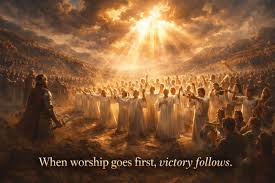
When Judah marched toward the enemy, Jehoshaphat sent singers ahead of the army.

Not the warriors.
Not the strongest men.
The worshipers.

They went before the soldiers, praising God and declaring His goodness before they ever saw the victory.

And as they began to praise, the Lord set ambushes against their enemies, and the enemy armies turned against one another.

By the time Judah arrived, the battle had already been won.

What a picture of faith.

They praised before the breakthrough.
They worshiped before the victory.
They trusted God before they could see what He was doing.

Maybe you’re facing a battle right now that feels bigger than you.

You may not know how God will make a way.
You may not know when the answer will come.
But you can still praise Him.

Because praise isn’t pretending the battle isn’t real.

Praise is remembering that the battle isn’t yours to carry alone.

Put praise on the front line.
Let worship speak louder than fear.
And trust the God who fights for His people.

“The battle is not yours, but God’s.” 🙏🏻🤍

📖 2 Chronicles 20:15–22

Battle Belongs  · Phil Wickham ·Salt and Light, https://www.facebook.com/saltandlight.words

When You Sift Wheat


Threshing Wheat
“Simon, Simon, Satan has asked to sift each of you like wheat.  But I have pleaded in prayer for you, Simon, that your faith should not fail.”
“So when you have repented and turned to me again, strengthen your brothers.”

Luke 22:31-32

I’ve been thinking about failure;  it is something that I am really, really good at.  In my over 40 years of walking with Jesus, I realized that I’ve experienced more weak moments then strong.  I have easily failed more than I have succeeded. I am embarrassed by this. 

I’ve sinned, and failed more as a Christian, than I ever did as a pagan sinner. And things sometimes show little sign of improving. 

Simon Peter is about to undergo a trial so intense and difficult, that unless Jesus intervenes it will probably destroy Peter!

(The only other blatant attack where Satan seeks permission is in the life of Job. It is reasonable to believe that the forces of hell are concentrated on Peter.)

You and I undergo some of this onslaught ourselves.  We go through periods of intense trial.  Everything just falls apart, and we lose hope.  I’ve had several periods like that, it’s like a tornado from hell bears down upon my life.

But there is something remarkably good in all of this.
  • First, Jesus is praying for me to endure.  He is the faithful intercessor for my soul.
  • Second, He gives us a modicum of understanding by warning us of the approaching storm.  Peter is told ahead of time of what was going to happen.
  • Third, the wheat will be sifted.  Sifting or winnowing of the grain is necessary, it’s a good and godly work of the Holy Spirit. It is a good thing, as it builds your faith.
  • Four, you will survive to strengthen your brothers and sisters.

All pain and failure gives us a mandate to serve others. Our weakness gives us a spiritual license to become a shepherd of mercy and hope.  (You could say that you are now a licensed minister.)

We can ask for nothing more; it is a good and profound work to serve others.
In love’s work, only sifted people can truly serve.


The Awful Pain of Job

job-and-his-friends

“Oh, why give light to those in misery,
    and life to those who are bitter?
21 They long for death, and it won’t come.
    They search for death more eagerly than for hidden treasure.22 They’re filled with joy when they finally die, and rejoice when they find the grave.
2Why is life given to those with no future,
    those God has surrounded with difficulties?”

Job 3:20-23, NLT

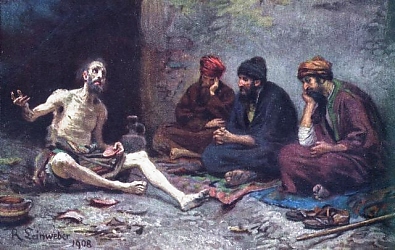
Job begins to curse his very existence. Life has become far too brutal. He has lost everything. At this point Job is completely undone.

There is an endless grief that even his tears can’t help.

In Job’s first speech he asks some basic questions:

  • Why is light given to those who are full of pain?
  • Why does life unfold to the one who rather not live anymore?

There is a powerful wish or desire in this three verses. He wants to die, and end the charade. He wishes for non-existence and laments that he can not die fast enough. His terrible pain has taken his life.

People with disabilities and chronic pain can understand Job’s welcome craving for any sort of release. Once they were “whole” people. Death was something to be avoided at all costs. But now it is seen as an escape.

Job simply wants out.

Hurting people will often turn to drinking and drugging as a way of coping. We’ll try anything to numb our thinking. It’s what gets us through the day. We are bitter, and we are lost.

For Job (the patron saint of pain) finds that nothing will fix him. His friends have come, but they seem to only accuse and confuse job. Honestly he is better when they just sat with him in silence. If you read the book of Job you will understand.

“God wants us to choose to love him freely, even when that choice involves pain, because we are committed to him, not to our own good feelings and rewards. He wants us to cleave to him, as Job did, even when we have every reason to deny him hotly.”

–Philip Yancey


“Come quickly, Lord, and answer me, for my depression deepens. Don’t turn away from me, or I will die. Let me hear of your unfailing love each morning, for I am trusting you. Show me where to walk, for I give myself to you.”

Psalm 143:7-8


ybic, Bryan


All Joy

James 1:2

“There is no circumstance, no trouble, no testing, that can ever touch me until, first of all, it has gone past God and past Christ, right through to me. If it has come that far, it has come with a great purpose.” 

 Alan Redpath

“All joy,” (verse 2) is a fantastic thought. It stresses a joy that becomes something very powerful and significant. “All joy,” surpasses “some joy” or even “occasional joy.” Instead it’s a joy that remains joy even when tired and weak. It will only shine brighter in the darkness.

Jewels, diamonds, and pearls are typically displayed on a black background.

The black only reveals their brilliance. In the same way darkness should only encourage us to be deliberately brighter than our surroundings. We must understand that we shine only because He makes us shine.

There is a divine incandescence that awaits every believer who feels the need or desire for more of God. When your difficulty is illuminated by grace, it will shine out and proclaim His glory. Perhaps this is what true holiness really is.

The signs surrounding God’s nearness are available to each believer. He is close to those who want Him, and there is nothing will stand in His way. The Lord cherishes and treasures the seeking heart. There is nothing that can detour the believer’s yearning after their Father.

Name your trial, and then tie it to God’s throne.

It’s not yours. Leave it alone and refuse to carry it any further. It’s now the Lord’s concern. Simply watch for the deliverance to come. When God sees your heart, He will lavish Himself out on you.

You were never meant to carry that burden alone.