The Prodigal Son of the Old Testament

God’s temple was now filled with an evil darkness. King Manasseh made the Lord’s holy place a fountain of sin and filth. Instead of holiness, it was an evil place.

He brought in dark things that were twisted, perverted and clearly forbidden.

“Manasseh led Judah and the inhabitants of Jerusalem astray, to do more evil than the nations whom the Lord destroyed before the people of Israel.”

2 Chronicles 33:9, ESV

His own darkness was now encouraged by others, it became accessible, available and promoted:

  • The high places were rebuilt throughout the land.
  • Altars to Baal rebuilt, using images of wood.
  • In the holy temple, altars to the “starry host,” astrology, plain and simple.
  • Human sacrifice of his own sons to Molech, a false god. Murder.
  • He practiced soothsaying, used witchcraft and sorcery, and consulted mediums and spiritists.

Evil was being encouraged and something wicked was replacing all that was good and true. The analysis of Manasseh’s policies was way beyond disturbing. Of all the kings of Judah, he was the most sinful and the most corrupt. He was at the bottom of the barrel.

The Hebrew word for “led astray” can be translated seduced.

Manasseh was an incredibly immoral man, a king who ruled for 40 years. “He did all he could to pervert the national character, and totally destroy the worship of the true God; and he succeeded.” (Clarke)

It’s believed that he put Isaiah to death by cutting him in two.

Moreover Manasseh shed very much innocent blood, till he had filled Jerusalem from one end to another, besides his sin by which he made Judah sin, in doing evil in the sight of the LORD.

1 Kings 21:16

But then something happened.

And the LORD spoke to Manasseh and his people, but they would not listen. Therefore the LORD brought upon them the captains of the army of the king of Assyria, who took Manasseh with hooks, bound him with bronze fetters, and carried him off to Babylon.

2 Chronicles 33:10-11

Assyria came knocking on Manasseh’s door. I think there was a certain mercy here, but also discipline. Manasseh had “hooks,” inserted through his jaw and out of his mouth. Like a fish he was led to Babylon, a trophy of the power of the army of Babylon.

It was from a dark dungeon that Manasseh cried out to the Lord and repented.

(2 Chronicles 33:12-13.)

There’s a Jewish fable that when Manasseh cried out to God the angels boarded up the windows in heaven. They wanted to block out his prayer so God wouldn’t be able to hear. But God, rich in mercy, bored a hole in front of His throne to hear Manasseh’s desperate cry.

The Lord’s intention was to forever show His kindness and grace given to the most awful repentant sinner.

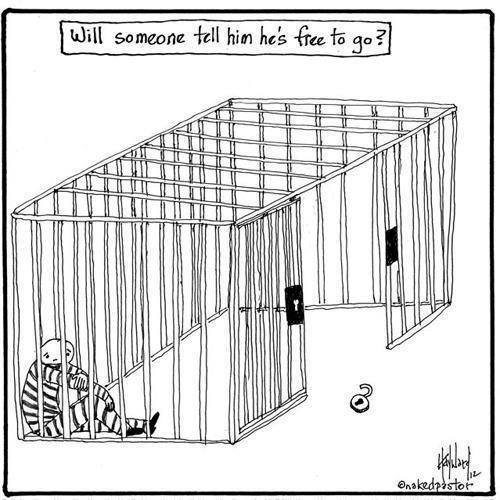
I believe that Manasseh was the “Prodigal Son” of the Old Testament.

God is not at a loss when He moves to bring us back to Himself. He can woo or whip. He can draw or drive. He can work rapidly or slowly, as He pleases. In other words, He is free to be God! And in His own way, at His own pace, He brings us back.

     Tom Wells

God is wildly in love with you. Yes, the sin you’ve committed is awful, but the Lord wants you to come back. He may discipline you, but He forgives everything if you’ll turn and repent.

No matter how awful your sin, He forgives and restores. Manasseh is proof of that.

Sources:

2 Chronicles 33:1-20

2 Kings 21:1-18

Enduring Word commentary

Despair and David’s Theology

For those on the mat and wrestling, things can move very fast.  Our own adversary is strong, and he knows us too well.  He is quite aware of the sequence of moves needed to pin us to the floor, and crush us.  He is spiritually dangerous. He is lethal.

I get bewildered and rattled by his attacks.  He knows how to pressure me at just the right time, and he refuses to follow the rules. He is no gentleman, he is both a cheater and a liar.

Of course I am talking about Satan and his team of demons.  I will not dispute their reality with you.  There is almost as much scriptural support for his existence as there is for Jesus’.  His hostility is  toward God and His people, and his viciousness cannot be camouflaged.  Evil is real, and believe this–

Satan has a terrible, and ugly plan for your life.

As a Christian, who has bouts of depression it quickly morphs into despondency and despair.  When I sink to that level I start to lose all hope.  It’s like I’m in a lifeboat and decide that I should abandon it and tread water on my own.  Despondency is not rational and just a little bit is deadly.

David intimately knew all about darkness and desperation.

He had been chased by his enemies, and maneuvered into the most difficult of situations.  To observe him at a distance we would say that “there is no hope for him in God.” Even God can’t save him, for he is reprobate.  We would be convinced that there is nothing for him in God’s thinking.

David fully understands how twisted he really is inside, and it’s at that point he composes Psalm 51. It shows us the way to freedom.

David was a moral failure; he was an adulterer and a brazen killer. You can debate this, but it seems that David had sinned deeper and more intensely than Saul ever had.  Join with the logic of the crowd, “There is no hope for him in God!”  No hope, none, nada, zero.

“Yet I am always with you;
you hold me by my right hand.

You guide me with your counsel,
and afterward you will take me into glory.

Whom have I in heaven but you?
And earth has nothing I desire besides you.

My flesh and my heart may fail,
but God is the strength of my heart
and my portion forever.”

–Psalm 73

David defied the theology of his day.  He embraced the Lord God with a desperate passion.  It was not orthodox or logical.  You could say it was disturbing for many who didn’t understand the infinite mercy of God.  But David would not let go of God!  He hung on, and continued to sing in faith, even though most wouldn’t agree he had the right to.

I encourage you besieged brother, and embattled sister.  Hold on to Him, even if it baffles all logic or theology. Renounce your sin, but seek His promises with a fervency, open your heart to Him with a passion.  Remember that sin can and will destroy you.  It is part of Satan’s stratagem.

Sing in your cave, and never lose hope of God’s love for you.

“The most valuable thing the Psalms do for me is to express the same delight in God which made David dance.”

C.S. Lewis

“Despondency and David’s Theology,” brokenbelievers.com, Bryan Lowe


bry-signat (1)

Related articles

God Must Hear Your Heart


There are different ways God uses to hear your heart. Your voice, actions and attitudes are all subject to His evaluation and analysis. He is continually watching us. He uses His divine stethoscope to know us.

“Yet even now,” declares the Lord,
    “return to me with all your heart,
with fasting, with weeping, and with mourning;
13     and rend your hearts and not your garments.”
Return to the Lord your God,
    for he is gracious and merciful,
slow to anger, and abounding in steadfast love;
    and he relents over disaster.
14 Who knows whether he will not turn and relent,
    and leave a blessing behind him,”

Joel 2:12-14

The Old Testament prophet Joel is also interested in the human heart. His words make that a central issue. He diminishes the outward that doesn’t include the inward. (Unfortunately, it is easier “to be seen” rather than “to be.“)

“Rend your hearts and not your garments.”

This is God’s very real word to a wayward people. To “rend” means to tear and it is perhaps the most critical attribute for a wayward heart.

I’m convinced that we must learn what it means to repent everyday. It is never completely done–never once and then you’re finished with it.

We also seem to have this strange tendency to reduce repentance to outward actions. We however must stress the inward rather than the outward. We must go deeper, and take repentance right down to the deepest core.

True repentance must go as deep as you can go, and be truly proven before we claim a victory.

God desires to hear your heart. The Holy Spirit is going to insist on it. (But He will also be a loving Guide.)

“Blessed are those who mourn [especially them], for they shall be comforted.”

Matthew 5:4, Emphasis mine

“To do so no more is the truest repentance.”Martin Luther


Self-Destruction

“For whoever finds me finds life
and receives favor from the Lord.
But those who miss me injure themselves.
All who hate me love death.”  

Proverbs 8:35-36

“There are seeds of self-destruction in all of us that will bear only unhappiness if allowed to grow.”  Dorothea Brande 

*

“If one looks with a cold eye at the mess man has made of history, it is difficult to avoid the conclusion that he has been afflicted by some built-in mental disorder which drives him towards self-destruction.”   Arthur Koestler 

*******

 Among people with a mental illness, there is a sort of impulsivity, and in advanced cases we can see a ‘self-destructive behavior‘.  We do things, superficially we recognize and even assert that it is detrimental, but we will continue to do it regardless.  Those ‘in the know around us’ can’t believe what we are doing. It is totally irrational.

Bipolar, schizophrenia, and many other mental illnesses have impulsivity as a common aspect of their disease processes.

  • We drink,
  • do drugs,
  • do pornography, strippers
  • steal from our friends,
  • cut ourselves,
  • misuse our credit cards (and go deeply in debt)
  • get crazy at rock concerts,
  • and much more.

We are impulsive and we do things that a healthy person would never do.  We consistently choose the worst things and we can’t seem to stop ourselves.

We are the ‘wild children,’ we just seem to thrive on the edge of destruction, repeatedly.  This is in spite of the consequences.  We just don’t worry about the side-effects of our choices.  We don’t think ahead, all we think is of the moment.  We consistently choose what is really bad for us, and then throw ourselves headlong into the darkness.  The more we do these terrible things, the wilder it seems to get.

We can’t seem to stop. 

I can say this because I had a personal issue with ‘self-destruction’.  You might say I have a ‘Masters degree’ in it.  I have gotten very proficient at it, and have utilized deception to cover my tracks.  So much of my life is hidden and I seem to float my darkness out in such a way as to diffuse questions and to excuse awful nasty behavior.

Being impulsive/self-destructive is a hard life in many ways. 

We cultivate an image to others that we have really never attained.  We are very good at deception, we have discovered how to do and say what we want without others “getting in our faces.” Being impulsive, ready to step into the most pleasurable darkness, becomes something we must cover up, at all costs.

“Can a man scoop a flame into his lap
    and not have his clothes catch on fire?”

Proverbs 6:27

Am I secretly drinking, doing drugs or using sex (esp. in pornography)?  The impulses that drive us to do this stuff will become the way we experience destruction, but somehow we don’t seem to get it.  The mentally ill have a horrendous rate of alcoholism and addiction.  I’ve seen figures that put us at 80% that have significant issues.  We seem to be ‘self-medicating’ ourselves to escape, or trying to get some stability.

When we come to Jesus, we discover that He loves us completely, including our ‘hidden side’.  His love comes to us without any conditions.  We are free to do whatever we want.  However, we will find that ‘sin accepted’ is very brutal to us.  Smashing out heads against a brick wall, over and over, doesn’t make the wall any softer.  And yet we continue to do the most foolish thing we can do, and then we–  REPEAT.

There is a way out of this.  But few will really do it. 

It’s called ‘public confession.’ We get it out into the open, where the sun shines, and it will be seen exactly for what it is.  We choose not to live out our lives in secretiveness. We must learn the skills of transparency, as we lay out our evil, our deception for the church to see.

When we deceive others, we will end up deceiving ourselves.  We absolutely cannot continue a life in darkness, or in long-term sin. wPeop cover their faults and excuse themselves do not have a repeneir faults and excuse themselves do not have a repentant spirit.

***

cropped-christiangraffiti1-3-1