God Keeps Your Tears in a Bottle

by Linda L. Kruschke

I have cried many tears in my life.

If you have never cried, you can stop reading right now. But if you have shed tears for yourself or for others, or if like me you have shed some without even knowing why or where they came from, take heart. God knows the tears you have shed. Psalm 56:8 says so. Here are several translations of that wonderful verse:

Record my lament;
       list my tears on your scroll —
       are they not in your record? (NIV)

You have taken account of my wanderings;
         Put my tears in Your bottle
         Are they not in Your book? (NASB)

You keep track of all my sorrows.
      You have collected all my tears in your bottle.
      You have recorded each one in your book. (NLT)

Write down my poem of sadness.
      List my tears on your scroll.
      Aren’t you making a record of them? (NIRV)

I love the image of God keeping all my tears in a bottle. I can envision shelves filled with bottles in Heaven, each with a name on it, and an accompanying scroll documenting every tear and lament. Or maybe it is just one huge bottle with all of our tears mingled together.

Today tears are being shed in dark rooms where children are being held as sex slaves, in Africa as people remain homeless and without food and water, in the United States as many remain jobless, in hospitals and on the streets where the mentally ill are forgotten, in homes around the world where people are spiritually lost and have no hope.

We live in a fallen and painful world.

Tragedies happen and humans are not always kind to one another. And so tears are shed. It is hard to fathom God collecting every single one, but He does. He notices and He records each tear and each lament.

The more I think about it, I like the idea that God has mingled all our tears together. The Psalm does refer to God’s “bottle” in the singular. And if He has collected every tear in that bottle, then mingled with our own are the tears of Jesus. In John 11, the apostle records this event: “Jesus wept.” (John 11:35.)

In this passage, Jesus weeps when He learns of the death of Lazarus.

When they see Him weeping, the people say “See how he loved him!” John 11:36. But I don’t think Jesus was weeping because Lazarus was dead – He knew He was going to raise Lazarus from the dead. Rather, I think He wept because of the compassion He felt for humanity as we weep over our own tragedies and losses. It is us that He loved so much that it brought Him to tears.

So if you weep today, remember that God is collecting your tears in His bottle, and mixing them with the tears of our dear Savior. Not only that, but God will deliver you from the final trial that lead to tears by redeeming your soul.

Psalm 116:8-9 (NIV).

Linda’s blog is at anotherfearlessyear.net  Please check out all she has to say and listen to her heart.
You may copy and use or distribute this post freely in its entirety please.
We’re a member.

p

Toxic Shame

“My disgrace is before me all day long,
and shame has covered my face.”

Psalm 44:15

Some years ago while in prayer I saw myself, apart of God. There was a marble fountain abandoned in a gorgeous courtyard. It was beautiful. As I looked I realized that it didn’t have clean fresh water like you might think, but it spewed feces and urine. It was gross, it was awful, and I immediately understood.

I suddenly realized that I was that marble fountain, and I was spouting out only filth.

Being ashamed is cruelty that can only destroy a person. We think we must have defense mechanisms to survive. We drink, use drugs, and get involved with sex. Some might put on a tie and raise their hands during our church worship time. Whatever works I suppose. Almost always shame drives us to look for ways to escape.

People who live with shame often feel worthless, depressed, and anxious.

Shame can be a contributing factor to depression, anxiety, and low self-esteem. People who are constantly ashamed live out a difficult emotional and mental battle each and every day.

The Hebrew word for “shame” is disgrace, confusion, or dishonor.

I believe only the power and blood of Jesus can purify me. Only He has the ability to clean my spirit. In the New Testament, we see Jesus healing the leper with just a touch. Shame will be removed from your heart when He touches your own “leprosy” of sin.

Here are things you must consider.

  • Shame separates me from God.
  • Shame is a sign of self-hatred.
  • Shame makes me feel like giving up.
  • Shame leads me to go out and sin more.
  • Shame destroys the gifts that He is waiting for me to serve others.
  • Shame makes me judgemental and critical of others.
  • Shame weakens the Church in ways I can’t comprehend.

God intends to move you out of shame and guilt. You must have faith to put His Word into practice before you can be really free. It will probably be a battle–every day. Faith is the only way to freedom. The following promise is crucial.

“But if we confess our sins to him, he can be depended on to forgive us and to cleanse us from every wrong. And it is perfectly proper for God to do this for us because Christ died to wash away our sins.”

1 John 1:9, LB

I must reiterate this, and use the authority God has given to me as a teacher of the Word, please shake off the humiliation you live in. You must do this.

Unless you step completely away from the shame of your life you’ll be destroyed by the enemy. I dare not pull any punches with you. I don’t mean to be hard, I really don’t. But I do understand. I really do.

“Once again you will have compassion on us. You will tread our sins beneath your feet; you will throw them into the depths of the ocean!”

Micah 7:19

It is the cross of Jesus, and by His blood–that is the only way sin and shame can be cleansed from our lives. There is nothing else in the whole universe that will do this. Only the red blood can turn the black into white.

I strongly suggest you share your battle with another believer who will understand and be discreet. (Sharing this maybe is the step you’re missing?)

Shame is the ugly fountain that only produces deadly things. It’s that shame that keeps me from understanding that I’m the beloved of God and His precious child.


The Prodigal Son of the Old Testament

God’s temple was now filled with an evil darkness. King Manasseh made the Lord’s holy place a fountain of sin and filth. Instead of holiness, it was an evil place.

He brought in dark things that were twisted, perverted and clearly forbidden.

“Manasseh led Judah and the inhabitants of Jerusalem astray, to do more evil than the nations whom the Lord destroyed before the people of Israel.”

2 Chronicles 33:9, ESV

His own darkness was now encouraged by others, it became accessible, available and promoted:

  • The high places were rebuilt throughout the land.
  • Altars to Baal rebuilt, using images of wood.
  • In the holy temple, altars to the “starry host,” astrology, plain and simple.
  • Human sacrifice of his own sons to Molech, a false god. Murder.
  • He practiced soothsaying, used witchcraft and sorcery, and consulted mediums and spiritists.

Evil was being encouraged and something wicked was replacing all that was good and true. The analysis of Manasseh’s policies was way beyond disturbing. Of all the kings of Judah, he was the most sinful and the most corrupt. He was at the bottom of the barrel.

The Hebrew word for “led astray” can be translated seduced.

Manasseh was an incredibly immoral man, a king who ruled for 40 years. “He did all he could to pervert the national character, and totally destroy the worship of the true God; and he succeeded.” (Clarke)

It’s believed that he put Isaiah to death by cutting him in two.

Moreover Manasseh shed very much innocent blood, till he had filled Jerusalem from one end to another, besides his sin by which he made Judah sin, in doing evil in the sight of the LORD.

1 Kings 21:16

But then something happened.

And the LORD spoke to Manasseh and his people, but they would not listen. Therefore the LORD brought upon them the captains of the army of the king of Assyria, who took Manasseh with hooks, bound him with bronze fetters, and carried him off to Babylon.

2 Chronicles 33:10-11

Assyria came knocking on Manasseh’s door. I think there was a certain mercy here, but also discipline. Manasseh had “hooks,” inserted through his jaw and out of his mouth. Like a fish he was led to Babylon, a trophy of the power of the army of Babylon.

It was from a dark dungeon that Manasseh cried out to the Lord and repented.

(2 Chronicles 33:12-13.)

There’s a Jewish fable that when Manasseh cried out to God the angels boarded up the windows in heaven. They wanted to block out his prayer so God wouldn’t be able to hear. But God, rich in mercy, bored a hole in front of His throne to hear Manasseh’s desperate cry.

The Lord’s intention was to forever show His kindness and grace given to the most awful repentant sinner.

I believe that Manasseh was the “Prodigal Son” of the Old Testament.

God is not at a loss when He moves to bring us back to Himself. He can woo or whip. He can draw or drive. He can work rapidly or slowly, as He pleases. In other words, He is free to be God! And in His own way, at His own pace, He brings us back.

     Tom Wells

God is wildly in love with you. Yes, the sin you’ve committed is awful, but the Lord wants you to come back. He may discipline you, but He forgives everything if you’ll turn and repent.

No matter how awful your sin, He forgives and restores. Manasseh is proof of that.

Sources:

2 Chronicles 33:1-20

2 Kings 21:1-18

Enduring Word commentary

Twisted and Bent

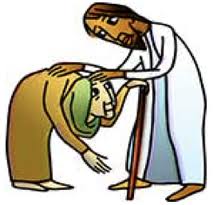
Luke 13:10-13

When we read through the Gospels we see that Jesus never laid His hands on those who were demon possessed, rather He would first command the demon to leave. (Interesting.)

The text tells us that the woman had been bent over for 18 years. (That’s a long, long time.) The cause was being “demonized” which is very different than being possessed.

There is a difference. Demons can oppress people and influence their lives, especially if that person is living in sin and rebellion.

“The physical cause of her inability to straighten up has been examined by J. Wilkinson, who identified the paralysis as the result of spondylitis ankylopoetica, which produces the fusion of the spinal bones.”

That is absurd. There’s a truth here that this “leader” is covering up. The woman is instantly healed, and this so-called leadertries to nullify what has just happened. Rather than rejoicing, he renounces what has just happened, and claims that the Sabbath law has been violated. He declares the Law is greater than this woman’s healing.

Jesus never once asserts His authority. Rather He points to this woman’s healing as being truly the very essence of the Law. In spite of what the Law means legalistically, it can never invalidate mercy.

CH Spurgeon

Her private agony was never to be found again. She was free. The pain she lived with was no more. The captivity was gone, and she was freed. The biblical text seems to ignore this and concentrates on the synagogues leader’s response, and that’s well and good. Perhaps though we should focus on this woman’s healing from an awful terrible darkness.

She is free. The stoop is gone. The pain is gone. Jesus has set her free, she gazes at the sun after many years. She stands erect, and though everything now seems different, she now knows her deliverer, and her healer.

“Bent,” brokenbelievers.com, Bryan Lowe