The London Underground

“And he said to them, “Come away by yourselves to a desolate place and rest a while.” For many were coming and going, and they had no leisure even to eat.’

Mark 6:31, ESV

Our Savior would never drive us to do things with a whip.  He is not a taskmaster, and He will not insist or impose His will over us.  Nothing about him is brutal or demanding. (He could, really– if he wanted to.)

There are no galley-slaves in the ship of the Kingdom of Jesus – every man chooses to work his oar out of love!

It is interesting that Jesus was very careful and aware of his disciples needs.  No one suggested a break from the work, but Jesus initiated the break from the massive press of the crowds. He knew intensely what his disciples needed.

 “Crowds of people were coming and going so that Jesus and his followers did not even have time to eat. He said to them, “Come away by yourselves, and we will go to a lonely place to get some rest.”

Mark 6:31, NCV

Underground-SymbolThe presence of so many people had put the disciples in a very hard place.  The NCV describes the crowds, as “coming and going.”  If you have ever been on the London Underground you will understand just the sheer number.  Everyday, 2.93 million people ride the trains.  I remember travelling from the backwoods of  Alaska, with just a backpack, and hitting the crowds on “the tube” in London, UK.

The intense masses I saw in London were way beyond anything I ever imagined.  Talk about a “culture shock!  I saw more people in a single minute than in an entire year of living in Alaska.  It was like an amazing giant ant-hill; I would stop, and just stare. Nothing prepared me for this.

Jesus is concerned about the living freshness of his disciples.  He shuts things down in order to rest with his followers.  Often the tendency will be the opposite, especially when the leader is weak and immature.  “Work harder, and even more hours!”  Jesus did not have the need to be available to the crowds 24/7.  And he certainly didn’t expect his disciples to.  His heart is committed to his followers.

He “orders” his disciples, come apart and let’s rest!
“But so many people were coming and going that Jesus and the apostles did not even have a chance to eat. Then Jesus said, “Let’s go to a place where we can be alone and get some rest.”

Mark 6:31, CEV

I don’t know if you can grasp the sensitivity, or see the nuances of Jesus shepherding his disciples.  He has a deep awareness of them; he doesn’t get lost by people pressing in from every side.  He loves the world of men and women, but his followers are his specialty.

He tunes in on their frequency, and knows their spiritual capacity.

What gives his followers strength, is to be close with Jesus, and to separate from the needs that were densely surrounding them.  We can be flattered by being needed, but that can be very corrosive or destructive.

I’m guessing but I believe that a few of the disciples may have been annoyed by this break in the action. They found it hard to remove themselves from the action.  Some may have been frustrated, perhaps maybe even slightly irritated by another “Jesus’ retreat.”

“One time Jesus entered a house, and the crowds began to gather again. Soon he and his disciples couldn’t even find time to eat.”

Mark 3:20

When you are pouring out, you will find there is only a certain capacity before you run dry.  You may think this is “noble and praiseworthy” but it is nothing of the sort.  It is a form of arrogance and pride.  In order to really mature as a believer, we must shake this off and not to entertain our seeming indispensability to the cause.

We must keep on following Jesus into the quiet places.
 “Are you tired? Worn out? Burned out on religion? Come to me. Get away with me and you’ll recover your life. I’ll show you how to take a real rest. Walk with me and work with me—watch how I do it. Learn the unforced rhythms of grace. I won’t lay anything heavy or ill-fitting on you. Keep company with me and you’ll learn to live freely and lightly.”

Matthew 11:28, MSG

Love, Bryan

@

God Keeps Your Tears in a Bottle

by Linda L. Kruschke

I have cried many tears in my life.

If you have never cried, you can stop reading right now. But if you have shed tears for yourself or for others, or if like me you have shed some without even knowing why or where they came from, take heart. God knows the tears you have shed. Psalm 56:8 says so. Here are several translations of that wonderful verse:

Record my lament;
       list my tears on your scroll —
       are they not in your record? (NIV)

You have taken account of my wanderings;
         Put my tears in Your bottle
         Are they not in Your book? (NASB)

You keep track of all my sorrows.
      You have collected all my tears in your bottle.
      You have recorded each one in your book. (NLT)

Write down my poem of sadness.
      List my tears on your scroll.
      Aren’t you making a record of them? (NIRV)

I love the image of God keeping all my tears in a bottle. I can envision shelves filled with bottles in Heaven, each with a name on it, and an accompanying scroll documenting every tear and lament. Or maybe it is just one huge bottle with all of our tears mingled together.

Today tears are being shed in dark rooms where children are being held as sex slaves, in Africa as people remain homeless and without food and water, in the United States as many remain jobless, in hospitals and on the streets where the mentally ill are forgotten, in homes around the world where people are spiritually lost and have no hope.

We live in a fallen and painful world.

Tragedies happen and humans are not always kind to one another. And so tears are shed. It is hard to fathom God collecting every single one, but He does. He notices and He records each tear and each lament.

The more I think about it, I like the idea that God has mingled all our tears together. The Psalm does refer to God’s “bottle” in the singular. And if He has collected every tear in that bottle, then mingled with our own are the tears of Jesus. In John 11, the apostle records this event: “Jesus wept.” (John 11:35.)

In this passage, Jesus weeps when He learns of the death of Lazarus.

When they see Him weeping, the people say “See how he loved him!” John 11:36. But I don’t think Jesus was weeping because Lazarus was dead – He knew He was going to raise Lazarus from the dead. Rather, I think He wept because of the compassion He felt for humanity as we weep over our own tragedies and losses. It is us that He loved so much that it brought Him to tears.

So if you weep today, remember that God is collecting your tears in His bottle, and mixing them with the tears of our dear Savior. Not only that, but God will deliver you from the final trial that lead to tears by redeeming your soul.

Psalm 116:8-9 (NIV).

Linda’s blog is at anotherfearlessyear.net  Please check out all she has to say and listen to her heart.
You may copy and use or distribute this post freely in its entirety please.
We’re a member.

p

Straining at Your Oars

“He saw the disciples straining at the oars because the wind was against them.”

Mark 6:48

It’s good to know that Jesus sees our labor.  He truly understands all that concerns us, and he understands every issue that concerns us.  Attentive and keenly aware He comes to our boat.  It’s quite common for us to think that he isn’t aware, and we may feel that He’ll pass us by without a word.

Jesus watches over us all the time. 

He knows all about our battles, the fight we have with our flesh, the difficulty we have with the challenging people in our lives. I often struggle to steer my boat. Jesus knows when and why I labor like I do.  And He doesn’t condemn me.

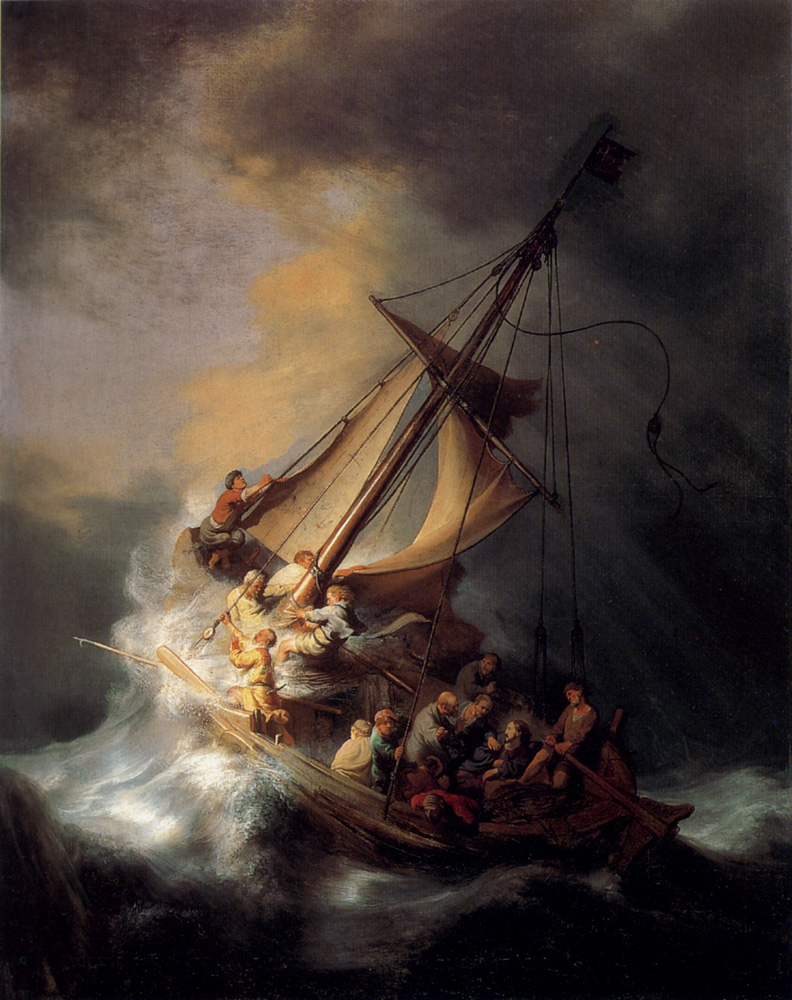
The disciples were straining hard to keep the boat afloat. 

Every oar was being used and every man had his seat.  They must work together.  Some were frantically bailing, and a couple gripped the tiller. A lot of effort was being expended but nothing was working.  The wind continued to push harder against them. 

This is really quite perplexing.  If you remember, they’re simply trying to obey the command of Jesus to cross the sea. They were being obedient, and yet they were starting to sink.

Why do things have to be so difficult?

I’m intrigued by believers who expect sunshine, blue sky, and red roses just because they are doing God’s will.  They don’t seem to think through the issues of conflict and challenge, weakness and humility. That’s not how it’s suppose to work.

“It is necessary to go through many hardships to enter the kingdom of God.”

Acts 14:22

Doing the will of God will often mean that there will be a headwind directly at us.
 The seas will become impossible, and we may even be driven back.  But special comfort comes when we realize we’re being watched.  Jesus is doing constant surveillance on us, and He sees our toil on the oars. And then He comes to us, walking on the water.
Even in our storm, our hearts should trust and rejoice.

“Lo, I am with you always, even to the end of the age”

Matthew 28:20

A Very English Pigeon

“I will instruct you and teach you in the way you should go; I will counsel you with my eye upon you.”

Psalm 32:8

In April 2002, I was sitting in a cavernous waiting room at King’s Cross in London, England.  I was waiting for a bus to Cambridge, UK.  I sat all alone and stared at the tiled floor at my feet.  The doctors had warned me not to travel alone, but I ignored their advice.

And now I was starting to really unravel.

Depression had followed me all the way from Alaska to England. I had pushed my limits and was completely drained and was becoming very confused.  I began to cry out to the Lord, very desperately. Sometimes madly. (Read Psalm 88.)

As I sat there staring intensely at the floor, several pigeons seemed to put on a show, just for me. They were fat little guys, apparently scratching out a good living. Several very large windows were open, and these pigeons seemed to have no fear as they took advantage of a meal from bored travelers.

All of a sudden something very odd happened. 

A pigeon came across the floor and “presented” himself, right square in front of me.  I watched him intently and saw that he was crippled, one of his feet was nothing more than a twisted claw.  He had been profoundly injured in such a way, that he would never be the same.  He was damaged, and yet somehow he was surviving, but even more, and he was thriving!

It was like experiencing a lightning bolt. God’s own light switch was being flipped.

I saw that pigeon, and I saw myself, and it was a moment of clarity, a shining grace.  In the mega-hustle of 13.6 million people in London, and in the midst of my own profound mental crisis, I knew God’s caring touch and it gave me real grace, love, and goodness–far greater than all my sin and confusion. He was just letting me know that He was very, very close. (See Psalm 34:18.)

I had seen my damaged pigeon, completely oblivious to self-pity.

I started to call out to the Father out of my confusion.  Within a few minutes, I found myself sitting on the top level of a double decker bus, with the driver aware of my problems and who specifically drove me to the place I was staying. 

I was being cared for. Between a crippled pigeon and the dutiful ministrations of a bus driver, I’d finally found my hotel. (See Matthew 6:26.) 

I have come to realize that this trip to England was not for me to see Big Ben, Parliament, or wander the academic schools of Cambridge University.  Rather I was brought there to make contact with a certain pigeon, who was waiting to meet me and pass on vital instructions. 

The Father shared things that I need to know.  British castles and churches are beautiful and worth seeing but I must admit I’ve forgotten much. I hope I can return someday.

But on this trip, all I really needed to see was a crippled English pigeon who was just waiting to meet me.