God Really Wants to Forgive You

forgiveness

“But neither of them could repay him, so he kindly forgave them both, canceling their debts.” 

Luke 7:42

When you are in debt, whether $50 or $50,000 there’s that anxiety of being in slavery to the lender.  And yet when we begin to line up the spiritual with the physical we learn that we are all in debt.  We all owe more than we have. Most of us realize this, and many just “turn off the spiritual apparatus” that seems to keep harping on this, and then we tell ourselves repeatedly that it really isn’t true.

But all of us are in debt. 

Of course not everyone is the same, we have different sins.  Some have lived a deliberately dark, prodigal life (as in “drugs, sex and rock-n-roll”).  Others, embracing a strained moralism of some kind, have apparently sinned less (think choir boys, or “Snow White”).  But no matter, for “all have sinned and fallen short of the glory of God.”  (Romans 3:23)

And “all” means all. “Fallen” means a complete collapse.

In this parable, Jesus adroitly tells the story of two men who were indebted to a very rich man.  One owed a relatively small amount, but yet it was significant enough for this man to worry and to hope maybe for some mercy.  He knew that he owed, and knew he lacked the means to pay what was required.

The second man owed far more, many times beyond the first man.  This guy was very deep in debt.  The modern equivalent was close to $500,000, and in ancient times this would have been a staggering amount of money.  But he too held out for mercy; and hoped for the forgiveness of his debt (stranger things have happened).

The astonishing thing is that the rich man completely and unreservedly forgave both. 

Kindness alone was what moved the Lender.  These two men would be released without any conditions, liens, or liabilities.  They walked into the room expecting imprisonment, and they walked out with all their debts forgiven. Plain and simple.jail-free The amazing fact for you and I is this– we have been released from the ponderous weight of our sins, and yet we are really confused.  Our sins have been taken from us and we bear them no more!  The guilt of our transgressions has been cut away from our souls.

What Jesus did, dying on that cross, not for His sin, but for mine, ours and theirs, allows even the most nasty and vile of us to walk out scot-free.

Some who read this have committed spectacular sins.

You have piled up more sin and evil than others around you.  But no matter, it’s all forgiven.  It’s time to believe this, repent and then take your pardon and walk out into the bright sunshine as a free man or woman. There is no record of your sins, you can scour heaven and earth looking for it, and yet there is no evidence it ever existed.  

Except for His nail-prints.


&


The Micro and the Macro: An Understanding

10piper
John Piper, Pastor of Bethlehem Baptist Church, Minneapolis. Writer and Speaker, DesiringGod.org

Originally dated, July 14, 2008 | By: John Piper 

One of the reasons God rarely gives micro reasons for his painful providences, but regularly gives magnificent macro reasons, is that there are too many micro reasons for us to manage, namely, millions and millions and millions and millions and millions. God says things like:

  1. These bad things happened to you because I intend to work it together for your good (Romans 8).
  2. These happened so that you would rely more on God who raises the dead (2 Corinthians 1).
  3. This happened so that the gold and silver of your faith would be refined (1 Peter 1).
  4. This thorn is so that the power of Christ would be magnified in your weakness (2 Corinthians 12).

But we can always object that there are other easier ways for God to accomplish those things. We want to know more specifics: Why now? Why this much? Why this often? Why this way? Why these people?

The problem is, we would have to be God to grasp all that God is doing in our problems. In fact, pushing too hard for more detailed explanations from God is a kind of demand that we be God.

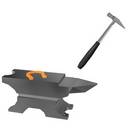
horseshoe-anvil-clipartThink of this, you are a blacksmith making horseshoes. You are hammering on a white hot shoe and it ricochets off and hits you in the leg and burns you. In your haste to tend to your leg you let the shoe alone unfinished. You wonder why God let this happen. You were singing a hymn and doing his will. Your helper, not knowing the horseshoe was unfinished gathered it up and put it with the others.

Later there was an invasion of your country by a hostile army with a powerful cavalry. They came through your town and demanded that you supply them with food and with shoes for their horses. You comply. Their commander has his horse shod by his own smith using the stolen horseshoes, and the unfinished shoe with the thin weak spot is put on the commander’s horse.

In the decisive battle against the loyal troops defending your homeland the enemy commander is leading the final charge. The weak shoe snaps and catches on a root and causes his horse to fall. He crashes to the ground and his own soldiers, galloping at full speed, trample him to death. This causes such a confusion that the defenders are able to rout the enemy and the country is saved. Now you might say, well, it would sure help me trust God if he informed me of these events so that I would know why the horseshoe ricocheted and burned my leg. Well maybe it would help you. Maybe not.

God cannot make plain all he is doing, because there are millions and millions and millions and millions of effects of every event in your life, the good and the bad. God guides them all. They all have micro purposes and macro purposes. He cannot tell you all of them because your brain can’t hold all of them.

Trust does not demand more than God has told us. And he has given us immeasurably precious promises that he is in control of all things and only does good to his children. And he has given us a very thick book where we can read story after story after story about how he rules for the good of his people. Let’s trust him and not ask for what our brains cannot contain.


http://www.desiringgod.org/Blog/1307_why_god_doesnt_fully_explain_pain/

Need Immediate Help? Call 1-888-NeedHim

Living Tethered to the Cross

We live in this place.
 “The devil never rejoices more than when he robs a servant of God of the peace of God.”
Sometimes I think I’ve made the devil dance far too many times.

I confess that peace has never been real high on my list. Love, joy, kindness and even goodness are clear priorities. Peace–well… not so much. Until it’s not there. And then I get frantic by its absence, and look for it with manic bewilderment. (Not again!) It seems that peace matters.

I’m panting for some real peace, some sign that God still loves me. Anxiety eats at me. I beat myself up by my last failure. The guilt of my latest sin grows until it looms larger than the blood that saved me. Someone once told me that religious people have the most neurosis. And that could be true.

Perhaps it’s a legalistic Christian that gets strangest?

I’m afraid that we are taking “the present tense’ out of the Gospel.

The past tense is far preferable to us as we manage the Christian life. We like to make check marks on our list. Repentance– check. Baptism– check. Bible study– check. I think it gives me a definite feeling of ‘maturity.’ I think that somehow I am holy.

The closer I move toward the light the more I see my sinfulness. I haven’t arrived, and it seems I’m still the sinner I always was. I cannot pretend otherwise, trying hard changes nothing. I still desperately need God’s grace.


I know, I’ve tried to produce godliness, and I just can’t do it. Discipleship starts in earnest but it ends up only disappointing me, and maybe even annoys God, ( but I’m not always sure of that). I know forgiveness, and I do walk in its wonderful light. When I read the Word it’s so good, and I know that it’s true. But, that’s not the issue.

I read Luther 30 years ago. (And Bonhoeffer would say something similar.)  “When our Lord and Master Jesus Christ said, ‘Repent,’ he willed the entire life of believers to be one of repentance.” Luther once wrote.

There is a present tense here we can’t ignore. I don’t just repent over smoking, or fornication, or of hypocrisy, once and done. But my entire way of living is meant to be one of repenting!

Repentance needs to be a moment-by-moment grace.

As I read the Beatitudes I cannot evade the sense that they are present tense. Read them, they’re obviously not a spiritual checklist. Each verse seems to speak of the time being, the present moment. No list here, guys. Discipleship is not a simple list to check-off spiritual growth.


“God blesses those who are poor and realize their need for him,
    for the Kingdom of Heaven is theirs.
4 God blesses those who mourn,
    for they will be comforted.
5 God blesses those who are humble…


Matthew 5:3-5

All of the Christian life is repentance. Turning from sin and trusting in the good news that Jesus saves sinners aren’t merely a one-time inaugural experience but the daily substance of Christianity. The gospel is for every day and every moment. Repentance is to be the Christian’s continual posture.”

John Piper

Luther’s last words, laying on his deathbed wrote on a scrap of paper these words, “We are beggars! This is true.” Thirty years before, he was only echoing his first thesis that he nailed on that door. It seems dear ones, we are to live at the foot of the cross. Everyday. Because we desperately need to.

And perhaps the biggest reason is this: Jesus only comes for ‘sinners.’

I want to suggest that we will always be beggars, I think that this is true. But I also believe that someday, I will shine with the glory of God and be changed into  the likeness of my Savior.

That dear one is true.

&bry-signat (1)

Esteeming His Word

Quite often, we’re intimidated by the Bible.  We all can take on a verse or two.  But that is pretty much it.

There is always more, much more.

The Bible isn’t made up of singular verses, but of whole books.  I intend to go on record, to encourage you to ingest the Word.  It’s as if we went to a Chinese restaurant buffet.  There is so many delicious choices.  But we load up exclusively on the “Kung Pao Chicken.”  We make many trips, but that is all we take.  Only the Kung Pao, and that’s it.

Have we really experienced this restaurant?  Or just the chicken?  The Word is extensively diverse.  There are recipes, and there are heaping and steaming platters of things we will never personally experience, and that is a shame.  So much is there, but we pick out just one thing.

I have been listening to the book of Luke. Repeatedly. 

It really humbles me, and I sense I’ve been sliced open and my innards have been drug out into the streets.  It has spiritually eviscerated me. It has opened me up, with a spiritual power.  (I’m sorry, but “Moby Dick” or “Great Expectations” or other works of classical literature does nothing comparable for me.)

God’s Word has a peculiar dimension to it. 

What it does is spiritually forceful.  It eagerly waits for us–this leather backed book.  At random we pick it up and start to read.  Quite quickly, it slips through our issues, and it directly ministers to us.  It has such power that it enters our thinking, and detonates, when the time is right. And we are left to pick-up the pieces. (This is good.)

You see, His presence has thoroughly saturated His Word.  He comes and infuses His books.  They have been dipped in His very personality and brought out for us to read and handle.  The things we discover there develop an awareness of truth and what is real.

If you study, you will hear the voice of God.

And yet you have not arrived.  There is still a substantial work to be done.  You desperately need God’s words.  And you don’t need to become proficient or educated.  Perhaps we should just strive to be holy and kind.  Even an unorthodox approach is better than none.  Please–put down the remote, take up your heart, and apply it to your Bible.  It won’t take long, but the work is eternal.

“The Bible is alive; it speaks to me. It has feet; it runs after me. It has hands; it lays hold of me!”

 — Martin Luther


bry-signat (1)