The Pruning Knife

“He cuts off every branch of mine that doesn’t produce fruit, and he prunes the branches that do bear fruit so they will produce even more.”

John 15:2, NLT

In order to become fruitful we must accept the knife. 

It takes a sharp eye and a sharper knife to do the Father’s work of cutting.  He slices to the quick, and all that is not useful falls to the ground.  The vine will produce grapes, and every bit of “grape-energy” will be used productively. Fruitlessness will be cursed, and sterility is condemned.  It takes a decisive heart, as well as a wise hand to prune God’s very own vineyard.

Fruitless believers may become fruitful ones.

Understand, the vine dresser does not attack the vine.  He is not malicious or vengeful.  All that He does is for the good of the vine.  He is motivated to produce fruit.  That is what He thinks about; you could say that He is preoccupied with that singular end.

Pruning and fruit are concepts that we vacillate over, some days we understand and other days we blow it off.  After over 30 years, I’ve probably heard every “John 15 sermon” there is.  And most of the time I turn down my spiritual hearing aid. That is tragic, and shows my heart has become hardened.

I need to come on board with this particular imagery. 

For years I have asked God to “show me His ways”.  I’d like to believe that this understanding of pruning has changed me.  I would like to think that I have attained a clearer view of wisdom.  This pruning business is all well and good.  But being sanctified by the knife is decidedly unattractive and uncomfortable.

You must be pruned; pieces of your life are earmarked to be lopped off.  (I always wonder if the trees that are spray painted are curious over the why and the when they are to be cut?)  In regards to being fruitful we must accept the knife.  If we want to be holy and conform to the image of Christ we will be cut.

There is simply no other way.

aabryscript


God’s Fire is Waiting for You


elijah-2

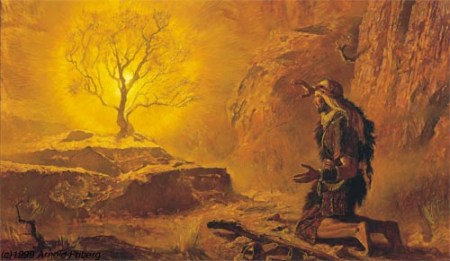
“Some Christians are called to endure a disproportionate amount of suffering. Such Christians are a spectacle of grace to the church, like flaming bushes unconsumed, and cause us to ask, like Moses: ‘Why is this bush not burned up?’

The strength and stability of these believers can be explained only by the miracle of God’s sustaining grace. The God who sustains Christians in unceasing pain is the same God — with the same grace — who sustains me in my smaller sufferings. We marvel at God’s persevering grace and grow in our confidence in Him as He governs our lives.”

— John Newton, 1725-1807, Author of “Amazing Grace”

God has said that He protects and sustains every born again believer. His personal honor is at stake. Knowing this, we can overcome religious fear and anxiety which can be crippling. We must constantly look in the Word and combine the promises with saving faith. 

Each believer must have an experience with God. Very often this will mean we will be barefoot and standing before our own burning bush. It’s in this holy place we see His love and grace, toward us and toward other people. What He reveals will change the trajectory of our life.

Do you really want to be changed? Your own “bush” is waiting for you. God is waiting as well. 

“The angel of the Lord appeared to him in a blazing fire from the midst of a bush; and he looked, and behold, the bush was burning with fire, yet the bush was not consumed.”

Exodus 3:2, NASB

u

u

\

His Oil, Your Head

Back by Popular Demand

I have to admit, I always wondered what this verse in Psalm 23 meant. I thought “He anoints my head with oil” was a nice poetic phrase for God blessing David. But as I delved deeper into the context and explored different interpretations, a beautiful and profound meaning unfolded before my eyes.

First of all the act of anointing with oil holds significant cultural and spiritual symbolism in biblical times. It was a practice to anoint guests as a sign of honor and welcome, especially in lavish feasts and celebrations.

Anointing with oil also had medicinal purposes, as it could soothe and heal various ailments. (Now that’s interesting, I thought.)

In the context of Psalm 23, the phrase “He anoints my head with oil” takes on a deeper metaphorical meaning. It signifies God’s abundant blessings, His provision, and His care for His people. Just as a host anoints the head of a guest as an act of honor and hospitality, God lovingly anoints us with blessings and favor.

Moreover, the act of anointing with oil has spiritual connotations. In ancient religious rituals, anointing with oil was a sign of consecration, setting apart someone or something for a holy purpose.

This verse also portrays a practical picture of medicinal shepherding.

In biblical times, shepherds used oil to treat and protect the sheep’s wounds and keep insects away from their heads. By anointing our heads with oil, God brings healing and comfort to our brokenness, soothing our hurts and protecting us from the turmoil of life.

Sheep often can do harmful things to themselves as they try to find relief from flies and ticks.

Their ears and eyes can be targets for tormenting insects as well.

Sheep have been known to bash their heads against rock walls to dislodge flies from their ears, noses, and eyes. A good shepherd watches closely over his flock. He watches over them carefully.

A good shepherd knows that poured out oil forms a barrier of protection against these things that would try to destroy the sheep.

Have you ever asked God to anoint your head with oil?

Psalm 23 as a whole beautifully paints a picture of God as our loving and caring Shepherd, guiding us, providing for us, and protecting us. The imagery of anointing with oil further illuminates the depth of His love and the extent of His care. It reminds us that we are chosen and cherished by God, and that His blessings are abundant and unending.

But ask yourself these questions. Do you have times of mental torment? Do the worrisome thoughts invade your mind over and over? Do you beat your head against a wall trying to stop them?

The Holy Spirit can come with His endless supply of oil!

“You prepare a table before me
    in the presence of my enemies;
you anoint my head with oil;
    my cup overflows.”

Psalm 23:5, ESV

Oh how He loves you!

Simply Mary at Jesus’ Feet

Mary-Jesus-feet

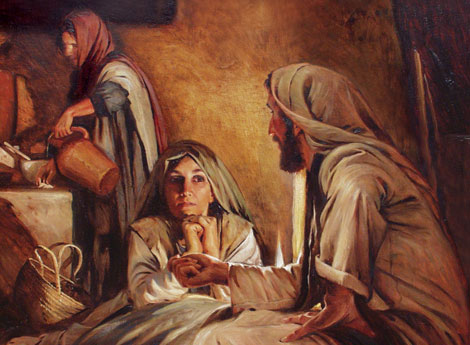
We see Mary three times in the gospels, and each time she is in the same posture — “at Jesus’ feet.” When we have our first glimpse within the Bethany home, we find Martha in her characteristic attitude– working and serving; and Mary we see sitting at the Master’s feet, sitting eagerly and listening to His words.

Our second view of Mary is when Jesus came back to Bethany after the death of Lazarus, and the sisters went out to meet Him. Again, we see her at the feet of Christ. But this time in deep sorrow, seeking comfort. And then we observe her a third time. She has come to anoint the feet of Jesus. We find her again, at Jesus’ feet, and now she is honoring her Lord.

It is her natural posture. I believe that she feels entirely comfortable in this place.  I have personally seen sparrows’ nest on a sheer cliff hundreds of feet straight up, without any apprehension at all. I have been astonished at their daring and simple confidence.  And Mary has this spunk.  She has that certain easy and confident boldness.

Martha, the oldest, obviously has the theology.  We see her taking issue with Jesus, she is questioning, and confronting.  But with Mary it seems, there is a quiet contentment and a rest.  An open readiness to receive. We don’t see that too much, but Mary was a “learner.”  She had become learned in the grace of trusting simply.

She was centered on her Master, He was the focus of her attention.  We dare not minimize this, or try to focus on something less “holy.” This is not something we can easily duplicate, because it proceeds out of a heart that is absorbed in love.  It may appear to be unseemly, and we scratch our head with nervous skepticism.  But it seems whenever Mary comes into the presence of Jesus, she works her way to the front– so she can sit with Jesus. (Interestingly, the Orthodox Church regard Mary to be the first real disciple.)

We have so much to learn from Mary.  Our Christian life can be very shallow and seem rather anemic.  We live in a culture that is racked in intellectualism and pride.  When we engage it we may end up with a bit of haughtiness and a lot of selfishness to deal with.  Mary can be our compass, and our example as we crash through these issues into authentic discipleship.  She really does deserve to be esteemed, and recognized for inspiring us to be with Jesus.

*