Our Worship Comes First

In 2 Chronicles 20, King Jehoshaphat received terrifying news: a vast army was coming against Judah.

They were outnumbered. They were afraid. And they didn’t know what to do.

So Jehoshaphat called the people together and sought the Lord.

And God gave them a powerful reminder:

“The battle is not yours, but God’s.”
— 2 Chronicles 20:15

Then came the most unusual battle strategy.

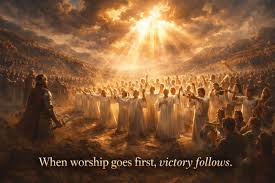
When Judah marched toward the enemy, Jehoshaphat sent singers ahead of the army.

Not the warriors.
Not the strongest men.
The worshipers.

They went before the soldiers, praising God and declaring His goodness before they ever saw the victory.

And as they began to praise, the Lord set ambushes against their enemies, and the enemy armies turned against one another.

By the time Judah arrived, the battle had already been won.

What a picture of faith.

They praised before the breakthrough.
They worshiped before the victory.
They trusted God before they could see what He was doing.

Maybe you’re facing a battle right now that feels bigger than you.

You may not know how God will make a way.
You may not know when the answer will come.
But you can still praise Him.

Because praise isn’t pretending the battle isn’t real.

Praise is remembering that the battle isn’t yours to carry alone.

Put praise on the front line.
Let worship speak louder than fear.
And trust the God who fights for His people.

“The battle is not yours, but God’s.” 🙏🏻🤍

📖 2 Chronicles 20:15–22

Battle Belongs  · Phil Wickham ·Salt and Light, https://www.facebook.com/saltandlight.words

Christians in Pain

No longer do I call you servants, for a servant does not know what his master is doing; but I have called you friends, for all things that I heard from My Father I have made known to you.”

John 15:15

I believe that the purpose of life is not to find our freedom. It’s really meant to find our Master.

Yes, the idea of being a slave to anyone is repugnant. We chafe at this, and yet man was never meant to be seperated from the Lordship of Jesus. We’re instructed repeatedly with the New Testament idea that “our life is not our own”  Over and over God proclaims Himself as the King.

That troubles us somewhat.

Not so much when life is fairly good, granted, but in those hard moments when a decision must be made between enjoying the titillating “lusts of the flesh,” or accepting the fruits of the Spirit. This is one of those “lordship moments.” They come, and go, and they show us exactly who we are.

If you’re really going to be authentic–a legitimate and real disciple, then you must determine who is going to be “boss.” This isn’t one of those casual decisions. You must securely fix it in your heart.

Your decision must become a settled issue.

The thief on the cross knew salvation, he was promised an eternity with God simply by faith. But I submit to you that he had put himself under the Lordship of Jesus, simply by recognizing the sign, “the King of the Jews.” I believe he saw and understood its imlications. Jesus was King!

This is a very hard word for some, but many of our personal issues hinge on this.

I know this first-hand. It can be a monumental struggle. You must admit to not only having Jesus as your Savior, but you also must put your life under His total Lordship.  You need to pick up your cross daily in order to follow.  You need to learn how to kneel.

I’ve chosen a crown to open up this post–it’s done on purpose.  I simply want you to to understand the supreme call He has on your life.

“The question in salvation is not whether Jesus is Lord, but whether we are submissive to His lordship.”

    John MacArthur

You must learn here and now how to kneel before the Sovereign King.

Protecting Others

“Those who carried burdens were loaded in such a way that each labored on the work with one hand and held his weapon with the other. 18 And each of the builders had his sword strapped at his side while he built. The man who sounded the trumpet was beside me.”

Nehemiah 4:17-18, ESV

Nehemiah was supervising the rebuilding of Jerusalem’s walls. He gathered the men and assigned them to various parts of this. His focus was on building as fast as possible.

But there was enemies who threatened to disrupt the work. There was a conspiracy that directly threatened the work that was taking place.

Nehemiah had to act. He prayed and then posted protection among the men in strategic places, These stood guard to defend the workers. Nehemiah then ordered those who labored to wear swords while they worked.

We who are building God’s kingdom need to arm themselves against our spiritual enemies. We are called to give diligent attention to this, and defend God’s people.

“Take… the sword of the Spirit, which is the word of God.”

Ephesians 6:17

Furthermore we are “may be able to stand against the schemes of the devil” (Eph. 6:11). We’re not working against “flesh and blood.” but the “spiritual forces in the high places.” This is an unseen war that really does exist.

God’s Word is our powerful defense. We’re called to handle it skillfully. This is a mark of maturity. The sword must be engaged to help those who aren’t really aware of this present darkness.

Nehemiah understood. He was diligent and very aware of the evil that swirled around him and his people. He wouldn’t minimize this problem, but met it head on.

We must be like him. We are to be aggressive defenders of our brothers and sisters in Christ. We cannot afford to look away or pretend the enemy is not resisting us. We see his work daily.

“Father, thank you for the Bible. The Word is alive and active as we yield it. Teach us to overcome the enemy as we protect our selves and our loved ones with it. In Jesus’ name, Amen.

1brobry-sig4 (2)


cropped-christiangraffiti1-3-1

Freezing a Brother

 Bearing with one another and, if one has a complaint against another, forgiving each other; as the Lord has forgiven you, so you also must forgive.”

Colossians 3:13, ESV

Since this blog originates in Alaska, and since winter is upon us, this post seems fitting. It’s cold. And, well, I’ve been thinking about things that have happened to me recently.

We have a sinful tendency to “freeze” people that offend us.

We do it with our words, attitudes, actions. It is called unforgiveness, or stigma, or just plain contempt. It locks another person in a place were they will stay forever, and you won’t ever have to deal with them.

We glaciate others with extraordinary ease.

Someone offends me, or irritates me and I blast them. In my mind I solidify them into one spot, and there they are locked. Sealed away, and out of my thinking. I sometimes call it “discernment.” And then I can avoid those pesky urges to humble myself.

I have been frozen by others, and to be quite honest, I have been the ‘freezer’ as well.

The sad part is that we ourselves are so far from perfect. When we zap someone we will never, ever ‘receive’ from that person. We can even preclude them as outside of the grace of God. (And usually that’s what happens.)

“You offend me, and I will never forget it, and you will never be more than an evil miscreant to me.” My rationale is “life is too short for hassling with jerks like you.” But yet I can’t fully accept that idea. That is not God’s will for me, and I know it.

We end up debasing ourselves by our own unforgiveness.

We restrict others from the Holy Spirit’s transforming ability. In our mind’s eye, the wicked person will never be able to offer up anything of value. We freeze–locking them into a place. And a vast amount comes from an unforgiveness that is ‘fallen,’ and an unbelief in God’s grace and power.

Mr-Freeze-1Furthermore, any use of our ‘freeze gun’ freezes us as well. Unforgiveness turns on us (which we didn’t count on) and the effect is cumulative. We can only absorb so much an we get hard and cold.

One more thing. We do this to whole groups of people. The alcoholics, the mentally ill, other races. This can be called prejudice or stigma. Ask yourself this–have you ever been stigmatized or demonized?  You will usually know it. But we cannot afford to be controlled by our unforgiveness.

There is far too much at stake.

“And whenever you stand praying, if you have anything against anyone, forgive him and let it drop (leave it, let it go), in order that your Father Who is in heaven may also forgive you your [own] failings and shortcomings and let them drop.”

Mark 11:25, Amplified

*bry-signat (1)Related articles: