Little Pieces of Obedience

abraham_isaac_1

“It was by faith that Abraham offered Isaac as a sacrifice when God was testing him. Abraham, who had received God’s promises, was ready to sacrifice his only son, Isaac, 18 even though God had told him, “Isaac is the son through whom your descendants will be counted.”[ 19 Abraham reasoned that if Isaac died, God was able to bring him back to life again. And in a sense, Abraham did receive his son back from the dead.”

Hebrews 11:17-19, NLT

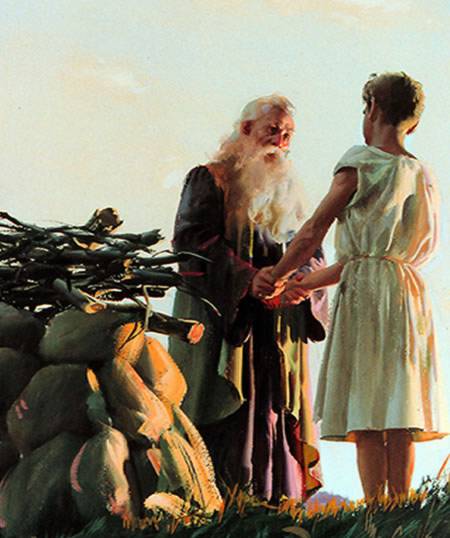
The faith of Abraham is understood by believers everywhere. This simple man followed God to a obscure mountain in Judea. He came fervently, and yet logically to the command of the Lord. Abraham’s confident assurance would carry him to Mt. Moriah were he would sacrifice his son. He would prefigure God’s own sacrifice of Jesus Christ, His only Son.

There were many steps Abraham had to take: the knife, the rope, the firewood, the donkey. There was a dozen details to arrange. Abraham would have had to plan ahead of time to prepare. I’m relatively certain he had ample time to consider what he was doing. The enormity of it all would’ve been staggering.

Hebrews reveals that ‘faith’ was what enabled Abraham. It was faith followed by a dozen little acts of obedience that strengthened him to follow God’s instructions. Abraham would obey God, through faith, by doing many little things. All would lead up to the ‘big thing,’ the offering up of his only son.

Heavy doors swing on small hinges.

I believe that no act is too small. Tiny actions make for big ones. It seems that several times during our daily grind we face little choices that often determine a far greater meaning. I’ve been told that there are flowers in alpine valleys that no man will ever see. Their sole beauty is visible only to God. Obedience is often like this. But the Lord knows.

God meets every act of obedience to Him with a smiling grace.

Hebrews 11 is known as the believer’s ‘hall of fame’. In its verses we’re pounded by the idea that the faith is visible only through obedience. What we do is as significant as what we believe. It has always been so.

“…but the people who know their God shall be strong, and carry out great exploits.”

Daniel 11:32, NKJV

A little obedience prepares us for bigger ones. If we won’t obey in the small ones, how will we in the big ones? The prophet Daniel spoke of a remnant that would do astonishing things, and that the core of their fame would come from knowing God. This is faith made visible. The ‘great exploits’ spring out of faith in a strong God. To be regarded in this way would be wonderful, but faith needs those little acts of obedience to be able to do the great ones. 

We must reclaim the reality that the details of our lives are not trivial.

I Know He Loves Me (But is that Enough?)

Gods-love

“Yet Jerusalem says, “The Lord has deserted us;  the Lord has forgotten us.”
Never! Can a mother forget her nursing child?  Can she feel no love for the child she has borne? But even if that were possible,    
 I would not forget you! 16 See, I have written your name on the palms of my hands. Always in my mind is a picture of Jerusalem’s walls in ruins.”

Isaiah 49:14-16, NLT

Some of us need to be persuaded of God’s love. We are unconvinced. But Isaiah understands. We grasp the theology, but not the meaning. Our own native ideas keep us in disbelief. Perhaps the greatest liability we have as believers is this doubt that God really feels this way about us. But, He does.

Isaiah claims the impossible, yet grounds himself in what is real. The Father loves us and we’re His very own. Even if we don’t seem as holy as we ought to be. In His out reached hands, we discover scars.  This is the price He has purchased us with. We once were blind, and very lost— but now we are His own children and can see.

God may love me. But does He like me?

We are given the impression that He more than ‘loves’ us; He ‘likes’ us. That dear ones, is not a point I’m prepared to support it with scripture, but that isn’t the truth, it doesn’t exist except in my own thinking. I know that He theologically loves me. But to be really honest I sometimes think that God is irritable with me, and He just gets tired of having me around.


But I also must believe God also likes me as well. Surely, there is such a fine line here, between ‘like’ and love. The more I walk with the Lord, and it’s been over 50 years now, the more I love/like Him. I have learned to like Him as much as I love Him. And if God doesn’t like me, I think it actually diminishes His love.

Isaiah speaks for the Lord using tender metaphors. Among the people some had the mindset that God had somehow forgotten them. They thought that they were ‘the lost ones.’

God then uses the analogy of a mother. A nurturing mother. This metaphor is strong and sure. No, God hasn’t forgotten His people. Look at His hands, your name is ‘tattooed’ on them. You’re His, forever. (I hope you like that truth.)

“In math, if you divide an infinite number by any number, no matter how large, you still have an infinite quotient. So Jesus’ love, being infinite, even though it is divided up for every person on earth, is still infinitely poured out on each one of us!” 

Charles Spurgeon

bry-signat (1)

Walking the Wire Again

I hope everybody can find a little flame
Me, I say my prayers,
then just light myself on fire
and walk out on the wire once again.”  

Counting Crows, “Goodnight Elizabeth”

Hope is a powerful thing— nothing compares. It truly is the ‘anchor of the soul.’ Without it, life would be hopeless, and that is intolerable to a human being.

We will implode without hope. The psalmist was well aware of this tendency; he speaks to himself about this. He ‘talks to himself’ which can seem a little weird to some.

“Why are you discouraged, my soul?
    Why are you so restless?
        Put your hope in God,
            because I will still praise him.
                He is my savior and my God.”

Psalm 42:11

Day-to-day life can be arduous. Sometimes faith falters and hopelessness becomes a real and deadly option. For those of us with debilitating illnesses this can be significant hazard. Depression can severely hinder us.

The writer of Psalm 42 understood this. Discouragement was a real issue, especially when he wondered what was swirling around him. (And I daresay he is not alone in this.)

He insists a certitude. He refuses to give in to the idea that failure is final. He will not allow himself to accept the finality of hopelessness. He will not surrender himself to this idea that ‘all is lost.’ The way he battles back is seen in an inner conversation with his soul. He speaks to himself directly concerning the great faithfulness of God to his situation.

It is real, it’s definitely not fluff. He operates in reality. He can’t pretend that the feeling of despondency is imaginary, it is far too cruel and real for it not to be.

However having a hope will cement me in the goodness and mercy of God. It is the sterling silver (.925) belief that He cares for me. The verse in 42:11 ties in with praise and worship. This is not a minor thing. When we praise, we break the bonds of hopelessness, in a way that our souls can know, and appreciate. It decisively disarms the depression, and fills the embattled soul with hope.

Pain can be a powerful indicator of depression unchecked. But hope changes the manner of which we live.

–John Piper

I wish you the best even as the battle intensifies. Jesus is enough. Look around, see Him and run right to Him. Your faith will hold you.

Your Master’s Voice

“But blessed are your eyes, for they see, and your ears, for they hear.”

Matthew 13:16, ESV

There is a vast audio ocean that surrounds us.  Did you know that in the room where you are reading this, that there are “voices” going on? You just don’t see or hear them unless you have your radio or television tuned in to the right frequency, or they’re just too far away. We live in this golden age of Bluetooth, and cell phones. ( I suppose that they have positives, but also negatives.)

There is a frequency that we must lock into, where we can hear important things (or block-out confusing sounds.) But the Holy Spirit really wants to talk with us.  We soon understand that He wants us to communicate with Him. He yearns for a dialogue with us,  just like He had once a long time ago in the early chapters of Genesis. (Gen. 3:9)

“Prayer is not monologue, but dialogue. Gods voice in response to mine is its most essential part.”

Andrew Murray

Knowing that I’ve been created in His image I can ponder the visible, which is a shadow of the real world. Mankind in general, creates and communicates–this is what we do–because it’s how God acts. After all, we are in His image. Just look at a mountain or an apple tree, in a way they explain God, if we can listen with our hearts. We will hear Him.

He is always speaking, but we’re not always listening.

The attribute of listening is amazingly profound.  Forty years ago, I listened to my local radio station while I’m driving. When I moved away from the radio tower, the signal got weaker and weaker. But if I turned the car around and drive back into town, the signal becomes stronger and I can hear it again.

In the same way, we stop hearing God when we drift away from Him. But if we will turn around and come back to Him, we’ll hear His voice again. The closer we are to God, the clearer we can hear Him. “Draw near to God and He will draw near to you” (James 4:8).

Dear one, if you foster listening to Him you’ll be really hearing, and that is why God created you. Hey. Read your Bible, and ponder a passage, and then prepare to hear Him.

1brobry-sig4