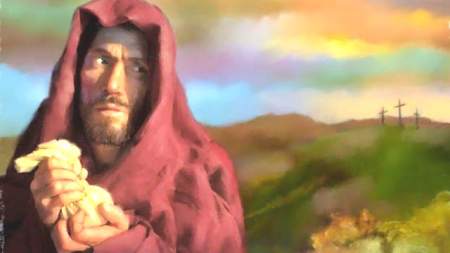
Judas Tries to Explain

This wasn’t the easiest post to write, and what I’ve shared is only meant to bring some light to the story of the ultimate betrayal in human history. —Bryan

My name is Judas Iscariot, and I betrayed my Lord. It really had nothing to do with avarice or greed. The money was fine, don’t get me wrong, but that isn’t why I turned him in to the authorities. I simply did what they couldn’t. I wanted to force Jesus’ hand, so he had to drive the Romans out of our country. I was mistaken, I see that now.

Jesus loved each of us, including me. But I didn’t see it at the time.

When he knelt to wash my feet, I was deeply disturbed. When he stripped down to his underwear, I admit I had some serious doubts. Behaving like a common slave wasn’t really in my thinking. It would take extra work to shape him, and to deaden such strange behavior. But it would be worth it in the end, if only Jesus would cooperate.

In my mind I knew that Jesus only needed the right moment to become the next ruler of Israel. That was his destiny, and I was going to help him bring it to pass. I knew that God had called me–this was my purpose. I would be the kingmaker, and Jesus would certainly reward me.

Some have said that Satan was inside me.

But I hardly noticed. Instead, I was filled with excitement. Finally, the other disciples would come to my side, and together we could make it happen. Enough kneeling, no more groveling–we were going to rule Israel and end the wicked Roman occupation. I truly believed this. He was our Messiah, our deliverer.

The tricky part was to convince Jesus, to manipulate him if necessary, to take control.

He had to see the opportunity that was waiting for him. He was already immensely popular among the people. We could quite easily turn all of this enthusiasm into a full-blown insurrection. But we obviously needed him to lead us, and I could help him find his way. I knew we could do it. This was God’s will for me.

My plan was simple–after I met with the Pharisees, I’d lead them to the garden where Jesus was staying. They insisted on an armed escort, just in case there was trouble among the disciples. I suppose that was prudent, my part in all of this was simply to give Jesus a kiss on the cheek, to signify that he was the one to the soldiers.

I assumed he would resist and fight. I was very wrong.

Nothing went as planned. Jesus didn’t take charge, and he certainly didn’t overthrow the government. As a matter of fact, you could say that the opposite happened; he was silent and refused to answer most of their questions. I did hear him say, “My kingdom is not of this world.” I should have listened.

I realized way too late, that I shed innocent blood. I went back to the priests who hired me, and I insisted they take back the silver. They refused. I threw the bag at their feet and left the temple. Ugly thoughts now filled my mind, and I knew without a doubt that I was completely lost.

Facing Down Your Dragon

Psalm 38:17

Over 85 million Americans live in chronic pain. That’s amazing. Maybe you’re one of them and maybe you just want to understand — perhaps you have a friend or family member who is hurting. They’re facing their dragon and that can be a challenge.

Pain can be constant, or, it can be intermittent. It shows up unpredictably. One never knows when. But believe me, it is terribly real, even if it’s not continual. I look at my dragon in the eye far too often. Way too often.

There are different kinds and various levels to it. Healthcare people often use the Numerical Rating Scale (NRS). Pain is ranked by numbers between 1-10, the higher the number the greater the pain.

Christians are part of that 85 million. We’re not immune just because we believe in Jesus. Some of us will hurt.

Coping with Chronic Pain

  • Learn all you can about your particular issue. I’m constantly looking and hopefully learning all I can, I want to be an expert. Research things. Google and Wikipedia can be deep reservoirs of knowledge.
  • Learn how to worship and pray in a brand new way. Things have changed now and seeking Him becomes a challenge, and, it can be easier.
  • Insomnia
  • Depression or anxiety, or both.
  • Fatigue, or stress.
  • Mood swings.
  • Doctors and meds.

I have to warn you, severe pain can make your dear one irrational. Pain can get so intense that you will find it impossible to relate to the sufferer. I once had a fierce battle with Complex regional pain syndrome (CRPS) in both forearms. Most doctors rate this as one of the worst types of pain to have.

Morphine didn’t help. Lynnie (my wife) could only watch and pray as the dragon kept attacking me, over and over. She watched me writhe in pain and she was pretty much helpless.

I was very angry, wildly rude and terribly mean. I was frustrated because I couldn’t communicate how bad the pain was. Over and over I tried to share how I was feeling, but words were not enough.

Some advance the idea that you need to find enough faith to be healed, but what about having enough faith to live in constant pain?

“Pain is no evil, unless it conquers us.”

     Charles Kingsley

The Desperation Factor

  1. : Loss of hope and surrender to despair. 2. : a state of hopelessness leading to rashness.
  2. Synonyms–desperation · concern · dejection · depression · despondency · disconsolateness · distraction · distress · pang · torture · trouble · worry. noun as in rashness.

A terrific study is finding the people who fell at Jesus’ feet. Tucked in the Gospels you’ll find stories of those who despair. You’ll also see them come to Jesus in brokenness and humility, without any other recourse. I call these the feet-finders.

They came to Jesus because they had no hope otherwise. They were people who were hopeless and wretched, they had long ago run out of options. They came to Jesus, falling down in front of Him. They were all feet-finders.

They were men and women who were truly desperate.

John 11:32

One of the classic scenes in the Gospels is when Mary meets Jesus after her brother’s death. She doesn’t understand Jesus’ delay, Lazarus has been very ill and Jesus could have healed him. She is grieving and confused. But she only has one posture and one place in her heart to be– at the feet!

There are some common characteristics that feet-finders have:

  • A great need that can’t be met without His touch
  • To understand one’s true condition–humility, brokenness
  • To beg for a healing, for self or family
  • To honor Jesus as the Messiah
  • To be more receptive to His teaching, to understand Him
  • To become a witness to others (although it does seem secondary)

The following 3 verses are just a small selection of those who fell at Jesus feet.

Matthew 15:30

Mark 7:25

Luke 8:35

But there are several other instances where people came to sit at Jesus’ feet:

  • Mark 5:22-23, Jairus, a leader in the local synagogue
  • Luke 7:37-38, a sorrowing mother for her daughter
  • Luke 8:41, also Jairus
  • Luke 10:39, Mary, when Jesus was teaching
  • John 11:32, Mary, meeting Jesus entering Bethany
  • John 12:3, Mary, with her perfume
  • Revelation 1:17, John to express what he was seeing (also 19:10)

In every case we find people consciously coming and kneeling at the feet of the Lord Jesus. It was a deliberate action that came from their hearts. Each had a terrible need, and each was without hope.

Formality and religious politeness are jettisoned. Brokenness and true humility takes their place. A foot-finder is no longer operating on spiritual niceties. Religion is comfortable, noble, and respectable, but it cannot heal or change people deeply.

Feet-finders know that they need Jesus desperately and will go to any length just to be touched by Him. They defy what is conventional and proper. They are not what we call respectable. You can find them at the feet of Jesus. They are feet-finders. Foot-finders weep, kneel, beg, shout. Too many tears and maybe some snot.

Hardly decent to religious people.

Are you really that desperate yet? Have you seen your need, and do you realize how lost you would be without His healing touch?

Often when I do pray, I sometimes think of the woman who was unclean. She speaks to me about approaching Jesus. I see myself in a crushing crowd of people, and I’m reaching out just to touch the hem of His robe. I know only Jesus can stop my own uncleanness. (Matthew 9.)

I’m convinced only Jesus can make me clean and whole.

I’ve tried to be holy and acceptable to Him. But I felt like a juggler, trying to keep my balls in the air all at the same time, and I could never pull it off. So I tried again and again. I was the unofficial master of religious effort.

But I found my rightful place at His feet. It’s where I belong. I love Him.

I’m not ashamed to be found kneeling.

bry-signat (1)

*

Messed Up People

Elijah was suicidal. Job wished he had never been born. David understood deep depression. Moses was anxious. Hannah was barren. Jonah was angry. Paul was all alone in a prison cell.

And actually, this is only a brief list. The Bible is loaded with flawed people who stumbled trying to be faithful. God uses imperfect people, because there really isn’t any other kind to be found. And there were others.

Noah got spectacularly drunk. Abraham lied. Jacob repeatedly deceived others. Rahab was a whore. Samson lusted. David committed adultery and was a murderer. Peter denied Christ.

Why does God favor and love people who are so disturbed? Honestly, none of us measure up. It seems He uses the weak to carry out a plan and a purpose of redeeming others, and establishing a Kingdom. He takes messes and gives them His message.

He is Love– 100% of the time, and He loves you, and He loves me, He loves the world. (John 3:16.)

Messed up people of faith become instruments and vessels of grace to other messed up people. We carry a treasure that is not ours. Sometimes it takes years to see this. I hope you can understand this. I hope it doesn’t take long.

And nothing is ever really wasted. Our mistakes (sins) become useful things to Him. For example, David’s sin would be transformed into Psalm 51 and 32. Yes, his disobedience had consequences, I won’t dispute that, but something wonderful also came when he repented.

David paid an awful price for his sin. That disobedience almost destroyed him. Not only did it separate him from God, but his family felt the effects of his evil actions.

Yes, you need to repent. But when sin is destroying you, it does seem you need to turn from it, and leave it now.

The first two verses of Psalm 51 can bring tears when we finally understand their profound beauty, for they came out of David’s personal evil:

Psalm 53:1-2, ESV

For thousands of years people of real faith have come and drawn beauty and grace from this song. David knew his sin was real, and incredible pain emerged from that, but the Psalm did also.

Please do not try to hide or excuse your sin, it always has the most awful consequences.

Broken people can be forgiven, redeemed and used. Sometimes I think God gets special enjoyment out of picking the worst and patiently loving us to wholeness. If you really know Him, and know your flaws, you’re well on your way of usefulness in His kingdom.

“But we have this treasure in jars of clay, to show that the surpassing power belongs to God and not to us.”

2 Corinthians 4:7