A Used Heroin Needle

Clarion Alley, 1987

I lived in the inner city of San Francisco from 1986-1989. I was a full-time missionary and lived in community called SOS. There were about 10 believers, and we were committed to doing high visibility evangelism, “taking the Church on the street.” We all lived in an old Victorian in the Mission district. 

I will not minimize the difficulty and danger of the streets combined with our ministry’s approach. Not only was it hard, but we also lived in a hard place. Our neighbors were heroin addicts, and we lived just a couple of doors down from the “largest lesbian rock-roll bar west of the Mississippi.”  

Directly behind our house was an alley that was as bad as you can imagine; addicts and winos had basically taken over. It was full of trash, feces, and urine. And in the hot summer it would make your eyes water. It really was awful. 

Please keep reading. 

One hot summer day I decided to clean up part of our alley. Armed with an old broom, laundry detergent, a hose (and courage) I headed out to scrub away. It took some doing; it was somewhat nauseating. 

I noticed a small hole in the corner of the wall. I reached in to discover a well-used heroin needle hidden inside. I ran that needle into my hand. 

I really didn’t think much about it at the time. 

About six months later I was in San Francisco General outpatient for AIDS testing. I had been terribly tired and had lost some weight. Perhaps I had been infected? It was funny but a part of all of this was having to sit in a circle with a dozen gay men being instructed about safe sex practices. (I remember bananas and condoms were used.) 

It was 1987, and AIDS testing was still primitive; it took 6 weeks for the results. 

That wait was a bit of a challenge. I cried out to the Lord many times. Since the symptoms got even worse, I started to think the worse. I was thinking, “was this considered martyrdom?” or “I can’t ask Lynn to marry me now.” (I had been thinking about this up to then.) 

I was positive that I had AIDS. 

About 20 years later I discovered I had contracted HCV, Hepatitis C. I had a good doctor who knew his stuff. Although my liver had been damaged by that point, he guided me through a maze of testing and found a new med that was supposed to have good results. It did, thank God. I had finally been cured. 

Lynnie and I were married on January 7, 1989. 

What can I say really? I know the Lord directly intervened. We returned to Alaska where I was asked to teach at the Alaska Bible Institute. I was able to draw on my many experiences with SOS in San Francisco to touch the hearts of young men and women going into ministry. 

Lynnie and I went on to pastor a Church in 2000. 

Only God can bring good out of something bad. 

“O Lord my God, I cried to You for help, and You have healed me.” 

Psalm 30:2 

 James H. Aughey 

His Oil, Your Head

Back by Popular Demand

I have to admit, I always wondered what this verse in Psalm 23 meant. I thought He anoints my head with oilwas a nice poetic phrase for God blessing David. But as I delved deeper into the context and explored different interpretations, a beautiful and profound meaning unfolded before my eyes.

First of all the act of anointing with oil holds significant cultural and spiritual symbolism in biblical times. It was a practice to anoint guests as a sign of honor and welcome, especially in lavish feasts and celebrations.

Anointing with oil also had medicinal purposes, as it could soothe and heal various ailments. (Now that’s interesting, I thought.)

In the context of Psalm 23, the phrase “He anoints my head with oil” takes on a deeper metaphorical meaning. It signifies God’s abundant blessings, His provision, and His care for His people. Just as a host anoints the head of a guest as an act of honor and hospitality, God lovingly anoints us with blessings and favor.

Moreover, the act of anointing with oil has spiritual connotations. In ancient religious rituals, anointing with oil was a sign of consecration, setting apart someone or something for a holy purpose.

This verse also portrays a practical picture of medicinal shepherding.

In biblical times, shepherds used oil to treat and protect the sheep’s wounds and keep insects away from their heads. By anointing our heads with oil, God brings healing and comfort to our brokenness, soothing our hurts and protecting us from the turmoil of life.

Sheep often can do harmful things to themselves as they try to find relief from flies and ticks.

Their ears and eyes can be targets for tormenting insects as well.

Sheep have been known to bash their heads against rock walls to dislodge flies from their ears, noses, and eyes. A good shepherd watches closely over his flock. He watches over them carefully.

A good shepherd knows that poured out oil forms a barrier of protection against these things that would try to destroy the sheep.

Have you ever asked God to anoint your head with oil?

Psalm 23 as a whole beautifully paints a picture of God as our loving and caring Shepherd, guiding us, providing for us, and protecting us. The imagery of anointing with oil further illuminates the depth of His love and the extent of His care. It reminds us that we are chosen and cherished by God, and that His blessings are abundant and unending.

But ask yourself these questions. Do you have times of mental torment? Do the worrisome thoughts invade your mind over and over? Do you beat your head against a wall trying to stop them?

The Holy Spirit can come with His endless supply of oil!

“You prepare a table before me
    in the presence of my enemies;
you anoint my head with oil;
    my cup overflows.”

Psalm 23:5, ESV

Oh how He loves you!

When God Doesn’t Heal You

Mike Mason

God heals. Of that I have no doubt. We have many promises and see so much actual healing in Scripture. Jesus’ ministry would connect with hundreds of people who would be physically touched. The Lord would pass the baton on to His Church. We’re called to “lay hands on the sick,” (James 5:14-15).

But not everyone who is sick will receive physical healing. Even those who were active in ministry knew sickness.

In the second episode of season 3 of “The Chosen,” Little James, who we’ve seen walks with a limp, comes to Jesus after He commissions the Apostles. He tells him he finds it hard to believe that he will be healing people, given that Jesus hasn’t healed him.

“Do you want to be healed?” asks Jesus.

“Yes, of course,” James says, “if that’s possible. Why haven’t you?” he asks Jesus—again, a question some of us would’ve asked.

“Because I trust you,” Jesus says. “Little James. Precious Little James. I need you to listen to me very carefully, because what I am going to say defines your whole life to this point and will define the rest of your life. Do you understand?”

Jesus tells James that he will heal many people, and they will have a good story to tell.

“To know how to proclaim that you still praise God in spite of this—to know how to focus on all that matters, so much more than the body—to show people that you can be patient with your suffering here on Earth, because you know you’ll spend eternity with no suffering—not everyone can understand that. How many people do you think the Father and I trust this with? Not many.”

“But the others,” James says, “they are so much more … stronger, better at this.”

“James, I love you,” Jesus says, “but I don’t want to hear that ever again.”

“I know how easy it is to say the Psalm of David, that I am beautifully and wonderfully made, but it doesn’t make this any easier,” says James, begins to weep. “It doesn’t make me feel like any less of a burden.”

“When you pass from this earth,” Jesus says to James, “and you meet your Father in Heaven, where Isaiah promises you will leap like a deer, your reward will be great. So hold on a little longer. And when you discover yourself finding true strength because of your weakness, when you do great things in my Name in spite of this, the impact will last for generations. Do you understand?”

James cries, and says, “Yes. Thank you, Master.”

I believe that there are two truths that every Christian can count on. These are solid, and completely trustworthy. They are forever fixed and will never change.

“Fear not, for I am with you; be not dismayed, for I am your God; I will strengthen you, I will help you, I will uphold you with my righteous right hand.” Isaiah 41:10

“He will wipe away every tear from their eyes, and death shall be no more, neither shall there be mourning, nor crying, nor pain anymore, for the former things have passed away.” Revelation 21:4

     John Henry Newman  

Twisted and Bent

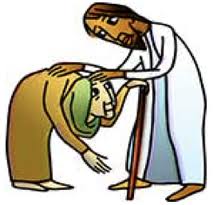
Luke 13:10-13

When we read through the Gospels we see that Jesus never laid His hands on those who were demon possessed, rather He would first command the demon to leave. (Interesting.)

The text tells us that the woman had been bent over for 18 years. (That’s a long, long time.) The cause was being “demonized” which is very different than being possessed.

There is a difference. Demons can oppress people and influence their lives, especially if that person is living in sin and rebellion.

“The physical cause of her inability to straighten up has been examined by J. Wilkinson, who identified the paralysis as the result of spondylitis ankylopoetica, which produces the fusion of the spinal bones.”

That is absurd. There’s a truth here that this “leader” is covering up. The woman is instantly healed, and this so-called leadertries to nullify what has just happened. Rather than rejoicing, he renounces what has just happened, and claims that the Sabbath law has been violated. He declares the Law is greater than this woman’s healing.

Jesus never once asserts His authority. Rather He points to this woman’s healing as being truly the very essence of the Law. In spite of what the Law means legalistically, it can never invalidate mercy.

CH Spurgeon

Her private agony was never to be found again. She was free. The pain she lived with was no more. The captivity was gone, and she was freed. The biblical text seems to ignore this and concentrates on the synagogues leader’s response, and that’s well and good. Perhaps though we should focus on this woman’s healing from an awful terrible darkness.

She is free. The stoop is gone. The pain is gone. Jesus has set her free, she gazes at the sun after many years. She stands erect, and though everything now seems different, she now knows her deliverer, and her healer.

“Bent,” brokenbelievers.com, Bryan Lowe