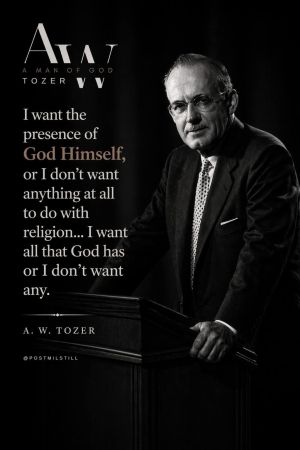
“You can see God from anywhere if your mind is set to love and obey Him.”
It is scarcely possible in most places to get anyone to attend a meeting where the only attraction is God.
A pharisee is hard on others and easy on himself, but a spiritual man is easy on others and hard on himself.
An idol of the mind is as offensive to God as an idol of the hand.
When we become too glib in prayer we are most surely talking to ourselves.
Wise leaders should have known that the human heart cannot exist in a vacuum. If Christians are forbidden to enjoy the wine of the Spirit they will turn to the wine of the flesh….Christ died for our hearts and the Holy Spirit wants to come and satisfy them.
The Spirit-filled life is not a special, deluxe edition of Christianity. It is part and parcel of the total plan of God for His people.
Jesus is not one of many ways to approach God, nor is He the best of several ways; He is the only way.
We must meet the uncertainties of this world with the certainty of the world to come.
He remembers our frame and knows that we are dust. He may sometimes chasten us, it is true, but even this He does with a smile, the proud, tender smile of a Father who is bursting with pleasure over an imperfect but promising son who is coming every day to look more and more like the One whose child he is.
Salvation apart from obedience is unknown in the sacred Scriptures… Apart from obedience there can be no salvation, for salvation without obedience is a self-contradictory impossibility.
“When the woman saw that the fruit of the tree was good for food and pleasing to the eye, and also desirable for gaining wisdom, she took some and ate it. She also gave some to her husband, who was with her, and he ate it.7 Then the eyes of both of them were opened, and they realized they were naked; so they sewed fig leaves together and made coverings for themselves.”
Genesis 3:6-7
The broken believer survives because he or she is constantly having to move toward “authenticity.” There exists a credibility and a realness about them. You’ll suddenly realize that you’re talking with someone who is real. They’ve stepped out of the wreckage and have survived their personal catastrophes. This doesn’t come easy.
It is a rarity and a gift.
On the other hand, we see those wrapped up in so much self-imposed deception that can’t admit anything is wrong. Like the problem drinker who denies he has a problem, we can’t handle the reality and drink to alter it. The addicted are compelled to live a delusion of their own choices, and soon discover they are hopelessly trapped. And so we hide under our favorite bush.
(Euphoria was my favorite.)
“When the cool evening breezes were blowing, the manand his wife heard the Lord God walking about in the garden. So they hid from the Lord God among the trees.9 Then the Lord God called to the man, “Where are you?”
Genesis 3:8
There is a Latin phrase, esse quam videri; to be rather than seem to be.” We would rather be “seeming to be” than actually just “be.” The sons of Adam and the daughters of Eve are still using “fig leaves.” We don’t want to deal with the truth about ourselves and face the sin of our lives. But it seems to be more than that.
The struggler and the broken believer may try to conceal themselves.
They may hold up an image that deflects the curious onlooker from seeing the real them. We won’t deal with the truth, and we choose to hide ourselves. We want to be seen as “together” even if we are not. It is all about looking good. This is pretense and sham. We dodge and deflect.
“And this is the judgment: the light has come into the world, and people loved the darkness rather than the light because their works were evil.”
John 3:19
This was Jesus’ indictment of the human heart. I wish it was otherwise.
Each day I must put to death my old self. Take my meds, and ask the Lord for strength to stay real. No more pretense, and no more projecting a false self to others (and myself.) I choose reality over fantasy.
The Holy Spirit is eagerly waiting to fill me. In this I discover I can live well with the strength and joy He gives me.
“The God who can change a sinner into a Christian by giving him His life can equally transform the fleshly Christian into a spiritual one by giving him His life more abundantly.”
—Watchman Nee
Lord Jesus, may it be that the real me meets the real You. Keep me real and authentic. Amen.
Does being in prison change a person? How would it affect you? I imagine the Apostle Paul’s frustration. He loved to disciple and establish churches. To be confined like this would be quite difficult. What a spiritual trial it would’ve been. Me, personally, I would have definite issues. I made a list. I probably would be:
Angry? Depressed?
Frustrated? Anxious?
Full of self-pity?
Isolated, lonely?
Frightened?
During his imprisonment, I’m sure that the Apostle Paul had to work through all of these things–I’m certain that Satan tempted him repeatedly. I think the man Paul had dealt with the enemy through all of this (and more besides). Most feel that he would be imprisoned in Rome for at least two years. That’s a long time.
It’s generally agreed that he wrote the four epistles in 60-62 AD. These letters are regarded as written from his prison cell in Rome: Ephesians, Philippians, Colossians, and Philemon. Each of these four is different. (But admittedly, Philemon is the most unalike.)
And yet the scent of the prison can be found in these writings.
Despite the possible response of an incarcerated man, Paul’s writings from the Mamertine Prison are incredibly encouraging–he shows none of the issues of a man locked in a cell–but yet there are hard things he must deal with. Take a second to look at some direct references to his imprisonment.
“I appeal to you, instead, on the basis of love. I, Paul, as an elderly man and now also as a prisoner of Christ Jesus,” (Philemon 9.)
I am going to Jerusalem, constrained by the Spirit, not knowing what will happen to me there, except that the Holy Spirit testifies to me in every city that imprisonment and afflictions await me. But I do not account my life of any value nor as precious to myself, if only I may finish my course and the ministry I received from the Lord Jesus, to testify to the gospel of the grace of God (Acts 20:22-24).
“For this reason I, Paul, a prisoner of Christ Jesus on behalf of you Gentiles,” (Ephesians 3:10).
“I, Paul, write this greeting with my own hand. Remember my chains. Grace be with you.” (Col. 4:18).
“I want you to know, brothers, that what has happened to me has really served to advance the gospel, so that it has become known throughout the whole imperial guard and to all the rest that my imprisonment is for Christ.” (Philippians 1:12-14).
“The following night the Lord stood by him and said, “Take courage, for as you have testified to the facts about me in Jerusalem, so you must testify also in Rome.” (Acts 23:11).
It’s clear to me that Paul used this time to witness through his writings. He never grew bitter, only better. One could suggest that it’s we have been blessed by these epistles. His time in prison was the time he needed to bless us today. Where would we be without these books?
A papyrus fragment from Paul’s epistle to the Ephesians.
How many times was Paul imprisoned? Was he jailed once, twice, or several times? I’ve read different commentaries and they can’t decide. It’s a challenge to put together a solid timeline. There seems to be more evidence for two different confinements. Check out this site if you want to dig deeper.
But no matter what. These writings are God’s gift to us today.
From a dark prison, Paul writes these absolutely incredible letters. I believe Satan wanted to destroy Paul. I also think that this was a tremendous trial for him. He was a spiritual dynamo, wanting to establish and strengthen churches and then being chained to a wall must’ve been a challenge for him. There was so much for him to do.
But we desperately needed these letters!
Perhaps, out of our confusion and challenges, God’s purpose goes far beyond what we think. Sometimes we have no idea what our “imprisonment” is going to do. That encourages me. He turns our hard times into spiritual gold!
Through these letters, we’ve been given so much. These epistles are written from Rome’s dungeon, and yet they continue to shake the world!
“Father,every family has a rascal someone who breaks the rulesa juvenile delinquent of untold frustrations and sleepless nights a repeated offender and bearer of sad woe the problem child who needs the most discipline.
Is this why you love me most persistently?When you correct me, is it becauseI’m the one most contrary?
Or is it that you love me so much?”
I wrote this thinking about Hebrews 12 and God’s purpose of chastening. I don’t pretend to understand this dynamic completely–all I can say is that my childhood was punctuated by much difficulty. But now, as a father (my two children are now grown), fatherhood has become far easier than my dad had with me.
7 “As you endure this divine discipline, remember that God is treating you as his own children. Who ever heard of a child who is never disciplined by its father? 10 For our earthly fathers disciplined us for a few years, doing the best they knew how.“
“But God’s discipline is always good for us, so that we might share in his holiness.11 No discipline is enjoyable while it is happening—it’s painful! But afterward there will be a peaceful harvest of right living for those who are trained in this way.”
Hebrews 12:7, 10-11
I really think we understand our Heavenly Father when we spend quality time with Hebrews 12. We are given insight into His care and into our own issues. It is a good thing He gives us— it enriches our spiritual lives.
It’s never nice to be corrected.
It’s not pleasant. Part of being corrected is being reminded that we’re not as righteous as we think we are. To be corrected strikes us to a reprimand, an admonition that something isn’t right inside of us.
The Father corrects His children–in many ways through a myriad of circumstances. He loves us far too much to allow us to continue in our sin. He’s making us into the image of Christ.
We should welcome His correction. He has a plan for you.
When He disciplines you, it only proves that He is your Father. It’s critical to remember: God’s correction is always for our good. It may be painful yes, but it comes with real hope. It’s not to harm or punish you.
“Father, I’m so sorry that I grieve you as often as I do. I promise to behave. Thank you for being a faithful Father who cares deeply for my soul. Amen.”
“Look upon your chastening as God’s chariots sent to carry your soul into the high places of spiritual achievement.”