

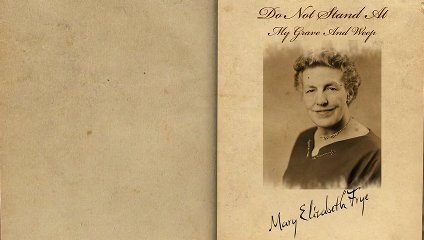
Don’t stand beside my grave and weep,
For I’m not there; I do not sleep.
I am a thousand winds that blow,
I am the diamond glints on snow,
I am the sun on ripened grain,
I am the gentle autumn rain.
When you awaken in the morning’s hush
I am the swift uplifting rush
Of quiet birds in circling flight.
I am the soft star-shine at night.
Do not stand at my grave and cry,
I am not there; I did not die.
Mary Elizabeth Frye
 “Do not stand at my grave and weep” is a Holocaust poem and elegy with a very interesting genesis, written in 1932 by Mary Elizabeth Frye (1905-2004). Although the origin of the poem was disputed for some time, Mary Frye’s authorship was confirmed in 1998 after research by Abigail Van Buren, the newspaper columnist better known as “Dear Abby.” The version above was published by The Times and The Sunday Times in Frye’s obituary on November 5, 2004.
Mary Frye wrote the poem in 1932. As far as we know, she had never written any poetry before, but the plight of a young German Jewish woman, Margaret Schwarzkopf, who was staying with her and her husband at the time, inspired the poem. Margaret Schwarzkopf had been concerned about her mother, who was ill in Germany, but she had been warned not to return because of increasing anti-Semitic unrest that was erupting into what became known as the Holocaust.
When her mother died, the heartbroken young woman told Frye that she never had the chance to “stand by my mother’s grave and shed a tear”. Frye found herself composing a piece of verse on a brown paper shopping bag. Later she said that the words “just came to her” and expressed what she felt about life and death.
Mary Frye circulated the poem privately. Because she never published or copyrighted it, there is no definitive version. She wrote other poems, but this, her first, endured. Her  obituary in The Times made it clear that she was the author of the famous poem, which has been recited at funerals and on other appropriate occasions around the world for eighty years. The poem was introduced to many Britons when it was read by the father of a young soldier, Stephen Cummins, killed by a bomb in Northern Ireland. The soldier’s father read the poem on BBC radio in 1995 in remembrance of his son, after having found it in an envelope addressed “To all my loved ones” in his son’s personal effects.
Related articles
- Mary Elizabeth Frye: Do Not Stand at My Grave and Weep (ruoxiangchau.com)
- Poetic Life Lessons (lovelikeangels.wordpress.com)
- The Wednesday Poetry Corner with Dr. Mary Annie AV (thesecretkeeper.net)
- Thanks for the Memories (ferenzcompositions.wordpress.com)

 Broken Believers