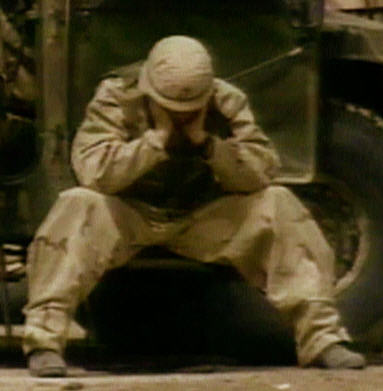
Combat’s Hidden Toll: 1 in 10 Soldiers Report Mental Health Problems

Soldiers Report PTSD Symptoms and Other Mental Health Problems
 
By KIM CAROLLO
ABCNews Medical Unit
June 9, 2010

Even though he’s retired from active military duty, CSM Samuel Rhodes still suffers from deep emotional wounds.

“I had to take this afternoon off from work today because of anxiety,” he said. “And sometimes, if I’m going through a really tough time, I think about suicide.”

He spent nearly 30 years in the Army and recently spent 30 straight months deployed in Iraq where he, like many soldiers, witnessed some of the horrors of war.

“In April 2005, it started to eat me up because I started losing one soldier after another,” Rhodes said. “We lost 37 soldiers that were in my unit.”

He was in charge of the brigade of 37 soldiers, and as time wore on, the loss of life wore him down.

“In April 2007, it came full circle. I considered suicide as an option. I felt guilty about losing those soldiers, even though I had no control over it,” he said.

“And I was sleepwalking. I had to tie myself to my cot to prevent it,” he added.

Later, during his 24th month in Iraq, he was found unconscious, and doctors diagnosed him with exhaustion. At that time, the combat stress doctor told him he was also suffering from post-traumatic stress disorder.

“He started explaining it to me, and I realized he was right,” Rhodes said.

And according to a new study conducted by researchers at Walter Reed Army Institute of Research, Rhodes’ mental health problems are common among soldiers returning from Iraq.

Between 2004 and 2007, researchers gave out anonymous surveys to four active duty brigade combat teams and two National Guard combat team three months and 12 months after deployment. The surveys screened soldiers for PTSD, depression, alcohol misuse and aggressive behavior and asked them to report whether these problems impacted their ability to get along with others, take care of things at home or perform their job duties.”A high number of those that had symptoms of PTSD and depression also reported some aspect of impairment,” said Jeffrey L. Thomas, one of the study’s co-authors. “The range was about 9 to 14 percent.” Depression rates ranged from 5 percent to 8.5 percent.

But by using a less stringent definition of PTSD, they found between 20 and 30 percent of soldiers showed symptoms of PTSD, while they found between 11.5 to 16 percent of them were depressed.

Full article, please go to:  http://abcnews.go.com/Health/MindMoodNews/10-soldiers-fought-iraq-mentally-ill/story?id=10850315&page=2

All About Meds for Depression

Depression is commonly treated with antidepressant medications. Antidepressants work to balance some of the natural chemicals in our brains. These chemicals are called neurotransmitters, and they affect our mood and emotional responses. Antidepressants work on neurotransmitters such as serotonin, norepinephrine, and dopamine.

The most popular types of antidepressants are called selective serotonin reuptake inhibitors (SSRIs). These include:

  • Fluoxetine (Prozac)
  • Citalopram (Celexa)
  • Sertraline (Zoloft)
  • Paroxetine (Paxil)
  • Escitalopram (Lexapro).

Other types of antidepressants are serotonin and norepinephrine reuptake inhibitors (SNRIs). SNRIs are similar to SSRIs and include venlafaxine (Effexor) and duloxetine (Cymbalta). Another antidepressant that is commonly used is bupropion (Wellbutrin). Bupropion, which works on the neurotransmitter dopamine, is unique in that it does not fit into any specific drug type.

SSRIs and SNRIs are popular because they do not cause as many side effects as older classes of antidepressants. Older antidepressant medications include tricyclics, tetracyclics, and monoamine oxidase inhibitors (MAOIs). For some people, tricyclics, tetracyclics, or MAOIs may be the best medications.

What are the side effects?

Antidepressants may cause mild side effects that usually do not last long. Any unusual reactions or side effects should be reported to a doctor immediately.

The most common side effects associated with SSRIs and SNRIs include:

  • Headache, which usually goes away within a few days.
  • Nausea (feeling sick to your stomach), which usually goes away within a few days.
  • Sleeplessness or drowsiness, which may happen during the first few weeks but then goes away. Sometimes the medication dose needs to be reduced or the time of day it is taken needs to be adjusted to help lessen these side effects.
  • Agitation (feeling jittery).
  • Sexual problems, which can affect both men and women and may include reduced sex drive, and problems having and enjoying sex.

Tricyclic antidepressants can cause side effects, including:

  • Dry mouth.
  • Constipation.
  • Bladder problems. It may be hard to empty the bladder, or the urine stream may not be as strong as usual. Older men with enlarged prostate conditions may be more affected.
  • Sexual problems, which can affect both men and women and may include reduced sex drive, and problems having and enjoying sex.
  • Blurred vision, which usually goes away quickly.
  • Drowsiness. Usually, antidepressants that make you drowsy are taken at bedtime.

People taking MAOIs need to be careful about the foods they eat and the medicines they take. Foods and medicines that contain high levels of a chemical called tyramine are dangerous for people taking MAOIs. Tyramine is found in some cheeses, wines, and pickles. The chemical is also in some medications, including decongestants and over-the-counter cold medicine.

Mixing MAOIs and tyramine can cause a sharp increase in blood pressure, which can lead to stroke. People taking MAOIs should ask their doctors for a complete list of foods, medicines, and other substances to avoid. An MAOI skin patch has recently been developed and may help reduce some of these risks. A doctor can help a person figure out if a patch or a pill will work for him or her.

How should antidepressants be taken?

People taking antidepressants need to follow their doctors’ directions. The medication should be taken in the right dose for the right amount of time. It can take three or four weeks until the medicine takes effect. Some people take the medications for a short time, and some people take them for much longer periods. People with long-term or severe depression may need to take medication for a long time.

Once a person is taking antidepressants, it is important not to stop taking them without the help of a doctor. Sometimes people taking antidepressants feel better and stop taking the medication too soon, and the depression may return. When it is time to stop the medication, the doctor will help the person slowly and safely decrease the dose. It’s important to give the body time to adjust to the change. People don’t get addicted, or “hooked,” on the medications, but stopping them abruptly can cause withdrawal symptoms.

If a medication does not work, it is helpful to be open to trying another one. A study funded by NIMH found that if a person with difficult-to-treat depression did not get better with a first medication, chances of getting better increased when the person tried a new one or added a second medication to his or her treatment.

Good source for personal research: http://www.nimh.nih.gov/index.shtml

Healthy Place on Depression Meds: http://www.healthyplace.com/depression/antidepressants/list-of-antidepressants/menu-id-68/

And Buzzle’s List:  http://www.buzzle.com/articles/depression-medication-list-of-antidepressants.html

Happy St. Patrick’s Day


Pray for the Church in Ireland today!  Ask the Lord to raise up pastors and elders that will be faithful to His word and to His flock.  Pray for Christian believers in Ireland who are afflicted with mental illness and chronic depression.  Pray for those who struggle with chemical dependence.

For more information, and a peek into ministry in Ireland, check out the Youth With A Mission- Ireland website.  YWAM is doing a great work in that country and ministry there is rich and full.  Check them out at : http://www.ywamireland.org/

For you and your home, a blessing…

An Old Irish Blessing
May the road rise up to meet you.
May the wind always be at your back.
May the sun shine warm upon your face,
and rains fall soft upon your fields.
And until we meet again,
May God hold you in the palm of His hand.


It’s a Med, Med, Med, Med World!

What are psychiatric medications?

Psychiatric medications treat mental disorders. Sometimes called psychotropic or psychotherapeutic medications, they have changed the lives of people with mental disorders for the better. Many people with mental disorders live fulfilling lives with the help of these medications. Without them, people with mental disorders might suffer serious and disabling symptoms.

How are medications used to treat mental disorders?

Medications treat the symptoms of mental disorders. They cannot cure the disorder, but they make people feel better so they can function.

Medications work differently for different people. Some people get great results from medications and only need them for a short time. For example, a person with depression may feel much better after taking a medication for a few months, and may never need it again. People with disorders like schizophrenia or bipolar disorder, or people who have long-term or severe depression or anxiety may need to take medication for a much longer time.

Some people get side effects from medications and other people don’t. Doses can be small or large, depending on the medication and the person. Factors that can affect how medications work in people include:

  • Type of mental disorder, such as depression, anxiety, bipolar disorder, and schizophrenia
  • Age, sex, and body size
  • Physical illnesses
  • Habits like smoking and drinking
  • Liver and kidney function
  • Genetics
  • Other medications and herbal/vitamin supplements
  • Diet
  • Whether medications are taken as prescribed.


Source- NIMH   http://www.nimh.nih.gov/index.shtml