Combat’s Hidden Toll: 1 in 10 Soldiers Report Mental Health Problems

Soldiers Report PTSD Symptoms and Other Mental Health Problems
 
By KIM CAROLLO
ABCNews Medical Unit
June 9, 2010

Even though he’s retired from active military duty, CSM Samuel Rhodes still suffers from deep emotional wounds.

“I had to take this afternoon off from work today because of anxiety,” he said. “And sometimes, if I’m going through a really tough time, I think about suicide.”

He spent nearly 30 years in the Army and recently spent 30 straight months deployed in Iraq where he, like many soldiers, witnessed some of the horrors of war.

“In April 2005, it started to eat me up because I started losing one soldier after another,” Rhodes said. “We lost 37 soldiers that were in my unit.”

He was in charge of the brigade of 37 soldiers, and as time wore on, the loss of life wore him down.

“In April 2007, it came full circle. I considered suicide as an option. I felt guilty about losing those soldiers, even though I had no control over it,” he said.

“And I was sleepwalking. I had to tie myself to my cot to prevent it,” he added.

Later, during his 24th month in Iraq, he was found unconscious, and doctors diagnosed him with exhaustion. At that time, the combat stress doctor told him he was also suffering from post-traumatic stress disorder.

“He started explaining it to me, and I realized he was right,” Rhodes said.

And according to a new study conducted by researchers at Walter Reed Army Institute of Research, Rhodes’ mental health problems are common among soldiers returning from Iraq.

Between 2004 and 2007, researchers gave out anonymous surveys to four active duty brigade combat teams and two National Guard combat team three months and 12 months after deployment. The surveys screened soldiers for PTSD, depression, alcohol misuse and aggressive behavior and asked them to report whether these problems impacted their ability to get along with others, take care of things at home or perform their job duties.”A high number of those that had symptoms of PTSD and depression also reported some aspect of impairment,” said Jeffrey L. Thomas, one of the study’s co-authors. “The range was about 9 to 14 percent.” Depression rates ranged from 5 percent to 8.5 percent.

But by using a less stringent definition of PTSD, they found between 20 and 30 percent of soldiers showed symptoms of PTSD, while they found between 11.5 to 16 percent of them were depressed.

Full article, please go to:  http://abcnews.go.com/Health/MindMoodNews/10-soldiers-fought-iraq-mentally-ill/story?id=10850315&page=2

Grade Your State

Our national mental health care system is in crisis. Long fragile, fragmented, and inadequate, it is now in serious peril. In 2003, the presidential New Freedom Commission presented a vision for a life-saving, recovery-oriented, cost-effective, evidence-based system of care. States have been working to improve the system, but progress is minimal.

Today, even those states that have worked the hardest stand to see their gains wiped out. As the country faces the deepest economic crisis since the Great Depression, state budget shortfalls mean budget cuts to mental health services.

The country as a whole was graded D. No states received an A grade, and only six (Connecticut, Maine, Maryland, Massachusetts, New York and Oklahoma) received a B. Eighteen states got C’s, a whopping 21 got D’s – and 6 states (Arkansas, Kentucky, Mississippi, South Dakota, West Virginia and Wyoming) got a failing grade – F.  The state I live in,  Alaska, received a D.

To see your states report card, go to http://www.nami.org/gtsTemplate09.cfm?Section=Grading_the_States_2009

The budget cuts are coming at a time when mental health services are even more urgently needed. It is a vicious cycle that destroys lives and creates more significant financial troubles for states and the federal government in the long run.

One in four Americans experience mental illness at some point in their lives. The most serious conditions affect 10.6 million people. Mental illness is the greatest cause of disability in the nation, and twice as many Americans live with schizophrenia than with HIV/AIDS.

We know what works to save lives and help people recover. In the face of crisis, America needs to move forward, not retreat. We cannot leave our most vulnerable citizens behind.

NAMI was the source of this study, you can see it at: http://www.nami.org/Content/NavigationMenu/Grading_the_States_2009/Overview1/Overview.htm

The Jesus Prayer, Prayer Beads, & Personal Revival

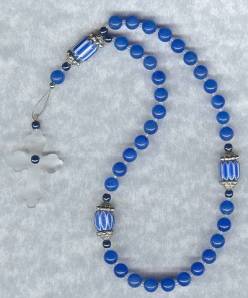
Prayerbeads
33 count for Protestant use

The Lord moves in mysterious ways.  As a good evangelical, I never thought I would be using prayer beads and saying the Jesus Prayer.  It started when an old friend decided he wanted to make me a set of beads.  It surprised me, but I said, “Why not?”

In my thinking, I laid down a single stipulation, I wasn’t open to a Catholic rosary, and wanted nothing to do with devotion to Mary.  So, he scrounged up his materials and fashioned me an Orthodox, or Anglican chaplet of 33 beads.  And they are beautiful.  I have other friends who are Orthodox and I’ve always had an affinity for their faith and practice.

Of course, I didn’t know how to blend them in my prayer times.  It seemed to be a tad peculiar for this “evangelical-charismatic” pastor to be using them. I felt like a grown man getting caught trying to ride his toddler’s tricycle. But since I was already familiar with the “Jesus Prayer”, and since I knew God wasn’t going to strike me down with lightning, I forged on ahead.

For many, the “prayer of the heart” or the “Jesus prayer” is understood as a practice of personal devotion, a response to Paul’s admonition to “pray unceasingly,” a prayer said with the lips which descends from the head into the heart. Our prayer is to become eventually so much a part of us that our very breathing, our very living becomes prayer.  At least that was the theory.  But, since I was unhappy with my prayer life on my own, I decided I had nothing to lose and so I gave it the green light.

The Jesus Prayer is this, “Lord Jesus Christ, Son of God, have mercy on me, the sinner.”  It is based on Mark’s account of the Pharisee and the Tax Collector.  I certainly could relate to the tax collector, especially with my battles with depression and bipolar disorder nipping at my heels.

I began praying, using the beads and the Jesus prayer.  Instinctively, I knew that I was about to learn something valuable.  But at first it was awkward.  I did not want it to become formal or religious.  I was wary of praying religiously.  I did not want to parrot a phrase to get some kind of “religious buzz”.  I was really cautious, with a somewhat skeptical eye on the whole affair.

What I found was a considerable breakthrough!  Using the prayer beads and focusing on just talking to the Lord began to be something I really, really wanted to do.  I found, improvising, I could adapt it to what was right for me.  I found that rather then being repetitive, it infused my time with insight and blessing.  The whole thing was like a track, a train track, that for the first time gave my prayer time structure and continuity.

As depressed and mentally ill Christians, we can be a bit unstructured and vague when it comes to praying and meditating on the Word.  For the most part, we can be pretty undisciplined people.  We require something a little different to help us in a relationship with the Lord.  I guess I want to challenge you, to experiment with this.

 Some links to help:

For general info: http://www.norian.org/jesus_prayer.html

Interesting–To try using the Jesus prayer, with “Cyber-beads”: http://www.kingofpeace.org/prayerbeads/trisagion.htm

From an artisan and a retail outlet:  http://www.blue-mariano.com/id16.html