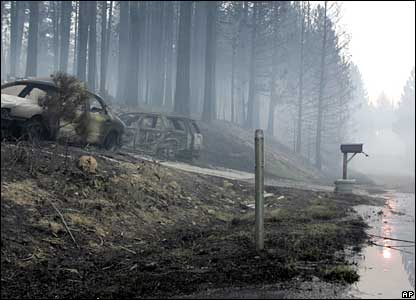
Charred Cinders

fire1
Aftermath of a forest fire in California

“When you pass through the waters, I will be with you;
And through the rivers, they will not overflow you.
When you walk through the fire, you will not be scorched,
Nor will the flame burn you.”

Isaiah 43:2, NASB

This will not be a typical commentary on this verse. (But it will be brief.)

The word I emphasize is “through.” I feel it is the salient point of the whole thought. Through implies a temporary state of being. We “pass through.” In a sense it is the state of being ‘between,’ and it is rarely, or ever comfortable.

Life is all about transitions– a job, children, marriage, health. We’re fine when things are steady and sure. However we feel the strain when things suddenly change. We are compelled to go through some things. Plain and simple. There are three simple things to think about.

  1. God is very present in those moments.
  2. Seldom do they vanish.
  3. They are never welcome.

The One who made the intricacies of our hearts stands by. Floods rage, trees float by. Fires get hot, and all becomes a blackened and charred cinder. Still God holds you. You will pass through this, and come out to the other side. Wiser and more compassionate.

recite-4295-45802551-tvf8xa (1)

Not for Sale!

not for sale

What is the most valuable thing that you possess? A gold locket, a grandfather clock, or a ring? With that clearly defined, would you then trade that item? How much– offered $50,000 or a $500,000, would you sell it? Consider Genesis 25:27-34.

27 As the boys grew up, Esau became a skillful hunter. He was an outdoorsman, but Jacob had a quiet temperament, preferring to stay at home. 28 Isaac loved Esau because he enjoyed eating the wild game Esau brought home, but Rebekah loved Jacob.

29 One day when Jacob was cooking some stew, Esau arrived home from the wilderness exhausted and hungry. 30 Esau said to Jacob, “I’m starved! Give me some of that red stew!” (This is how Esau got his other name, Edom, which means “red.”)

31 “All right,” Jacob replied, “but trade me your rights as the firstborn son.”

32 “Look, I’m dying of starvation!” said Esau. “What good is my birthright to me now?”

33 But Jacob said, “First you must swear that your birthright is mine.” So Esau swore an oath, thereby selling all his rights as the firstborn to his brother, Jacob.

34 Then Jacob gave Esau some bread and lentil stew. Esau ate the meal, then got up and left. He showed contempt for his rights as the firstborn.

Inserted into this conversation is a transaction of sorts– I give you this, for that. I’ve always read this straight, and had more questions than answers. I’m confused with how Esau could do such a stupid thing. Stew– for a “birthright”? What the ______? He’s a moron!

Then instead of straight I read this above passage and read into it a sense of humor. All of a sudden the situation came alive and the questions lifted. If Esau is joking, but Jacob is not it changes nothing. Esau is still a “dope.” But it explains how he trades the intangible and eternal for the edible and the temporary. “But I was just joking!”

Esau is left broken and sort of betrayed by Jacob. What he had was ripped off, and he had nothing to show for it. What he didn’t take seriously was by someone else. How often am I guilty of the same thing?

My own heirloom is precious. It is eternal. It is a relationship with God– intimacy with the Creator of my soul and of the universe. But I sell it off for something as trivial as a bowl of lentil stew. WHAT???!!! The enemy values what he does not possess. My salvation is real, and a precious gift. But Satan (my adversary) continually chips away at it, and I more or else could care less.

Esau scares me a bit. I am too much like him. I wear his sandals quite well. I ease up and dismiss what is real; I trade it for the world of illusory pleasure of the moment. I then must live with the consequences of my foolish choice. It is a bitter blow.

God forgives. When I do confess and repent a measure is retrieved for me. I choose to avoid the savory stew of the present and hold tight to my faith. It is the most precious thing I have.

“I am coming soon. Hold on to what you have, so that no one will take away your crown.”

Revelation 3:11, NLT

A Case of Exceptional Goodness

“He wouldn’t do it. He said to his master’s wife, “Look, with me here, my master doesn’t give a second thought to anything that goes on here—he’s put me in charge of everything he owns. He treats me as an equal. The only thing he hasn’t turned over to me is you. You’re his wife, after all! How could I violate his trust and sin against God?”

 “She pestered him day after day after day, but he stood his ground. He refused to go to bed with her.”

Genesis 39:9-10, MSG

Joseph is a blazing star in the Old Testament.  Everything he does is remarkable. He carries this exceptionalism into all that he does, or directs.  He realizes the blessing he has been given.  He can easily describe his status– and he is quite aware of the deep presence that overshadows his life.  He will not pretend that any of this has come about as a result of his personal giftedness or goodness.

Joseph refuses to negotiate, for he knows who he is, exactly.  First, he is not Potiphar. He cannot make it seem otherwise.  The amazing things that have come upon Potiphar’s life, belong to him, and him alone.  Joseph has a sure understanding of this fact, and he does not try to blur the issues, no matter how “sweet and cute” the possibilities. He just says “no!”

When we look to Joseph, we find that he has retreated into a special place of protection.  For a man, there is a deep attraction for sexual conquest and pleasure. Joseph has processed this, way before us. And he is not enticed by this lie.  (And my friend, it is a lie.)

Joseph is a wonder.  He is full of grace and a certain goodness.  From him, we can fully understand a heart that is set apart by an exceptional sweetness. Joseph has a certain kindness and goodness.  He responds to all that is evil, with a greatness, and a complete awareness of what is right.

In our scriptural selection, we see clearly the effort that the wife of Potiphar’s wife made to seduce Joseph.  However, her lust will not direct his life.  He will not give in to his deep desires.  He simply refuses to enter into the seduction issues of an out-of-control passion.  He won’t be controlled by lust.

When we look directly at Joseph, we see a man who has chosen a deep path of faithfulness. He has separated himself from a difficult darkness.  He now is a real and definite example for us who must endure a deep testing of our own.  The darkness we face is especially crafty and exceptionally black.  We can only really trust in His promise to cover and sustain us. And to learn to say no!

recite-19584--993243901-14ssdta