Landmine Warfare

Landmines are a very interesting form of warfare.  Buried and essentially unseen, they lay waiting for the enemy.  Trained as a Combat Engineer at Fort Leonard Wood, Missouri, I was taught that there were things to counteract other things like mines.  I knew how to operate a ‘minesweeper’.  I was also taught how to probe with a stick to find mines that could not be detected.  In the heat of an Ozark summer, I would be coated with a red mud after crawling on my belly through the Missouri dirt.

There are landmines in the Church. 

Buried they simply wait on a believer to step on it.  Wisdom would tell us to advance with caution, but the counsel is not always taken.   They only await our careless step.  We can know they exist, yet we can step on them without thinking.  It is a definite form of deception. There are definite things which can cripple us spiritually. landmine-little

Mines such as fear, doubt, unforgiveness, jealousy, lust, pride and selfishness lay waiting for us.  When you step on a mine, you’ll hear a distinct click.  This is the downward signal that you have engaged the mechanism of the mine.  At this point it gets grim.  It is highly unlikely that you can move quickly enough to get away from the explosion.

We are incredibly vulnerable to the mines of our walk as a believer.  However, the Holy Spirit holds the maps that can enable us to transverse that which is ahead of us.  His presence gives us a safe awareness to progress difficult ground.  He is there to direct us to pass through the danger.

Too many people are getting blown up. 

They make a misstep and the resulting blast is awful.  Unless we listen to the Spirit’s direction we will find ourselves in a very hard place, full of difficulty and danger.

We need the Holy Spirit to help us navigate difficult places. 

Without Him present we will step in places that are extremely detrimental, and very dangerous.  He must guide us, step by step, through the danger that surrounds us.  He will do this, if we only ask.


To Be Despised by All, but God

I’m working my way through Ezekiel in the Old Testament, and before that I was reading Jeremiah. These are challenging books to read and to apply to our daily lives. Here and there is a nugget with direct – and easy – application, but I think these books are there for a much bigger purpose. The Old Testament prophets show us what is important to God. As I read, I find that God is concerned with two things:

  1. That His people trust in Him, and not in idols of their own making. This seems reasonable, since He alone is trustworthy. An idol made of stone or gold – or as we often trust in these days, of paper in the form of money and stocks – cannot protect us or provide a sure and trustworthy future. Only God can do that.
  2. That His people care for the “widow and the orphan,” that is, the less fortunate of society who are in need of a helping hand. This seems reasonable, too, since those of us who have been blessed should not find it a burden to bless others in return.

These are simple principles. When asked what the greatest commandment was, Jesus echoed these two principles when He answered, “’Love the Lord your God with all your heart and with all your soul and with all your mind.’ This is the first and greatest commandment. And the second is like it: ‘Love your neighbor as yourself.’”

Matthew 22:37-38 (NIV).

And yet the prophets were hated and ridiculed for telling the Israelites that they would suffer and were suffering exile and death, war and famine, because they failed to follow these two simple principles. Instead of loving and trusting the God who had seen them through so much and protected them, they trusted in idols and the ways of their neighbors. Instead of loving their neighbors and caring for the downtrodden, they cared only for their own gain and gluttony. The Israelites were warned over and over by the prophets. I believe that the message of the prophets – that these two principles are paramount – is just as relevant for our world today as it was for ancient Israel.

The other day I received this wonderful quote in my Quotemeal email from Heartlight.org. I believe it illustrates not only the struggle the Old Testament prophets faced, but also the struggle those who trust in Christ alone for salvation and seek to share His expectation that we love our neighbors with the world face today.

“To be forged upon the anvil of God’s purpose, to be at once His hammer, His tongs, and His molten iron; to hear words that rend the heart, see visions that pierce the chest; to be emptied like an urn, again and again and again until one desires only rest, only an end to the refilling — and to know one cannot live without the refilling. To be given words that one dare not speak, and to feel those words churning and boiling in the belly until one must speak them aloud, or die. To be despised, soon or late, by everyone except Adonai — and to desire it so, while hating it. This is to be a prophet.”

— Thom Lemmons

I’m not suggesting that I am a prophet, but there have been times in my life when I was compelled to speak, or to write, words I did not wish to say or write. I have had words churn and boil in my mind and in my heart, felt the fear of saying or writing them, but had to push through that fear and let those words fly and land wherever God desires.

Just writing that last paragraph makes it seem all so dramatic, but really it just is. Sometimes I don’t push through the fear and I fail to share the words that are on my heart. Although I have not yet died as a result, a small part of my spiritual growth does whither. Perhaps my faith would be stronger and more souls would have been saved if I had always spoken up.

But, in the end, I know that God loves me and knows I am being sanctified daily, though sometimes more slowly than I would like.


Love, Linda


Linda’s blog is at http://lindakruschke.wordpress.com/.  Please check out all she has to say.  Linda tells me that it is absolutely guaranteed to bless, or your money back!


The Mystery of Each Other

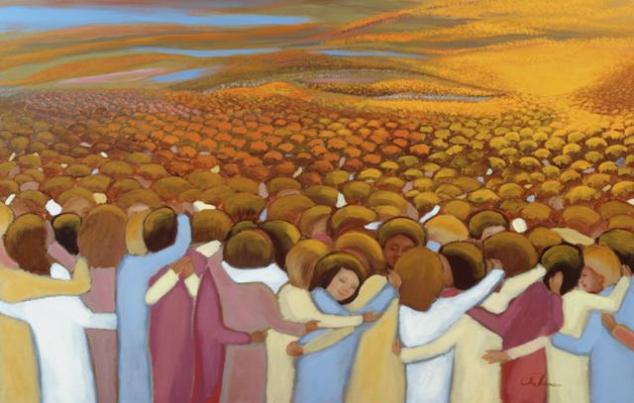
Communion_of_Saints
The Fellowship of the Saints

No one has ever seen God. If we love one another, God remains in us and his love is made complete in us.

1 John 4:12

As believers we should understand the mysterious substitution that has happened. Jesus has exchanged places with us, giving His righteousness in exchange for our sin.  Verses in 1 John make it clear. Every encounter we have with a brother is an encounter with Jesus.

Every brother, every sister is a rendezvous of wonderful significance. 

When we serve them, we are really serving the Lord Himself.  I guess it can also be a sobering experience if we should mistreat or neglect them.  What we say and what we do has consequences.

“The King will answer and say to them, ‘Truly I say to you, to the extent that you did it to one of these brothers of Mine, even the least of them, you did it to Me.’”

Matthew 25:40

There is no escaping the Gospel logic that our personal contact with each other carries an eternal weight.  Immaturity and pride keep us from seeing the delicate connections that believers have with each other, and perhaps suggesting a new basis for our relationships is a bit much to hope for.

Every believer is someone who will be covered in glory someday.

Without a complete mind removal renewal we will continue to see others as rivals or people to control.  We use the H.S. gifts to ascend rather than serve.  The disciples had to make their adjustments.  They were told that they were to lay it all down and wash each others feet.

We must begin to realize that when we touch someone, when we speak to a friend, we’re doing that to the Lord.  Every believer is someone who will be covered in glory someday.  We are to live out this wonderful mystery of Jesus living in our brother.  He is that close!

“To love someone means to see him as God intended him.”   

Fyodor Dostoevsky


f

Please, Don’t Find Fault

“Here Comes the Judge!”

“You may think you can condemn such people, but you are just as bad, and you have no excuse! When you say they are wicked and should be punished, you are condemning yourself, for you who judge others do these very same things.”

Romans 2:1, NLT

One of the spiritual diseases endemic to the Christian believer is “fault finding”. For some reason, (and I’m still trying to figure out why), is we have a strong inclination to pass a judgement on people (those whom Christ died for!)  We don’t throw stones (far be it from me)– however, we certainly do and will point fingers. And perhaps we feel that its our religious duty, or maybe even our ministry (!).

Almost always, there a sense of certain and attainable righteousness. or our generated holiness involved. This should not be dismissed or overlooked. Because I believe I am right, and have religious grounds, I put all of the “evil sinners” on trial, and then I pronounce my verdict. (And they certainly deserve whatever I decide.)

Much of the same type of thinking was used in Romans 2.  Paul castigates those who were judging others. He goes on a scathing and sizzling rebuke directly at those who were destroying others by their overly-righteous attitude.

” And we know that God, in his justice, will punish anyone who does such things. 3 Since you judge others for doing these things, why do you think you can avoid God’s judgment when you do the same things? 4 Don’t you see how wonderfully kind, tolerant, and patient God is with you? Does this mean nothing to you? Can’t you see that his kindness is intended to turn you from your sin?.”

Romans 2:3-4

Without a doubt this whole subject is highly complex and nuanced. Hundreds of verses should be worked through. But this blog is not that place. However, I will advance this– I read this written by the Desert Fathers.

“Correct and judge justly those who are subject to you, but judge no one else. For truly it is written: ‘Is not those inside the church whom are you to judge? God judges those who are outside’.

Macarius of Alexandria, 296-393 AD


A Simple Poem of a Quiet Wisdom

Pray, don’t find fault with the man who limps
Or stumbles along the road
Unless you have worn the shoes that hurt
Or struggled beneath his load
There may be tacks in his shoes that hurt,
Though hidden away from view
Or the burden he bears, placed on your back,
Might cause you to stumble, too.
Don’t sneer at the man who’s down today
Unless you have felt the blow
That caused his fall, or felt the same
That only the fallen know.
You may be strong, but still the blows
That were his, if dealt to you
In the self same way at the self same time,
Might cause you to stagger, too.
Don’t be too harsh with the man who sins
Or pelt him with words or stones,
Unless you are sure, yea, doubly sure,
That you have no sins of your own.
For you know perhaps, if the tempters voice
Should whisper as soft to you
As it did to him when he went astray,
‘Twould cause you to falter, too.


r