To Be Despised by All, but God

I’m working my way through Ezekiel in the Old Testament, and before that I was reading Jeremiah. These are challenging books to read and to apply to our daily lives. Here and there is a nugget with direct – and easy – application, but I think these books are there for a much bigger purpose. The Old Testament prophets show us what is important to God. As I read, I find that God is concerned with two things:

  1. That His people trust in Him, and not in idols of their own making. This seems reasonable, since He alone is trustworthy. An idol made of stone or gold – or as we often trust in these days, of paper in the form of money and stocks – cannot protect us or provide a sure and trustworthy future. Only God can do that.
  2. That His people care for the “widow and the orphan,” that is, the less fortunate of society who are in need of a helping hand. This seems reasonable, too, since those of us who have been blessed should not find it a burden to bless others in return.

These are simple principles. When asked what the greatest commandment was, Jesus echoed these two principles when He answered, “’Love the Lord your God with all your heart and with all your soul and with all your mind.’ This is the first and greatest commandment. And the second is like it: ‘Love your neighbor as yourself.’”

Matthew 22:37-38 (NIV).

And yet the prophets were hated and ridiculed for telling the Israelites that they would suffer and were suffering exile and death, war and famine, because they failed to follow these two simple principles. Instead of loving and trusting the God who had seen them through so much and protected them, they trusted in idols and the ways of their neighbors. Instead of loving their neighbors and caring for the downtrodden, they cared only for their own gain and gluttony. The Israelites were warned over and over by the prophets. I believe that the message of the prophets – that these two principles are paramount – is just as relevant for our world today as it was for ancient Israel.

The other day I received this wonderful quote in my Quotemeal email from Heartlight.org. I believe it illustrates not only the struggle the Old Testament prophets faced, but also the struggle those who trust in Christ alone for salvation and seek to share His expectation that we love our neighbors with the world face today.

“To be forged upon the anvil of God’s purpose, to be at once His hammer, His tongs, and His molten iron; to hear words that rend the heart, see visions that pierce the chest; to be emptied like an urn, again and again and again until one desires only rest, only an end to the refilling — and to know one cannot live without the refilling. To be given words that one dare not speak, and to feel those words churning and boiling in the belly until one must speak them aloud, or die. To be despised, soon or late, by everyone except Adonai — and to desire it so, while hating it. This is to be a prophet.”

— Thom Lemmons

I’m not suggesting that I am a prophet, but there have been times in my life when I was compelled to speak, or to write, words I did not wish to say or write. I have had words churn and boil in my mind and in my heart, felt the fear of saying or writing them, but had to push through that fear and let those words fly and land wherever God desires.

Just writing that last paragraph makes it seem all so dramatic, but really it just is. Sometimes I don’t push through the fear and I fail to share the words that are on my heart. Although I have not yet died as a result, a small part of my spiritual growth does whither. Perhaps my faith would be stronger and more souls would have been saved if I had always spoken up.

But, in the end, I know that God loves me and knows I am being sanctified daily, though sometimes more slowly than I would like.


Love, Linda


Linda’s blog is at http://lindakruschke.wordpress.com/.  Please check out all she has to say.  Linda tells me that it is absolutely guaranteed to bless, or your money back!


Seeking Truth

Look for It

Words matter. Our choice of words, whether speaking or writing, makes a difference.

And words have meaning. That’s what dictionaries are for—to tell us what words mean. When we try to use words to mean something other than what they really mean, it causes confusion.

Sometimes people do this on purpose. One such misuse of a word that I have encountered lately is the use of the word “true” to substitute for “believe.” A person will say “such and such is true for me” when what they really mean is “I believe such and such.”

According to the dictionary, the word “true” means “being in accordance with the actual state or conditions; conforming to reality or fact.” Truth is not relative and is not affected by what any one person believes. Truth is external, and belief is internal, in origin.

Many years ago, when I was suffering from major clinical depression, there were a number of things I believed about myself. I believed I would always be depressed based on how long I had been depressed already and my doctor telling me I would always have bouts of major depression for the rest of my life. I also believed I would never be able to hold down a full-time job. I believed no one liked me and that I was worthless. In the parlance of relativism, these things were true for me.

But they weren’t true. They aren’t true and they never were, no matter how deeply I believed them.

And trust me, I deeply believed these things about myself.

But here I am, 18 years later, and I haven’t had a bout of major depression since God showed me how to be free. I’ve had the same good-paying full-time job for almost 12 years, and I had a different full-time job that paved the way for this one for 5 1/2 years before that. On top of my full-time job, I’m actively involved in my church and Bible Study Fellowship, have self-published two poetry books, and take care of my family. And I have a lot of friends, people who like me (and some who even love me).

As I look back over the past 20 years, I see God’s hand in my life, lifting me up and leading me to see the truth. I believe that. But it’s not my belief that makes it true. In fact, I could be dead wrong, but I don’t believe I am.

Whether God is real and cares about His creation enough to do all I believe He has for us is either true or not. It can’t be true for me and not for you, or vice versa. Truth is. As humans, our greatest purpose is to seek the truth. To say that truth is relative—that what is objectively true for me is different from what is objectively true for you—negates that essential human drive to know truth, to know our Creator, to know where we come from, and to know our reason for being.

At any rate, that’s what I believe.

Love,

Linda K.

Check out Linda’s site at: anchoredvoices.com.

To Pray without Ceasing

Brother Lawrence once wrote: “There is not in the world a kind of life more sweet and delightful than that of a continual conversation with God.” That’s easy for a monk to say. What did Brother Lawrence have to do all day but be in “continual conversation with God.” But how does one do that with a full time job, a family, and numerous other commitments, not to mention the struggles of illness and other trials this world throws at us?

In our never-slow-down world, the idea of continually conversing with God seems radical.

And yet, scripture calls us to do what Brother Lawrence suggests. 1 Thessalonians 5:17 says, “pray continually,” “pray without ceasing,” or “Never stop praying,” depending on the translation you choose. I love this verse, but I used to have a hard time figuring out how to put it into practice.

Do you think of prayer as the time during which you stop to ask God for all the things you need or want, and tell Him about your family and friends who are sick or in trouble, and plead with Him to fix all your problems? Is this but a brief time after which you get up and go about your day? If so, then you may struggle with the concept of continual conversation with God.

One day it occurred to me that this is the wrong way to think about prayer. Instead, I began to equate prayer to spending time with my best friend. When I spend time with a good friend, we can both be in the same room doing different things and not even talking. But I always know that if I have something to say then my friend will listen. And if my friend says something to me, I will be there to hear.

God’s Word tells me that He is always there for me; He is everywhere and wherever I am. If I always remember that, then I can easily “pray without ceasing.” Wherever I am, if I need someone to talk to He will listen because He is my friend. I also need to be aware that He may have something to say to me, so I should be ready to listen to that “small still voice.” Continual prayer doesn’t require constant words; it requires only continual awareness of the presence of God. In this way, even the busiest life can be sweet and delightful.

Sorry, Not Sorry

Have you ever heard someone say those words? “Sorry, not sorry.” It’s kind of annoying. It’s said following a statement or action the speaker knows is unkind or won’t be appreciated by someone else, but they just don’t care. It’s worse than not saying sorry at all.

We humans have a terrible time admitting when we are in the wrong. There’s always some justification for our actions, often that we were wronged first, or we had no choice, or some such nonsense. Misunderstandings escalate into disagreements, which quickly become heated arguments, and nobody really wins in the end. Sometimes good friends end up enemies, all because no one will say those two simple, yet truly difficult, words: “I’m sorry.”

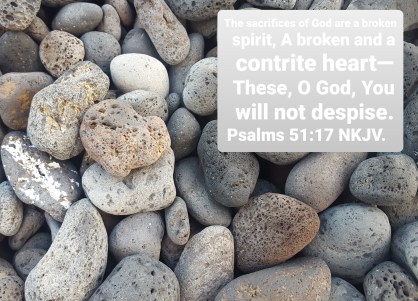
We sometimes have the same problem with God. We know we have not acted as we should, but we can’t let go of pride and say we are sorry. Scripture reveals the truth: a contrite heart is all God wants from us. He desires for us to admit when we’ve missed the mark.

The stories of King David and King Saul illustrate this principle. Both were in the wrong. David committed adultery, and then had the husband of the woman he slept with sent to the front lines of a battle, knowing he would be killed. But when the prophet Nathan brought David’s transgressions to his attention, David’s response was a remorseful attitude. He immediately fell to his knees and confessed his sin. And God forgave David.

Saul, on the other hand, committed a transgression that seems much less serious. He counted his army. Doesn’t sound like much of a sin, does it? But the heart of Saul’s transgression was a lack of trust in God. He didn’t believe he would win a battle even though God had promised him victory. Not only did Saul not trust God, he refused to confess his lack of trust. Instead he made excuses, tried to justify his actions. As a result, God took away Saul’s kingdom and gave it to David. And God did not forgive Saul.

David is remembered as a man after God’s own heart in spite of his many sins because a relationship with God was most important to him. Saul is not remembered so kindly.

What have we lost because we refuse to say we are sorry? A kind word, an admission of our own contribution to a dispute, can go a long way toward healing relationships. Is there someone you need to say “I’m sorry” to today? What’s holding you back? Is it a stubborn nature, like what often holds me back? What do you have to lose? What do I have to lose? More importantly, think what we have to gain.

What about your relationship with God? Is there some transgression you need to confess to restore the intimacy you once enjoyed with your Savior? What do you have to lose? You have the best God intends for you to gain.