In Pursuit of Happyness

By CARONAE HOWELL, From the New York Times, dated July 20, 2009

flight1
To fly away

I’m the kind of woman who spends entire days thinking of nothing but birds: woodcocks, goldfinches, kingfishers. I look for loons everywhere I go. Sometimes I find herons in Central Park and they are mysteries. There is one thing in this world that I envy: the hollowness of bird bones. In the three milliseconds of liftoff, a bird separates itself from its problems. The sky is the freest part of the world.

I have always been depressed, and I have always wanted to fly — not to emulate Superman or to travel faster. I want to fly because of the elation. In my dreams I am a butterfly or a fairy or a honeybee. Depression, for me, is when you want to be a bird, but can’t.

There is a specific moment in which I became a woman. It was February — always the worst month with its aching light and its slip-induced bruises. I had been trying to fall asleep for at least four hours. At 3 a.m., I found myself sobbing and shaking and confused, sitting on my metal dorm bed in the bird-with-a-­broken-wing position. I dug my fingernails into my forearms, leaving shell-shaped trenches behind. I have the kind of skin that refuses to heal, just stays eternally raw and mottled. It was five weeks into my fourth semester.

In late January, a freshman hanged himself in my old dorm. I found myself asking, really, how hard is it to suddenly find yourself perched on a sink, rope around your beautiful neck, ready to fly? How hard? My dad drove through four states to pick me up the next week. On the way home I had tea and ice cream. He asked me if I remembered the time he took too many of his antidepressants. I did not. Nor did I remember my uncle’s suicide (gun to the cerebrum) or my sister’s delicately sliced arms and hips. These were things I had only been told. The space between my skull and my irises hurts sometimes — hurts like the shatter of a tiny bird that has fallen midflight.

And so it was that sour February night that I took the delicate step into the adult world: realizing that I was too depressed to stay at college was realizing I had not only lost my flock; I had fallen from the air entirely. Michigan has many birds. My favorite might be the wood duck, with its banded neck and flat little wings. When I watch birds take off, I hold my breath. They always make it to the sky.

Every Monday morning at 9 I see my therapist, mug of green tea and honey close at hand. I take new pills now. I have a routine: oatmeal in the morning, Wednesday nights with my father. I tell my therapist about Toni Morrison’s “Song of Solomon.” Who isn’t searching for their people? I arrange my thoughts. (No, I have never been in love and I am, in fact, afraid of men; I panic in Times Square; I grow attached to almost everyone I meet.) I have feathers and questions.

I moved to New York City for college in 2007. School did not grow me into an adult, nor did voting for the first time or doing my own banking. These things were not confrontations. How did I arrive at the place where I could look at my disease and say, “Yes, you are here, but I will not let you take the joy out of looking for birds”? I like to think it was New York, or my newfound discipline, but it was a more internal revolution. I acknowledged my traumas: I was not crazy, just damaged. I was molting. Columbia gave me many new things: a copy of the “Iliad” with a note saying the first six books should be read before orientation, a job in the oral history office, a sense of time management.

But without my sanity — without joy — these things had little value. I knew nothing until I knew I was hardly living. Hobbes and Locke and all the philosophers in the world could not matter when each day was insurmountable and burning. In my year and a half at Columbia, I began to learn how to love myself. I tell my therapist about my earliest memories and the bizarre geography of my family. I’m anxious and I have no self-esteem. But I am mending. Fifteen lost credits is a small price to pay for happiness. Perhaps I am learning how to fly. My bones may not be hollow, and joy will never come easily, but the beauty is in the struggle. The birds are everywhere.

Caronae Howell, Columbia, class of 2011, history major

Depression and Diabetes

DepressionCaseStudy_clip_image001For some reason lately I’ve been thinking about the similarities between diabetes and depression. I know that depression can be one of the complications of diabetes, but that is something I learned only when I did a little research about diabetes and isn’t what I want to share about these two diseases.

I do not have diabetes, but I do know people who do. Diabetes is a disease for which there is no “cure,” though there are treatments that can minimize the symptoms and complications that can arise from this disease. Some people with diabetes do a great job of taking such good care of themselves and following their doctor’s orders that they are virtually symptom free. You would never know they had diabetes unless they told you. I’ve known other diabetics who don’t follow doctor’s orders, and the outcome was terrible.

Dealing with diabetes is not an easy road. For people with Type 2 diabetes, a strict diet and exercise are a must, and monitoring blood sugar levels is essential. For people with Type 1 diabetes, insulin injections are also necessary because their bodies do not produce any of this necessary hormone. It is a lifelong affliction, the potential effects of which can be minimized but never forgotten or ignored.

I believe that for some people depression is similar to diabetes in that it is never cured. These people are prone to depression, and may have suffered through one or more episodes of major depression in their lives. From a statistical standpoint, a person who has had more than two major depressive episodes is highly likely to have another in their lifetime. But it isn’t inevitable that they will. Just as the symptoms of diabetes can be prevented or minimized with careful management, so the symptoms of depression can be prevented or minimized with proper care.

Caveat: I am not a doctor and this post is not intended as medical advice. It simply an observation that has been on my mind lately and is helpful for me in understanding my own challenges to keep depression at bay.

There are some people who, like the person with Type 1 diabetes, need medication to help keep them stable and to prevent major depression from setting in. (Though this may be a small percentage, just as Type 1 diabetes is much rarer than Type 2.)  But everyone who struggles with depression can help prevent or minimize the effects of a relapse by taking steps to truly care of themselves. Diet and exercise can be part of this self-care, but for the person who lives with the knowledge of depression there is a mental and spiritual component of their self-care that goes beyond what is required of the diabetic.

Many years ago the doctor I was seeing told me I would be on antidepressants for the rest of my life. Having now been off them for 13 years and not suffered another major depressive episode in all that time, I think I can safely say she was wrong. But in the last few years I have come to understand that I am one of those people who cannot take for granted that depression is strictly a part of my past. It is forever a part of who I am and I must never forget the misery it has caused me and could cause me again if I do not take care of my mental and spiritual health.

For me, warding off a relapse of depression requires that I choose to engage in regular prayer time; to listen to music that is encouraging and uplifting, and avoid music that is depressing; to talk to a Christian friend if something is bothering me; to take a periodic inventory of my own actions and attitudes, and correct any that are negative; and to trust in the Holy Spirit to guide my thoughts, putting on the whole armor of God. When I do these things, I can live in such a way that others would never know that depression is a part of my life. But if I neglect these things for too long, I will soon detect the specter of depression looming in my heart and in my mind, and the outcome will be terrible.

Just as the diabetic can never forget that they have diabetes and neglect their diet and health regimen, I can never forget that depression is ever a part of me and neglect my mental and spiritual regimen. I must be ever vigilant and cling to Jesus as my Rock, trusting in His promises, and following His commands and precepts to love, forgive, and be content.


ysic, Linda K.


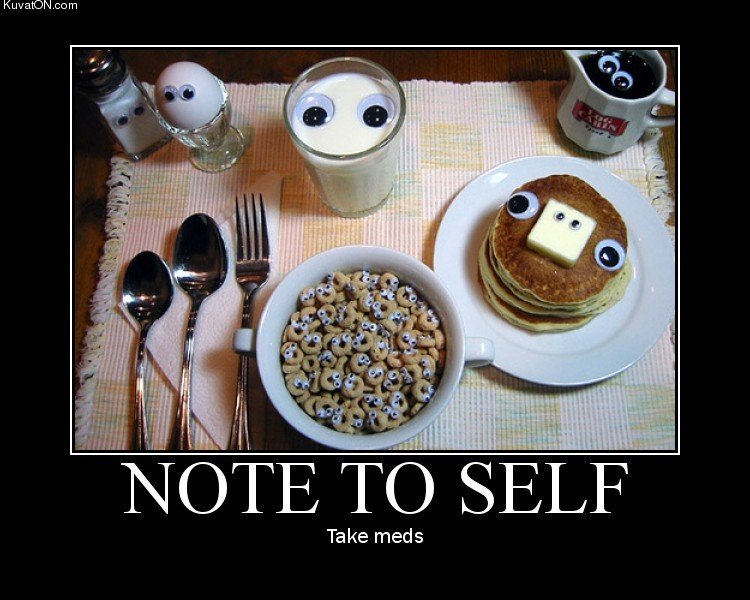
I Guess It’s Time for Meds: Funny Pic


Just a little something to lighten your day.  Hope all is well and if you’d like prayer for anything please let me know.