Hell and Hope

inferno

Sometimes, I feel like a tour guide for believers that are walking through hell. I point out the different strugglers, and urge each one not to linger too long but to keep moving. We look on those trapped (they have no hope within them) but we hope that they are yet to reach out for the Savior. It is distressing, and yet somehow we understand them just a little bit.

Our journey out and down each sad corridor can be painfully disturbing for us. There are so many different types of prisons and chains used to confine and control. Dante wrote his “Inferno” (Italian, for hell), and somehow he in some curious way walks through the different levels (varieties) of hell with us. Virgil (Dante’s own tour guide) takes Dante through some pretty hairy stuff, and they pass through the very gate, which bears an inscription, of the infamous phrase “Lasciate ogne speranza, voi ch’intrate“, or “Abandon all hope, ye who enter here.”

Our own rescue from this dreadful place is based on that singular word, “hope”. Somehow, hope has distilled inside us, and that alone can enable us to walk out as the freed. We have chosen not to abandon hope, but to use it as our passport out of the bottom of hell itself. We show it to each guardian, and then pass through without any hinderance.

  • And so at last the poor have hope. (Job 5:16)
  • Having hope will give you courage. You will be protected and will rest in safety. (Job 11:18)
  • Lord, you know the hopes of the helpless. Surely you will hear their cries and comfort them. (Ps. 10:17)
  • All day long I put my hope in you. (Ps. 25:5)
  • Let your unfailing love surround us, Lord, for our hope is in you alone. (Ps. 33:22)
  • O Lord, you alone are my hope. (Ps. 71:5)
  • Your word is my source of hope. (Ps. 119:114)
  • “Listen to me, all who hope for deliverance— all who seek the Lord!” (Isa. 51:1)
  • And his name will be the hope of all the world.” (Matt. 12:21)
  • Even when there was no reason for hope, “Abraham kept hoping.” (Rom. 4:18)
  • We, too, wait with eager hope. (Rom. 8:23)
  • Rejoice in our confident hope. (Rom. 12:12)
  • The Scriptures give us hope and encouragement as we wait. (Rom. 15:4)
  • Three things will last forever—faith, hope, and love. (1 Cor. 13:13)
  • That you can understand the confident hope he has given us. (Eph. 1:18)
  • Our hope is in the living God, who is the Savior of all. (1 Tim. 4:10)
  • In order to make certain that what you hope for will come true. (Heb. 6:11)
  • This hope is a strong and trustworthy anchor for our souls. (Heb. 6:19)
  • Let us hold tightly without wavering to the hope we affirm. (Heb. 10:23)
  • They placed their hope in a better life after the resurrection. (Heb. 11:35)
  • You have placed your faith and hope in God. (1 Pet. 1:21)
  • If someone asks about your Christian hope. (1 Pet. 3:15)

I suppose we must say (it’s clear) that hope is what sets us free from the difficulty that rests in our minds. Whatever DSM-IV has branded us, whatever a psychiatrist has declared us to be, and whatever our therapist has told us– our hope, that’s in Christ, will open all doors that are closed and locked.

Hope really is the Christian’s freedom from hell. Those of us who have been freed from our incarceration from our mental illness are amazingly liberated. I know the lostness of being very much lost. But hope is everything. When our hope somehow connects with Jesus, our souls are set free. We walk out of hell, with our souls soaring clean.

kyrie elesion, Bryan

*

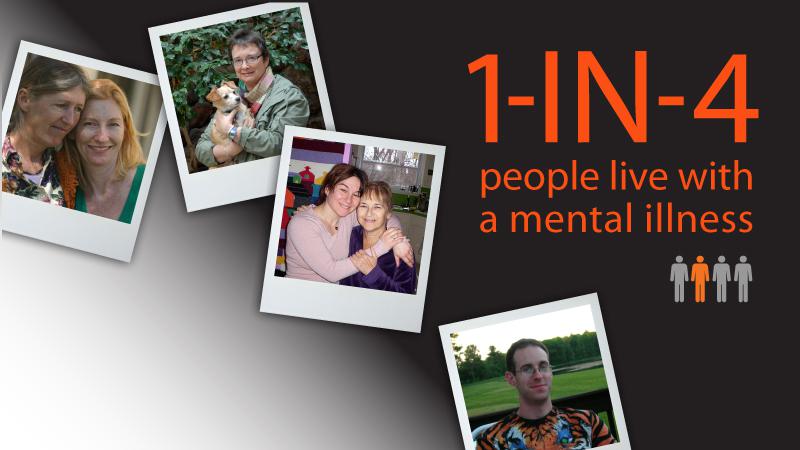
1 in 4 Church Homes Are Dealing With This!

By Carlene Hill Byron

How many families in your church have a loved one who struggles with mental health problems? That’s kind of a trick question. People don’t talk about mental health problems. You’re more likely to hear them describe their child’s condition as “something like autism,” as the elder of one church we know says.

Or they might cover up entirely, as does an elder’s wife in another congregation. When her bipolar disorder swung into mania after childbirth, her family, already managing the added responsibilities of a newborn, had to manage her condition as well. But because her condition is a secret, they did so without any support beyond the usual “new baby” dinners.

The answer to the question is, if your congregation is representative of the U.S. population, one in four households will struggle with someone’s mental health problems over their lifetime. That’s schizophrenia, bipolar disorder, obsessive compulsive disorder, disabling chronic depression, and various anxiety disorders.  Look at the faces seated around you this Sunday.  Someone is probably hurting. And they’re probably afraid to tell you.

The least acceptable disability

Schizophrenia2
Out of Control

A study where people ranked disabilities by their “acceptability” returned these results, in order–most acceptable: obvious physical disabilities, blindness, deafness, a jail record, learning disabilities, and alcoholism.

Least acceptable: mental health problems. People with mental health problems frighten us because when people become mental ill, they become someone we don’t know. A bright boy who was his family’s bright hope may find he just can’t cut it anymore as schizophrenia turns him paranoid, disoriented, unmotivated in the extreme, and overwhelmed by delusional voices that tell him, over and over, how worthless he is.

Or, in the case of bipolar disorder, a girl who was a well-liked and active member of her Teen Challenge group may suddenly turn promiscuous, run away from home, and make a new home in the streets of a strange city. Laziness. Promiscuity. Violence. Sin. That’s what many people see when they look at those with mental health problems. It’s hard to believe that people may behave in such unacceptable ways and not be in control of their behavior.

Having a mental health problem is a lot like being on alcohol or drugs, without being able to stop. Medications “work” for about two-thirds of us. That means that a third of us can’t ever get off the chemical ride that our brains produce.

For those of us who can use medications, the side effects can be daunting. I have lost about 20 percent of my small motor functionality as a result of one of the five medications I take for bipolar disorder. I prefer that to losing large motor control and having another auto accident, being so disoriented I can’t find my way home from the store, losing bowel control in a busy bookstore, gaining 45 pounds, or any of dozens of side effects I’ve experienced on other medications.

Many people become so frustrated with side effects that they stop taking medications. Only about half of us accept treatment. Even when we are treated, not everyone regains their status as a fully functioning adult. In our extended family, six people have diagnoses. Those with bipolar disorder and chronic depression are successfully medicated and work full-time. Those with panic disorder and schizophrenia are on permanent disability. Nothing has pulled them through.


What the Bible says

The Bible talks about mental illness, as well as physical illness.

  • It describes a king who was made mentally ill until he would recognize the sovereignty of God (Dan. 4:29-34).
  • It describes demonized men who lived among the tombs and terrorized everyone until Jesus set them free (Matt. 8:28-33).
  • It also describes as demonized a young boy that most scholars today say had epilepsy (Matt. 17:15-18). Jesus delivered him, too.
suicide_germs
What was once believed

What does this tell us about illness?

First, that God is able to heal. Second, that some physical and mental illnesses are caused by demons. Third, that some mental illnesses are caused by sin. But are all mental illnesses caused by demons or sin, and is seeking God our sole resource for physical and mental healing?

Since the 1950s, we have usually sent church members with epilepsy to doctors for effective treatment with anti-convulsant drugs. In a similar way, we’ve learned that medicines can effectively treat many cases of mental illness. So if all mental illnesses were caused by demons and sin, medicine would be exorcising demons and turning hearts to repentance. That is certainly untrue, for those are the works of the Holy Spirit.

Instead, we now know that most if not all mental illnesses are biological in origin, with environmental factors possibly triggering an existing genetic predisposition to the illness. Mental illnesses, just like epilepsy, are biological disorders of the brain.

What can the church do?

Compassionate service is one of our core charges as Christians. We observe it almost daily in the experience of one man we know with schizophrenia. His life is confined almost entirely to his home due to the fear, indecision, and lethargy that have become the shape of the illness in his body. But neighbors bring him occasional meals. The secretary of his small church talks to him by telephone every weekday. Several other members take weekly calls at designated times to help break his isolation. If he doesn’t feel up to driving to his Bible study meeting or Sunday services, some member will give him a ride. Nearby relatives help him plan and manage his finances, and come by to clean occasionally and for DVD “movie nights.” Phone cards given as gifts allow him to call his mother nightly. There’s much more that could be done—more frequent house cleaning and more meals and more visits—but he enjoys far more contact with many more loving people than many shut-ins.

The challenging good news is that when people with mental illness turn to someone outside “the system” for help, the church is first to get the call 40 percent of the time. Is your church ready?

…………………..

Carlene Hill Byron is the former Director of Communications for Vision New England. Through NAMI—the Nation’s Voice on Mental Illness, she and her husband, James, train churches to effectively serve people within the congregation with mental health problems and also teach NAMI’s class for families of people with mental health problems. They are members of Asbury United Methodist Church in Raleigh, North Carolina, where James serves on staff. First published by Vision New England’s Ministries with the Disabled, Acton, Massachusetts.

http://www.mentalhealthministries.net/index.html

Getting Both Barrels

Dual Diagnosis of Mental Illness and Substance Abuse

Drugs & booze are deadly

Dual diagnosis services are treatments for people who suffer from co-occurring disorders — mental illness and substance abuse. Research has strongly indicated that to recover fully, a consumer with co-occurring disorder needs treatment for both problems — focusing on one does not ensure the other will go away. Dual diagnosis services integrate assistance for each condition, helping people recover from both in one setting, at the same time.

Dual diagnosis services include different types of assistance that go beyond standard therapy or medication: assertive outreach, job and housing assistance, family counseling, even money and relationship management. The personalized treatment is viewed as long-term and can be begun at whatever stage of recovery the consumer is in. Positivity, hope and optimism are at the foundation of integrated treatment.

How often do people with severe mental illnesses also experience a co-occurring substance abuse problem?

There is a lack of information on the numbers of people with co-occurring disorders, but research has shown the disorders are very common. According to reports published in the Journal of the American Medical Association (JAMA):

  • Roughly 50 percent of individuals with severe mental disorders are affected by substance abuse.
  • Thirty-seven percent of alcohol abusers and 53 percent of drug abusers also have at least one serious mental illness.
  • Of all people diagnosed as mentally ill, 29 percent abuse either alcohol or drugs.

The best data available on the prevalence of co-occurring disorders are derived from two major surveys: the Epidemiologic Catchment Area (ECA) Survey (administered 1980-1984), and the National Comorbidity Survey (NCS), administered between 1990 and 1992.

Results of the NCS and the ECA Survey indicate high prevalence rates for co-occurring substance abuse disorders and mental disorders, as well as the increased risk for people with either a substance abuse disorder or mental disorder for developing a co-occurring disorder. For example, the NCS found that:

  • 42.7 percent of individuals with a 12-month addictive disorder had at least one 12-month mental disorder.
  • 14.7 percent of individuals with a 12-month mental disorder had at least one 12-month addictive disorder.

The ECA Survey found that individuals with severe mental disorders were at significant risk for developing a substance use disorder during their lifetime. Specifically:

  • 47 percent of individuals with schizophrenia also had a substance abuse disorder (more than four times as likely as the general population).
  • 61 percent of individuals with bipolar disorder also had a substance abuse disorder (more than five times as likely as the general population).

For the rest of this article, go to NAMIhttp://www.nami.org/Template.cfm?Section=By_Illness&Template=/TaggedPage/TaggedPageDisplay.cfm&TPLID=54&ContentID=23049

*****************

Grade Your State

Our national mental health care system is in crisis. Long fragile, fragmented, and inadequate, it is now in serious peril. In 2003, the presidential New Freedom Commission presented a vision for a life-saving, recovery-oriented, cost-effective, evidence-based system of care. States have been working to improve the system, but progress is minimal.

Today, even those states that have worked the hardest stand to see their gains wiped out. As the country faces the deepest economic crisis since the Great Depression, state budget shortfalls mean budget cuts to mental health services.

The country as a whole was graded D. No states received an A grade, and only six (Connecticut, Maine, Maryland, Massachusetts, New York and Oklahoma) received a B. Eighteen states got C’s, a whopping 21 got D’s – and 6 states (Arkansas, Kentucky, Mississippi, South Dakota, West Virginia and Wyoming) got a failing grade – F.  The state I live in,  Alaska, received a D.

To see your states report card, go to http://www.nami.org/gtsTemplate09.cfm?Section=Grading_the_States_2009

The budget cuts are coming at a time when mental health services are even more urgently needed. It is a vicious cycle that destroys lives and creates more significant financial troubles for states and the federal government in the long run.

One in four Americans experience mental illness at some point in their lives. The most serious conditions affect 10.6 million people. Mental illness is the greatest cause of disability in the nation, and twice as many Americans live with schizophrenia than with HIV/AIDS.

We know what works to save lives and help people recover. In the face of crisis, America needs to move forward, not retreat. We cannot leave our most vulnerable citizens behind.

NAMI was the source of this study, you can see it at: http://www.nami.org/Content/NavigationMenu/Grading_the_States_2009/Overview1/Overview.htm