•When workers with depression were treated with prescription medicines medical costs declined by $882 per employee per year and absenteeism dropped by 9 days (Health Economics).
•Half of all lifetime cases of mental illness begin by age 14, three-quarters by age 24. Treating cases early could reduce enormous disability, before mental illnesses become more severe.
•One in four adults experiences a diagnosable mental disorder in any given year, including our returning troops. One in ten children has a serious mental or emotional disorder.
•Suicide is the third leading cause of death for America’s youth ages 15-24. More youth and young adults die from suicide than from cancer, heart disease, AIDS, birth defects, stroke, pneumonia, influenza, and chronic lung disease combined. The vast majority of those who die by suicide have a mental illness-often undiagnosed or untreated.
•Our jails and prisons are now the largest psychiatric wards in the nation, housing well over 350,000 inmates with serious mental illness compared to approximately 70,000 patients with serious mental illness in hospitals.
•One out of every five community hospital stays involves a primary or secondary diagnosis of mental illness.
The World Health Organization estimates that approximately 1 million people die each year from suicide. What drives so many individuals to take their own lives? To those not in the grips of suicidal depression and despair, it’s difficult to understand. But a suicidal person is in so much pain that he or she can see no other option.
Suicide is a desperate attempt to escape suffering that has become unbearable. Blinded by feelings of self-loathing, hopelessness, and isolation, a suicidal person can’t see any way of finding relief except through death. But despite their desire for the pain to stop, most suicidal people are deeply conflicted about ending their own lives. They wish there was an alternative to committing suicide, but they just can’t see one.
Suicide is not chosen; it happens when pain exceeds resources for coping with pain.
Because of their ambivalence about dying, suicidal individuals usually give warning signs or signals of their intentions. The best way to prevent suicide is to know and watch for these warning signs and to get involved if you spot them. If you believe that a friend or family member is suicidal, you can play a role in suicide prevention by pointing out the alternatives, showing that you care, and getting a doctor or psychologist involved.
Common Misconceptions about Suicide
FALSE: People who talk about suicide won’t really do it.
Almost everyone who commits or attempts suicide has given some clue or warning. Do not ignore suicide threats. Statements like “you’ll be sorry when I’m dead,” “I can’t see any way out,” — no matter how casually or jokingly said may indicate serious suicidal feelings.
FALSE: Anyone who tries to kill him/herself must be crazy.
Most suicidal people are not psychotic or insane. They must be upset, grief-stricken, depressed or despairing, but extreme distress and emotional pain are not necessarily signs of mental illness.
FALSE: If a person is determined to kill him/herself, nothing is going to stop him/her. Even the most severely depressed person has mixed feelings about death, wavering until the very last moment between wanting to live and wanting to die. Most suicidal people do not want death; they want the pain to stop. The impulse to end it all, however overpowering, does not last forever.
FALSE: People who commit suicide are people who were unwilling to seek help . Studies of suicide victims have shown that more then half had sought medical help within six month before their deaths.
FALSE: Talking about suicide may give someone the idea.
You don’t give a suicidal person morbid ideas by talking about suicide. The opposite is true –bringing up the subject of suicide and discussing it openly is one of the most helpful things you can do.
Can a Christian believer attempt suicide? My own first-hand experience rings out a resounding YES! We can be so driven by major depression that it effects our relationship with the God who loves us and pushes us into a place of complete hopelessness. Very often, it is an attack by evil upon our lives.
Suicide is not a mental illness in itself, but a serious potential consequence of many mental disorders, particularly major depression.
Who is most likely to commit suicide? Suicide rates are highest in teens, young adults, and the elderly. People over the age of 65 have the highest rate of suicide. Although women are more likely to attempt suicide, men are more likely to be successful.
Suicide risk also is higher in the following groups:
•Older people who have lost a spouse through death or divorce
•People who have attempted suicide in the past
•People with a family history of suicide
•People with a friend or co-worker who committed suicide
•People with a history of physical, emotional, or sexual abuse
•People who are unmarried, unskilled, or unemployed
•People with long-term pain, or a disabling or terminal illness
•People who are prone to violent or impulsive behavior
•People who have recently been released from a psychiatric hospitalization (This often is a very frightening period of transition.)
•People in certain professions, such as police officers and health care providers who work with terminally ill patients
•People with substance abuse problems
What are the warning signs for suicide? Following are some of the possible warning signs that a person may be at risk for suicide:
•Excessive sadness or moodiness — Long-lasting sadness and mood swings can be symptoms of depression, a major risk factor for suicide.
•Sudden calmness — Suddenly becoming calm after a period of depression or moodiness can be a sign that the person has made a decision to end his or her life.
•Withdrawal — Choosing to be alone and avoiding friends or social activities also are possible symptoms of depression. This includes the loss of interest or pleasure in activities the person previously enjoyed.
•Changes in personality and/or appearance — A person who is considering suicide might exhibit a change in attitude or behavior, such as speaking or moving with unusual speed or slowness. In addition, the person might suddenly become less concerned about his or her personal appearance.
•Dangerous or self-harmful behavior — Potentially dangerous behavior, such as reckless driving, engaging in unsafe sex, and increased use of drugs and/or alcohol might indicate that the person no longer values his or her life.
•Recent trauma or life crisis — A major life crises might trigger a suicide attempt. Crises include the death of a loved one or pet, divorce or break-up of a relationship, diagnosis of a major illness, loss of a job, or serious financial problems.
•Making preparations — Often, a person considering suicide will begin to put his or her personal business in order. This might include visiting friends and family members, giving away personal possessions, making a will, and cleaning up his or her room or home. Some people will write a note before committing suicide.
•Threatening suicide — Not everyone who is considering suicide will say so, and not everyone who threatens suicide will follow through with it. However, every threat of suicide should be taken seriously.
Can suicide be prevented? Definitely. In many cases suicide can be averted. Research suggests that the best way to prevent suicide is to know the risk factors, be alert to the signs of depression and other mental disorders, recognize the warning signs for suicide, and intervene before the person can complete the process of self-destruction.
Praying for and listening to the afflicted should be something we practice. The despair of the suicidal is intense, but it gets dangerous when that despair turns into resignation and calmness (without a resolution).
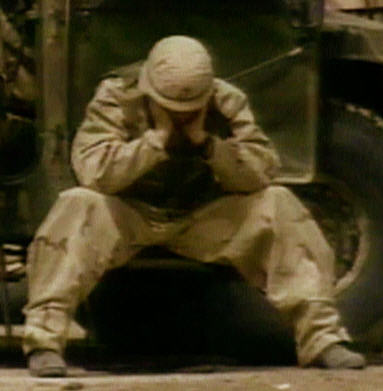
Soldiers Report PTSD Symptoms and Other Mental Health Problems
By KIM CAROLLO
ABCNews Medical Unit
June 9, 2010
Even though he’s retired from active military duty, CSM Samuel Rhodes still suffers from deep emotional wounds.
“I had to take this afternoon off from work today because of anxiety,” he said. “And sometimes, if I’m going through a really tough time, I think about suicide.”
He spent nearly 30 years in the Army and recently spent 30 straight months deployed in Iraq where he, like many soldiers, witnessed some of the horrors of war.
“In April 2005, it started to eat me up because I started losing one soldier after another,” Rhodes said. “We lost 37 soldiers that were in my unit.”
He was in charge of the brigade of 37 soldiers, and as time wore on, the loss of life wore him down.
“In April 2007, it came full circle. I considered suicide as an option. I felt guilty about losing those soldiers, even though I had no control over it,” he said.
“And I was sleepwalking. I had to tie myself to my cot to prevent it,” he added.
Later, during his 24th month in Iraq, he was found unconscious, and doctors diagnosed him with exhaustion. At that time, the combat stress doctor told him he was also suffering from post-traumatic stress disorder.
“He started explaining it to me, and I realized he was right,” Rhodes said.
And according to a new study conducted by researchers at Walter Reed Army Institute of Research, Rhodes’ mental health problems are common among soldiers returning from Iraq.
Between 2004 and 2007, researchers gave out anonymous surveys to four active duty brigade combat teams and two National Guard combat team three months and 12 months after deployment. The surveys screened soldiers for PTSD, depression, alcohol misuse and aggressive behavior and asked them to report whether these problems impacted their ability to get along with others, take care of things at home or perform their job duties.”A high number of those that had symptoms of PTSD and depression also reported some aspect of impairment,” said Jeffrey L. Thomas, one of the study’s co-authors. “The range was about 9 to 14 percent.” Depression rates ranged from 5 percent to 8.5 percent.
But by using a less stringent definition of PTSD, they found between 20 and 30 percent of soldiers showed symptoms of PTSD, while they found between 11.5 to 16 percent of them were depressed.





 Broken Believers