Sorry, Not Sorry

Have you ever heard someone say those words? “Sorry, not sorry.” It’s kind of annoying. It’s said following a statement or action the speaker knows is unkind or won’t be appreciated by someone else, but they just don’t care. It’s worse than not saying sorry at all.

We humans have a terrible time admitting when we are in the wrong. There’s always some justification for our actions, often that we were wronged first, or we had no choice, or some such nonsense. Misunderstandings escalate into disagreements, which quickly become heated arguments, and nobody really wins in the end. Sometimes good friends end up enemies, all because no one will say those two simple, yet truly difficult, words: “I’m sorry.”
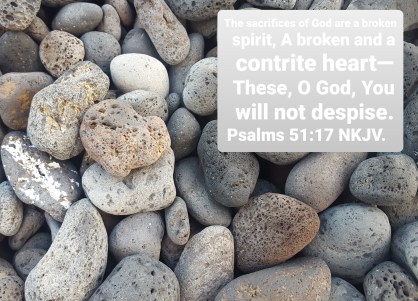
We sometimes have the same problem with God. We know we have not acted as we should, but we can’t let go of pride and say we are sorry. Scripture reveals the truth: a contrite heart is all God wants from us. He desires for us to admit when we’ve missed the mark.

The stories of King David and King Saul illustrate this principle. Both were in the wrong. David committed adultery, and then had the husband of the woman he slept with sent to the front lines of a battle, knowing he would be killed. But when the prophet Nathan brought David’s transgressions to his attention, David’s response was a remorseful attitude. He immediately fell to his knees and confessed his sin. And God forgave David.

Saul, on the other hand, committed a transgression that seems much less serious. He counted his army. Doesn’t sound like much of a sin, does it? But the heart of Saul’s transgression was a lack of trust in God. He didn’t believe he would win a battle even though God had promised him victory. Not only did Saul not trust God, he refused to confess his lack of trust. Instead he made excuses, tried to justify his actions. As a result, God took away Saul’s kingdom and gave it to David. And God did not forgive Saul.

David is remembered as a man after God’s own heart in spite of his many sins because a relationship with God was most important to him. Saul is not remembered so kindly.

What have we lost because we refuse to say we are sorry? A kind word, an admission of our own contribution to a dispute, can go a long way toward healing relationships. Is there someone you need to say “I’m sorry” to today? What’s holding you back? Is it a stubborn nature, like what often holds me back? What do you have to lose? What do I have to lose? More importantly, think what we have to gain.

What about your relationship with God? Is there some transgression you need to confess to restore the intimacy you once enjoyed with your Savior? What do you have to lose? You have the best God intends for you to gain.


C.S. Lewis on Forgiveness

I love the Psalms and C.S. Lewis’s reflections are inspiring. This quote in particular makes you think. Jesus really did say forgive “seventy times seven,” which literally means as many times as necessary. Ouch! That’s a hard truth to swallow along with our pride.

There is no use talking as if forgiveness were easy. We all know the old joke, ‘You’ve given up smoking once; I’ve given it up a dozen times.’ In the same way I could say of a certain man, ‘Have I forgiven him for what he did that day? I’ve forgiven him more times than I can count.’ For we find that the work of forgiveness has to be done over and over again. We forgive, we mortify our resentment; a week later some chain of thought carries us back to the original offence and we discover the old resentment blazing away as if nothing had been done about it at all. We need to forgive our brother seventy times seven not only for 490 offences but for one offence.

-from Reflections on the Psalms, C.S. Lewis

Seventy times seven to the tenth power seems to be how many times I must learn the lesson of forgiveness. I know how healing and freeing it is to forgive . . . until I forget.

1 Corinthians 13:5 says love “keeps no record of wrongs.” But when someone has wronged me I don’t much feel like loving them anyway.

Thankfully Jesus never said to His Father, “Don’t forgive them. I don’t much feel like loving them anyway.”

Last Year’s Transgression

Earlier this year I was holding onto an offence from summer 2020. I reached the hard decision to forgive. Really, I had. But every time I was reminded of it, I record anew how I was wronged.

“And she’s not even sorry,” I explained to God. She doesn’t even think she did anything wrong. Early on, He woke me in the middle of the night: “Pray for her.”

“You mean like David prayed for You to destroy his enemies in the Psalms?”

“No, not like that. Pray as Jesus prayed for you.”

So I did. And it helped to heal the wound and free my mind from the trap of bitterness.

I learned my lesson and each time the anger creeped in again, I forgave a little more quickly.

The Never-Ending Transgression

Until recently when someone who has said things that hurt me on way more than seventy-times-seven occasions. It’s been the story of my life, to have her speak words that shatter my heart.

I know I need to forgive her. And many times I have. But this latest wound was just too much. I was already grieving and she compounded my grief tenfold with her words.

She’ll blame it on her mental illness, and I get that it’s a struggle for her. She’ll blame it on her own grief, but that doesn’t give her the right to ignore my grief.

She’ll claim she doesn’t even remember saying what she said. And maybe she doesn’t. But I do. I remember every cruel word she has ever spoken to me. Every single one. Maybe that’s my problem. I’ve often forgiven but not forgotten.

I ruminated on what I might say to her when next we met and I couldn’t come up with anything nice. I’ve spent decades being loving and understanding and forgiving. This time I didn’t think I could.

But I did. It took the power of the Holy Spirit to draw from my mouth the right things to say, the forgiving thing to say. It helped that the focus was on the one we were both grieving over.

A Prayer for You and Me

Heavenly Father, Help me to forgive as You do, more quickly and completely, as You forgive me. Help the one reading this post, who may also be struggling to forgive a long list of transgressions, to turn to You for help. In Jesus’s Name, Amen.

Dark Saturday

Your disciples all hid away
terrified that dark Saturday
Not knowing what to do
now that men had crucified You

Hope that day was hidden too
doubting what You said was true
Wondering if You would really rise
or if Friday proved Your demise

I think I know just how they felt
as with hopelessness I have dealt
Mired in the Saturday of depression
in need of Your intercession

As the disciples on Sunday found
You as King would clearly be crowned
I have found Your promises true
of eternal hope to help me through

Although Saturday may seem quite dark
Sunday’s resurrection is Your hallmark

Contemplating Suicide Is Not Selfish

Sept. 10,  is World Suicide Prevention Day. Why there is but a single day of the year devoted to preventing suicide, I do not know. We should endeavor every day to provide the hope the hopeless need to get them through the pain that leads to suicide.

Often we hear it said that those who kill themselves are selfish because they hurt the people they leave behind. But if you’ve ever had suicidal thoughts or tried to die by suicide, you know that is not the case.

If you never have, it is difficult to understand.

I’ve only been truly suicidal once, but my thoughts were far from selfish. At the time, my actual thought was that my husband and son would be better off without me because I was so depressed and broken that I was no good to them. I truly believed this terrible lie.

Thoughts of suicide often follow a long pattern of trying to get well with little or no success. It stems from hopelessness and a sense of feeling like you are a burden to those around you. To consider suicide is to desire to unburden others and put an end to endless pain.

Unfortunately, the thought processes of a person who is suicidal are just simply wrong. I know mine were. I can’t imagine where my husband and son (who was 1 ½ then and is 26 now) would be if I had gone through with it. They certainly would not be better off. That thought was a lie.

There is always hope, even when things seem the most hopeless. What a person struggling with depression and suicidal thoughts needs is love and hope. They need understanding and reassurance that the rest of us would not be better off if they were gone. They need to know we are there for them and that they matter to someone.

They need to know that God loves them and wants what is best for them, and that “This too shall pass.” But in the meantime, we are there to be a shoulder to cry on and a heart to confide in.