Words of Hope for a Baby Born Blind

Anophthalmia–the condition of being born with no eye tissue–affects about 30 out of 100,000 babies, leaving them irrevocably blind. This is the letter that a pastor wrote to a Christian couple confronted with this tragic reality.

R

 Dear John and Diane,baby-with-no-eyes

Last night, as I prayed with Noel, you were heavy on my mind. I said, “Lord, O Lord, please let me be a pastor who preaches and leads and loves in a way that makes the impossibilities of life possible for your people by a miracle of sustaining grace. Help me to know the weight and pain of this life and not to be breezy when the mountains have fallen into the sea. Help me to have the aroma of Christ’s sufferings about me. Prevent shallowness and callousness to pain. O Lord make me and my people a burden bearing people.”

O John and Diane, I am so heavy with your child’s sightlessness! God is visiting Bethlehem Church with such pain these days in the birth of broken children. Randy and Ann Erickson with their baby’s broken heart; Jan and Rob Barrett with their baby’s liver outside the body; and your precious little one! Is the Lord saying, “I have a gift for your community.” This is not one or two or three couples’ burden. This is a gift and call to the whole church.

This is a word concerning the brokenness of this fallen age of futility.

This is an invitation for you all to believe that “here we have no lasting city” (Hebrews 13:14). This is an invitation for you to “count every gain as loss for the sake of Christ” (Philippians 3:7). This is a shocking test to see if you will “lose heart” when in fact God’s purpose is to show that his grace is sufficient to renew our inner person every day to deal with the “slight momentary affliction which is preparing for us an eternal weight of glory beyond all comparison, because we look not to the things that are seen but to the things that are unseen; for the things that are seen are transient, but the things that are unseen are eternal” (2 Corinthians 4:17-18).

O Lord, open our eyes to your love in this pain. Open our eyes.

“Then Elisha prayed, and said, ‘O Lord, I pray thee, open his eyes that he may see.’ So the Lord opened the eyes of the young man, and he saw; and behold, the mountain was full of horses and chariots of fire round about Elisha” (2 Kings 6:17).

John and Diane, the mountains surrounding your lives are filled with the horses and chariots of God. Only to the eyes of unbelief does the devil have the upper hand here. God is at work in ways and for years and generations and millions of people that we cannot now imagine. This is ours to believe and to bear, no matter the cost. This is ours for this short life.

It seems to me that this life is a proving ground for the kingdom to come. Some are asked to devote forty or fifty years to caring for a handicapped child instead of breezing through life without pain. Others are asked to be blind all their lives…

But only in this life – ONLY in this life.

I want to be the kind of person who makes that “ONLY” what it really is – very short. Prelude to the infinity of joy, joy, joy. But not yet. Not entirely.

How will we ever cope with the burdens of this life if we believe this is all there is, or even the main act in this drama of reality? O Lord, give us your view of things.

May God fill you with anticipated joy.

“I consider that the sufferings of this present time are not worth comparing with the glory that is to be revealed to us.”

I love you,

Pastor John

Source: http://theworksofgod.com/2009/09/24/helpful-things-pastors-who-love-their-people/

Pastor John Piper site:  http://www.desiringgod.org/
OCD: Plain & Simple

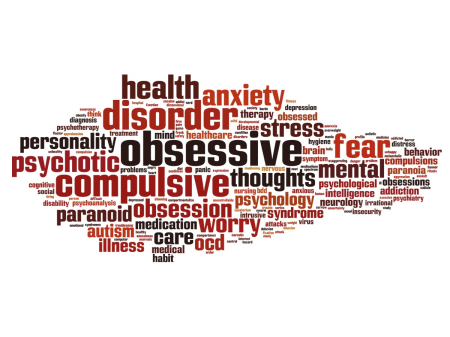
The OCD Cloud

A woman visits her dermatologist, complaining of extremely  dry skin and seldom feeling clean. She showers for two hours every day.

A lawyer insists on making coffee several times each day. His colleagues do not realize that he lives in fear that the coffee will be poisoned, and he feels compelled to pour most of it down the drain. The lawyer is so obsessed with these thoughts that he spends 12 hours a day at work — four of them worrying about contaminated coffee.

A man cannot bear to throw anything away. Junk mail, old newspapers, empty milk cartons all “could contain something valuable that might be useful someday.” If he throws things away, “something terrible will happen.” He hoards so much clutter that he can no longer walk through his house. Insisting that nothing be thrown away, he moves to another house where he continues to hoard.

A 10 year old girl keeps apologizing for “disturbing” her class. She feels that she is too restless and is clearing her throat too loudly. Her teachers are puzzled and over time become annoyed at her repeated apologies since they did not notice any sounds or movements. She is also preoccupied with “being good all the time”.

These people suffer Obsessive-Compulsive Disorder (OCD). The National Institute of Mental Health estimates that more than 2 percent of the U.S. population, or nearly one out of every 40 people, will suffer from OCD at some point in their lives. The disorder is two to three times more common than schizophrenia and bipolar disorder.

What is Obsessive-Compulsive Disorder? 

Obsessions are intrusive, irrational thoughts — unwanted ideas or impulses that repeatedly well up in a person’s mind. Again and again, the person experiences disturbing thoughts, such as “My hands must be contaminated; I must wash them”; “I may have left the gas stove on”; “I am going to injure my child.”

On one level, the sufferer knows these obsessive thoughts are irrational. But on another level, he or she fears these thoughts might be true. Trying to avoid such thoughts creates great anxiety.

Compulsions are repetitive rituals such as handwashing, counting, checking, hoarding, or arranging. An individual repeats these actions, perhaps feeling momentary relief, but without feeling satisfaction or a sense of completion. People with OCD feel they must perform these compulsions. Heredity appears to be a strong factor. If you have OCD, there’s a 25-percent chance that one of your immediate family members will have it. It definitely seems to run in families.

Can OCD be effectively treated? Meds might help.

Many of the antidepressant medications known as selective serotonin reuptake inhibitors (SSRIs) have also proven effective in treating the symptoms associated with OCD. The SSRIs most commonly prescribed for OCD are Luvox (fluvoxamine), Paxil (paroxetine), Prozac (fluoxetine), and Zoloft (sertraline). Luvox (fluvoxamine): 

How long should an individual take medication before judging its effectiveness?

Some physicians make the mistake of prescribing a medication for only three or four weeks. That really isn’t long enough. Medication should be tried consistently for 10 to 12 weeks before its effectiveness can be judged.

What is behavior therapy, and can it effectively relieve symptoms of OCD?

Behavior therapy is not traditional psychotherapy. It is “exposure and response prevention,” and it is effective for many people with OCD. Consumers are deliberately exposed to a feared object or idea, either directly or by imagination, and are then discouraged or prevented from carrying out the usual compulsive response. For example, a compulsive hand-washer may be urged to touch an object he or she believes is contaminated and denied the opportunity to wash for several hours. When the treatment works well, the consumer gradually experiences less anxiety from the obsessive thoughts and becomes able to refrain from the compulsive actions for extended periods of time. 

Will OCD symptoms go away completely with medication and behavior therapy?

Response to treatment varies from person to person. Most people treated with effective medications find their symptoms reduced by about 40 percent to 50 percent. That can often be enough to change their lives, to transform them into functioning individuals. A few consumers find that neither treatment produces significant change, and a small number of people are fortunate to go into total remission when treated with effective medication and/or behavior therapy.

Reviewed by Judith Rapoport, MD May 2003

Information Helpline: (800) 950-NAMI


The One Minute Bible Survey

(Taking a break from my serious stuff.)

Found this recently and felt it might bless (or humor) you.  It is almost a Bible survey course, and as about as brief as you can go without losing any kind of comprehension at all.  I so hope  you like this, if just for the novelty of it. I wish I could attribute it to someone. I have no idea. I wish them the best.

bry-signat (1)

There’s More Than One Billion of Us!

handicappedsigns

With wheelchair users making up only 5% of disabled people it has become a poor way of acknowledging those of us with a different type of disability.

More than 1 billion people in the world are living with some sort of disability, according to a new international survey. That’s about 15 percent of the world’s population, or nearly one of every 7 people.

The numbers come from a joint effort by the World Health Organization and the World Bank. The last time anyone tried to figure out the prevalence of disabilities was back in the 1970s, when WHO figured it was about 10 percent. The current report suggests the 15 percent estimate will grow as the world’s population ages.

Like the 1970s numbers, today’s figures are at best an approximation. Many countries don’t collect numbers carefully, and definitions of disability differ from place to place. The World Bank/WHO folks sought out tabulations of people who have trouble seeing, hearing, walking, remembering, taking care of themselves or communicating. Worldwide, the most common disability in people under the age of 60 is depression, followed by hearing and visual problems.

The report includes a foreword by theoretical physicist Stephen Hawking, who can’t feed himself or get dressed or speak without assistance because of his amyotrophic lateral sclerosis, a debilitating and usually fatal disease. He says there’s a moral duty to help disabled people.

The head of WHO, Margaret Chan, offers up another reason: “Almost every one of us will be permanently or temporarily disabled at some point in life.” An editorial in the medical journal The Lancet points out that accommodations for people with disabilities, such as curb cuts, help the non-disabled as well (such as people with strollers).

Why even come up with a number? Knowing the prevalence of disabilities helps organizations set priorities and figure out what it will cost them to set up the kind of programs called for by WHO and the World Bank — programs that make it possible for people with disabilities to take care of themselves, to work and get around.

The report didn’t estimate the total cost of establishing such programs. And it offered no solutions for perhaps the biggest challenge: finding the money.flourish-bird

Source: http://www.npr.org/blogs/health/2011/06/09/137084239/nearly-1-in-7-people-on-earth-are-disabled-survey-finds?sc=fb&cc=fp

Also, most helpful: http://www.designassembly.org/2008/11/14/iconic-disability/

Y