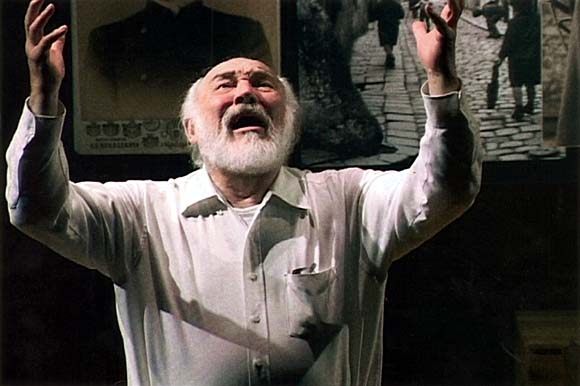
Chutzpah!

chutz·pah

  http://sp.dictionary.com/dictstatic/d/g/speaker.swf

A word from the Hebrew

1. unmitigated effrontery or impudence; gall. 2. audacity; nerve.  3. shameless audacity; impudence.

****

The essence of “chutzpah” has been described as the man who murders his parents, and then throws himself on the court because he is now an orphan. (At least that is what I have heard.) Chutzpah is most often found when things seem unattainable. It is an intelligent response to things that are ugly and desperate, and yet somehow making them available. And it is typically and completely “out-of-hand.” It seems to step-up when things are bleak, and you make certain things negotiable again.

It’s like healing and deliverance are stored on the top-shelf.  Chutzpah goes and comes back with a ladder.  It simply will not be dissuaded or denied.

“Let us then with confidence draw near to the throne of grace, that we may receive mercy and find grace to help in time of need.”

Hebrews 4:16, ESV

There is the special need for a definite form of chutzpah here. We “get close.” And then we push closer. And we are totally beyond our place and status. But all we can see, is the “mercy and grace.” So because we see such wonders, we audaciously step into His presence.

“So, friends, we can now—without hesitation—walk right up to God, into “the Holy Place.” Jesus has cleared the way by the blood of his sacrifice, acting as our priest before God. The “curtain” into God’s presence is his body. So let’s do it—full of belief, confident that we’re presentable inside and out. Let’s keep a firm grip on the promises that keep us going. He always keeps his word.”

Heb. 10:19-21, MSG

I must admit, my preference is this– I just don’t like people with chutzpah. They seem arrogant, and I distrust arrogance. I don’t like it, and it is hard for me to see it as a virtue. But as I read the Word, I discover that the people of true faith seem very conceited. They swagger in, and will receive all (and more) of what they request (or demand.)

All of there behavior seems smug and superior to a sceptical heart. And yet I must reflect on all those in the Word who were outrageous, who stepped totally out-of-line. Jacob who wrestled. Moses who negotiated. Esther who persuaded. The adulterous woman who anointed. The leper who begged. There are quite a few others, we can find. They all were “cheeky” and dauntless.

What role does “chutzpah” have in our personal walk? Should we step out into this faith that is inherently susceptible to our incredible demands?  It is outrageous that we should demand an entrance into the presence of the Most High. And then when we finally stand in this place, we insist on complete and total forgiveness. Now that, dear friends, is a chutzpah kind of  arrogance!

If we should be “chutzpah-believers” we need to know the promises in the Bible. That alone will be the only place we can stand. Our faith must exclusively be based on what God has proclaimed in the Word. To come forward without a promise is very foolish.

In the Gospels we will find a blind man whose name was Bartimaeus. He steps up and clearly insists on a healing. “Jesus, Son of David, have mercy on me.” Jesus turns at this act of chutzpah. “What would you have Me do for you?” There is a profound audaciousness in his reply. “Heal me!”

As believers, sometimes we simply take the “humble route.” But if you want God, then you must step up, be bold and take what you need from Him. It seems that our Father insists we enter His presence quite “boldly.”

Over and over, we read of Bible characters who pronounced that boldness was an incredible virtue. But faith at its essence simply will not conform to any other definition. Faith insists that we be audacious and bold, way beyond any logic or reasoning. They might think we are quite outrageous, but we know that we are only being faithful.

Depression and Diabetes

DepressionCaseStudy_clip_image001For some reason lately I’ve been thinking about the similarities between diabetes and depression. I know that depression can be one of the complications of diabetes, but that is something I learned only when I did a little research about diabetes and isn’t what I want to share about these two diseases.

I do not have diabetes, but I do know people who do. Diabetes is a disease for which there is no “cure,” though there are treatments that can minimize the symptoms and complications that can arise from this disease. Some people with diabetes do a great job of taking such good care of themselves and following their doctor’s orders that they are virtually symptom free. You would never know they had diabetes unless they told you. I’ve known other diabetics who don’t follow doctor’s orders, and the outcome was terrible.

Dealing with diabetes is not an easy road. For people with Type 2 diabetes, a strict diet and exercise are a must, and monitoring blood sugar levels is essential. For people with Type 1 diabetes, insulin injections are also necessary because their bodies do not produce any of this necessary hormone. It is a lifelong affliction, the potential effects of which can be minimized but never forgotten or ignored.

I believe that for some people depression is similar to diabetes in that it is never cured. These people are prone to depression, and may have suffered through one or more episodes of major depression in their lives. From a statistical standpoint, a person who has had more than two major depressive episodes is highly likely to have another in their lifetime. But it isn’t inevitable that they will. Just as the symptoms of diabetes can be prevented or minimized with careful management, so the symptoms of depression can be prevented or minimized with proper care.

Caveat: I am not a doctor and this post is not intended as medical advice. It simply an observation that has been on my mind lately and is helpful for me in understanding my own challenges to keep depression at bay.

There are some people who, like the person with Type 1 diabetes, need medication to help keep them stable and to prevent major depression from setting in. (Though this may be a small percentage, just as Type 1 diabetes is much rarer than Type 2.)  But everyone who struggles with depression can help prevent or minimize the effects of a relapse by taking steps to truly care of themselves. Diet and exercise can be part of this self-care, but for the person who lives with the knowledge of depression there is a mental and spiritual component of their self-care that goes beyond what is required of the diabetic.

Many years ago the doctor I was seeing told me I would be on antidepressants for the rest of my life. Having now been off them for 13 years and not suffered another major depressive episode in all that time, I think I can safely say she was wrong. But in the last few years I have come to understand that I am one of those people who cannot take for granted that depression is strictly a part of my past. It is forever a part of who I am and I must never forget the misery it has caused me and could cause me again if I do not take care of my mental and spiritual health.

For me, warding off a relapse of depression requires that I choose to engage in regular prayer time; to listen to music that is encouraging and uplifting, and avoid music that is depressing; to talk to a Christian friend if something is bothering me; to take a periodic inventory of my own actions and attitudes, and correct any that are negative; and to trust in the Holy Spirit to guide my thoughts, putting on the whole armor of God. When I do these things, I can live in such a way that others would never know that depression is a part of my life. But if I neglect these things for too long, I will soon detect the specter of depression looming in my heart and in my mind, and the outcome will be terrible.

Just as the diabetic can never forget that they have diabetes and neglect their diet and health regimen, I can never forget that depression is ever a part of me and neglect my mental and spiritual regimen. I must be ever vigilant and cling to Jesus as my Rock, trusting in His promises, and following His commands and precepts to love, forgive, and be content.


ysic, Linda K.


Thinking Out Things

There is a full treatment that the Father intends to work in us. And He will work in us, and we can’t prevent its work.  We don’t really want Him to make us a saint.  But He carries out a different plan.  We shouldn’t be entirely surprised to have Him inside of us, working and building.  We really are brought to a point when the things He does will need to be tolerated, at least.

To be a Christian is a challenging endeavour.  Just ike taffy is pulled to an amazing length, it will always unfold and duplicated.  This work starts to insist that we turn over everything ugly and evil and we turn over the nastiness that wants to invade our darkness.  We are the lost sheep, and we honestly renounce a corruption of our hearts, and the desire to wander away.

There is one of those stories, which can be found in many different cultures.  It is this– a man wears a mask, for several years.  He never takes it off.  The mask is a permanent fixture in His life.  As the moment of revelation when the mask comes off, we all discover that he has been changed, transformed by the wearing of the mask.

Will you wear the mask?

Might it be, that it you will “put on the Lord Jesus Christ, and make no provision for the flesh,” transformation will happen as we start to “wear Him” through our unique and surprising life.  We have been bonded to Him, and He is now working “Christlikedness” inside us.  If we try to evaluate the Lords work, we maybe disappointed.  But we so seldom discern these things properly.  However it is clear that He has not postponed His work, but is actively seeking it to work in our lives.

Welcoming His Judgement

To be judged by God is an awful thing.  It is always immutable and just.  He brings to us the inevitable awareness of the guilt and rebellion that we have secretly harbored for years.  We try to dodge His correction like a boxer does to the punches of his opponent.

We see judgement with a distinct clarity; as if it was to be avoided like the plague.  We fear Him, but like an eccentric guest at our special dinner party.  He is unpredictable, and sometimes will pull out the table cloth, in spite of the plates and dishes.  He does amazing tricks, but to us He seems a bit capricious and not at all in control of Himself.  We really don’t trust Him. Not really, anyway.

But the judgement of God is never punishment.  It is always corrective however, with a desire for us to find good and health in its presence.  We can contaminate our hearts with a wrong perspective.  But He is love, and our sin and iniquity won’t change that about Him.

He loves us so much, that He is obligated to correct us.  Some here have had great Dads.  The were active in our lives.  They were not perfect, but it didn’t matter; Dad loved us and that was all we needed.  Everything God does, comes out of this matrix of love.  When we truly grasp how much someone loves us, we can open up to anything they might say.

He does correct us, which can be harsh and difficult.  But God carefully weighs out the situation, just like a druggist weighs out to the milligram of the medicine we need.  He does discern, and gives no one more then they need.  He is definitely aware, and has no desire to destroy us.  Quite the opposite.

When we are judged for a particular sin or iniquity, we will know it.  But within that correction we will find no darkness or maliciousness.  Within our Father, there is nothing that would suggest evil or a desire to inflict pain.  He most definitely is not a sadist.  When we are corrected, we need to accept it, and receive it.  At the bottom of this, we will find that there is nothing but love.