This was a book saturated with holy surprises. For sure, the title seemed eccentric and I couldn’t be certain that it be worth reading. After I read several pages I was able to use my own “spiritual” GPS and locate, and understand the “lay-of-the-land.” There was a sense of reading something very fresh, and striding to keep up with Mikalotos. I discovered that I couldn’t wait for the next page, which is a great indicator.
Imaginative and engaging. If this book transformed into a person, I would immediately invite him to my living room for coffee and a conversation. I would not hesitate. Plot and content wise–this is a narrative of a man’s journey to what is real. Especially in the spiritual realm of the truth, where it is best to possess what you confess.
The book unfolds with adventure after adventure. It has a plot that seems like sci-fi. It is both exotic and friendly, all at the same time. If I could think out loud my impressions of “Imaginary Jesus” in a single word it would be “winsome.” Mikalatos presses into our imaginations a journey that is both amusing as it is cutting. It is a fun read, that is explosive and sure, it puts together for us an understanding of our own hearts in this generation.
Outside Review: “Take the theological forcefulness of Bonhoeffer, combine it with the imaginative whimsy of C. S. Lewis and the wit of Charles Spurgeon, and you get Matt Mikalatos. Imaginary Jesus marks the debut of one of today’s most prominent young Christian writers. “(Gary Thomas, Author of Sacred Marriage and Pure Pleasure )
————————-
I purchased my book direct from Amazon.com for $10.19 USD.
Paperback: 240 pages
Publisher: BarnaBooks (March 18, 2010)
Language: English
ISBN-10:9781414335636
ISBN-13:978-1414335636
ASIN:1414335636
Product Dimensions: 8.2 x 5.6 x 0.5 inches
Average Customer Review: 4.3 out of 5 stars. (134 customer reviews)
Amazon Bestsellers Rank: #75,518 in Books (See Top 100 in Books)
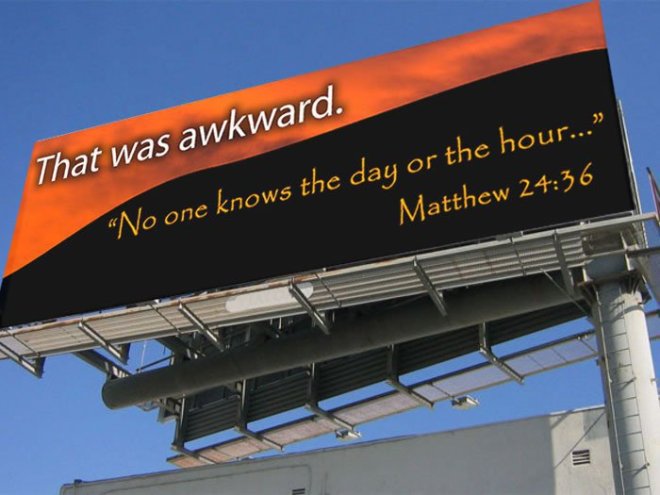
Someone made a real good effort to put up this billboard. Essentially it expresses a lot of humility without any compromise. My gut feeling is that it touches a lot of frayed thinking in a very good way. Ministering grace can be a definite challenge, especially when the scorner and mocker are heavily involved.
I think it not only speaks to the person who doesn’t believe, but it connects to the believer who thought that this could very well be true. And actually, humility beautifies the Church very wonderful way. (I would submit that perhaps this was the real reason this unfolded the way it did?) This is a perfect time for the Church to admit a definite humility of heart and mind. This is never easy, but is always good.
Ken Medema (born December 7, 1943 as Kenneth Peter Medema in Grand Rapids, Michigan) is a composer–singer–songwriter who has been performing in the United States, Canada, and Europe for more than thirty years. Ken Medema was born almost blind; his eyes let him tell light from shadow and look at outlines of major objects. He began playing the piano when he was five years old, and three years later began taking lessons in classical music through braille music, playing by ear and improvising in different styles. In 1973, he began performing and recording his own songs. His lyrics generally provide social commentary on themes such as justice, hunger, poverty, homelessness, and Christian charity as it pertains to them. He has published a total of 26 albums, the first of which he recorded for Word and Shawnee Press, and then went on to found Brier Patch Music in 1985. Through Brier Patch Music he organizes and schedules his events, as well as publishes his music. Performances regularly include songs improvised both musically and lyrically by accepting audience recommendations, sermon topics, or guest speaker stories as their basis. He performs in national and worldwide (church) congregations, campuses, youth gatherings, and annual assemblies. He lives in San Francisco, California. http://en.wikipedia.org/wiki/Ken_MedemaThis featured song, “Mr. Simon,” is based on the words of Jesus as found in Luke 18:10-14, ESV.
“Two men went up into the temple to pray, one a Pharisee and the other a tax collector. 11The Pharisee, standing by himself, prayed thus: ‘God, I thank you that I am not like other men, extortioners, unjust, adulterers, or even like this tax collector. 12 I fast twice a week; I give tithes of all that I get.’ 13But the tax collector, standing far off, would not even lift up his eyes to heaven, but beat his breast, saying, ‘God, be merciful to me, a sinner!’ 14I tell you, this man went down to his house justified, rather than the other. For everyone who exalts himself will be humbled, but the one who humbles himself will be exalted.”
Bryan’s note: I guess there is a touch of sarcasm in this song, but never delving into cynicism. He communicates the very real world of hypocrisy and acceptance in the life of the believer. This is not a classic worship song, but is a song that starkly reveals the iniquity of our hearts as we approach the presence of God. Perhaps this touch of sarcasm is a definite weapon of choice in exposing the hypocrisy that confuses us. The CCM Music Index on Brokenbelievers can be found at: https://brokenbelievers.com/classic-christian-music-index/
Larry David Norman (April 8, 1947 – February 24, 2008[1]) was an American Christian musician, singer, songwriter, record label owner, record producer, writer, playwright, actor, photographer, and humorist, who is credited as “a key figure in the development of contemporary Christian music“,[2] “the most significant artist in the creation of contemporary Christian music (CCM)”,[3] the “father of Christian rock music”,[4] the “Godfather of gospel rock”;[5] “Christianity’s first rock star”,[6] the “bad boy of Christian music”,[7] and “the poet laureate of the Jesus revolution”.[8] “By 1970, Norman had the most recognized name (and face) in the Jesus Movement and the Christian music scene”,[9] with Time magazine soon describing him as “probably the top solo artist in the field”.[10] While he had long been associated with the Jesus people,[11][12] and was even described as “the personification of the Jesus Movement of the late ’60s and early ’70s”,[13] Norman himself “did not particularly identify himself with the youth-oriented ‘Jesus movement’ of the time”.[14][15] He has been credited with having a significant influence on many artists, both secular and religious.[16] Norman has also been described as having a “propensity for spinning stories”,[17] and a “penchant for revisionist history”.[18]
Since Norman’s first professional release in 1967, more than 100 of his own albums have been released through such commercial record labels as Capitol, MGM, Verve, and his own independent labels: One Way Records, Solid Rock Records, Street Level Records, and Phydeaux Records. Norman’s first album, I Love You, recorded when he was one of the lead singers for the group People!, was released in 1968. The band’s cover version of The Zombies song of the same name reached number 14 on Billboard magazine‘s top twenty list in 1968 as a single.[19] Norman left People! in 1968 and subsequently performed as a solo artist, appearing both on mainstream and independent labels.[20] In 1969 Norman recorded Upon This Rock, “the first commercially released Jesus rock album”,[21] and in 1972 one of “the most influential Christian rock records of all time”, Only Visiting This Planet.[22] Norman’s recordings are noted for their Christian and social subject matter, having successfully “wed the rhythms of pop music with the spiritual and social outlook of Christianity to create a kind of flower-power gospel.”
–Copied from Wikipedia, the free encyclopedia
My note: Larry Norman seemed to struggle most of his life. He was a very talented and gifted songwriter. Some of his “issues” seem to be proceed from what some considered bipolar disorder, but that probably was never medically confirmed. He was known by many to be a rascal (the kind of person we minister to at BB.)
An excerpt from Christianity Today, announcing his death.
“Christian music legend Larry Norman died Sunday of heart failure, according to his brother Charles Norman. He was 60.
Norman, a blonde, long-haired rocker who is often called the father of Christian rock music, was a giant in the Christian music industry, said Chris Willman, senior music writer for Entertainment Weekly.
“His influence outweighed his sales so much that it’s comical,” Willman said. “He certainly had a heart for evangelism — almost to his detriment, I might say. He really could’ve been a star if he were singing about something other than Jesus.”
Norman’s 1972 Only Visiting This Planet album is regarded as one of the top contemporary Christian music albums of all time. His many hits were at the cutting edge, said Larry Eskridge, associate director of the Institute for the Study of American Evangelicals at Wheaton College.
“The song ‘Why Should the Devil Have All the Good Music?’ was one of his enduring trumpet blasts against the stodgy, old Christian establishment,” Eskridge said. “‘I Wish We’d All Been Ready’ fit with the end times, apocalyptic feel that was in the air at the time.”
“I Wish We’d All Been Ready” was also featured in the 1972 end times film, A Thief in the Night. In concerts, the singer gave his trademark “One Way” gesture, pointing an index finger toward heaven.
Eskridge said Norman was an icon during the Jesus People of the 1960s but distanced himself from the movement when it became a fad and eventually faded.”