Seeking Truth

Look for It

Words matter. Our choice of words, whether speaking or writing, makes a difference.

And words have meaning. That’s what dictionaries are for—to tell us what words mean. When we try to use words to mean something other than what they really mean, it causes confusion.

Sometimes people do this on purpose. One such misuse of a word that I have encountered lately is the use of the word “true” to substitute for “believe.” A person will say “such and such is true for me” when what they really mean is “I believe such and such.”

According to the dictionary, the word “true” means “being in accordance with the actual state or conditions; conforming to reality or fact.” Truth is not relative and is not affected by what any one person believes. Truth is external, and belief is internal, in origin.

Many years ago, when I was suffering from major clinical depression, there were a number of things I believed about myself. I believed I would always be depressed based on how long I had been depressed already and my doctor telling me I would always have bouts of major depression for the rest of my life. I also believed I would never be able to hold down a full-time job. I believed no one liked me and that I was worthless. In the parlance of relativism, these things were true for me.

But they weren’t true. They aren’t true and they never were, no matter how deeply I believed them.

And trust me, I deeply believed these things about myself.

But here I am, 18 years later, and I haven’t had a bout of major depression since God showed me how to be free. I’ve had the same good-paying full-time job for almost 12 years, and I had a different full-time job that paved the way for this one for 5 1/2 years before that. On top of my full-time job, I’m actively involved in my church and Bible Study Fellowship, have self-published two poetry books, and take care of my family. And I have a lot of friends, people who like me (and some who even love me).

As I look back over the past 20 years, I see God’s hand in my life, lifting me up and leading me to see the truth. I believe that. But it’s not my belief that makes it true. In fact, I could be dead wrong, but I don’t believe I am.

Whether God is real and cares about His creation enough to do all I believe He has for us is either true or not. It can’t be true for me and not for you, or vice versa. Truth is. As humans, our greatest purpose is to seek the truth. To say that truth is relative—that what is objectively true for me is different from what is objectively true for you—negates that essential human drive to know truth, to know our Creator, to know where we come from, and to know our reason for being.

At any rate, that’s what I believe.

Love,

Linda K.

Check out Linda’s site at: anchoredvoices.com.

To Pray without Ceasing

Brother Lawrence once wrote: “There is not in the world a kind of life more sweet and delightful than that of a continual conversation with God.” That’s easy for a monk to say. What did Brother Lawrence have to do all day but be in “continual conversation with God.” But how does one do that with a full time job, a family, and numerous other commitments, not to mention the struggles of illness and other trials this world throws at us?

In our never-slow-down world, the idea of continually conversing with God seems radical.

And yet, scripture calls us to do what Brother Lawrence suggests. 1 Thessalonians 5:17 says, “pray continually,” “pray without ceasing,” or “Never stop praying,” depending on the translation you choose. I love this verse, but I used to have a hard time figuring out how to put it into practice.

Do you think of prayer as the time during which you stop to ask God for all the things you need or want, and tell Him about your family and friends who are sick or in trouble, and plead with Him to fix all your problems? Is this but a brief time after which you get up and go about your day? If so, then you may struggle with the concept of continual conversation with God.

One day it occurred to me that this is the wrong way to think about prayer. Instead, I began to equate prayer to spending time with my best friend. When I spend time with a good friend, we can both be in the same room doing different things and not even talking. But I always know that if I have something to say then my friend will listen. And if my friend says something to me, I will be there to hear.

God’s Word tells me that He is always there for me; He is everywhere and wherever I am. If I always remember that, then I can easily “pray without ceasing.” Wherever I am, if I need someone to talk to He will listen because He is my friend. I also need to be aware that He may have something to say to me, so I should be ready to listen to that “small still voice.” Continual prayer doesn’t require constant words; it requires only continual awareness of the presence of God. In this way, even the busiest life can be sweet and delightful.

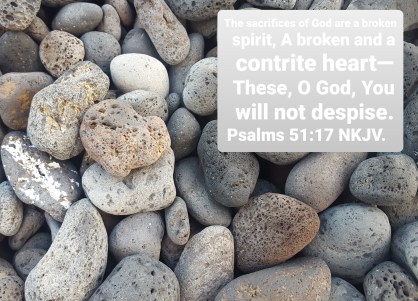
Sorry, Not Sorry

Have you ever heard someone say those words? “Sorry, not sorry.” It’s kind of annoying. It’s said following a statement or action the speaker knows is unkind or won’t be appreciated by someone else, but they just don’t care. It’s worse than not saying sorry at all.

We humans have a terrible time admitting when we are in the wrong. There’s always some justification for our actions, often that we were wronged first, or we had no choice, or some such nonsense. Misunderstandings escalate into disagreements, which quickly become heated arguments, and nobody really wins in the end. Sometimes good friends end up enemies, all because no one will say those two simple, yet truly difficult, words: “I’m sorry.”

We sometimes have the same problem with God. We know we have not acted as we should, but we can’t let go of pride and say we are sorry. Scripture reveals the truth: a contrite heart is all God wants from us. He desires for us to admit when we’ve missed the mark.

The stories of King David and King Saul illustrate this principle. Both were in the wrong. David committed adultery, and then had the husband of the woman he slept with sent to the front lines of a battle, knowing he would be killed. But when the prophet Nathan brought David’s transgressions to his attention, David’s response was a remorseful attitude. He immediately fell to his knees and confessed his sin. And God forgave David.

Saul, on the other hand, committed a transgression that seems much less serious. He counted his army. Doesn’t sound like much of a sin, does it? But the heart of Saul’s transgression was a lack of trust in God. He didn’t believe he would win a battle even though God had promised him victory. Not only did Saul not trust God, he refused to confess his lack of trust. Instead he made excuses, tried to justify his actions. As a result, God took away Saul’s kingdom and gave it to David. And God did not forgive Saul.

David is remembered as a man after God’s own heart in spite of his many sins because a relationship with God was most important to him. Saul is not remembered so kindly.

What have we lost because we refuse to say we are sorry? A kind word, an admission of our own contribution to a dispute, can go a long way toward healing relationships. Is there someone you need to say “I’m sorry” to today? What’s holding you back? Is it a stubborn nature, like what often holds me back? What do you have to lose? What do I have to lose? More importantly, think what we have to gain.

What about your relationship with God? Is there some transgression you need to confess to restore the intimacy you once enjoyed with your Savior? What do you have to lose? You have the best God intends for you to gain.

C.S. Lewis on Forgiveness

I love the Psalms and C.S. Lewis’s reflections are inspiring. This quote in particular makes you think. Jesus really did say forgive “seventy times seven,” which literally means as many times as necessary. Ouch! That’s a hard truth to swallow along with our pride.

There is no use talking as if forgiveness were easy. We all know the old joke, ‘You’ve given up smoking once; I’ve given it up a dozen times.’ In the same way I could say of a certain man, ‘Have I forgiven him for what he did that day? I’ve forgiven him more times than I can count.’ For we find that the work of forgiveness has to be done over and over again. We forgive, we mortify our resentment; a week later some chain of thought carries us back to the original offence and we discover the old resentment blazing away as if nothing had been done about it at all. We need to forgive our brother seventy times seven not only for 490 offences but for one offence.

-from Reflections on the Psalms, C.S. Lewis

Seventy times seven to the tenth power seems to be how many times I must learn the lesson of forgiveness. I know how healing and freeing it is to forgive . . . until I forget.

1 Corinthians 13:5 says love “keeps no record of wrongs.” But when someone has wronged me I don’t much feel like loving them anyway.

Thankfully Jesus never said to His Father, “Don’t forgive them. I don’t much feel like loving them anyway.”

Last Year’s Transgression

Earlier this year I was holding onto an offence from summer 2020. I reached the hard decision to forgive. Really, I had. But every time I was reminded of it, I record anew how I was wronged.

“And she’s not even sorry,” I explained to God. She doesn’t even think she did anything wrong. Early on, He woke me in the middle of the night: “Pray for her.”

“You mean like David prayed for You to destroy his enemies in the Psalms?”

“No, not like that. Pray as Jesus prayed for you.”

So I did. And it helped to heal the wound and free my mind from the trap of bitterness.

I learned my lesson and each time the anger creeped in again, I forgave a little more quickly.

The Never-Ending Transgression

Until recently when someone who has said things that hurt me on way more than seventy-times-seven occasions. It’s been the story of my life, to have her speak words that shatter my heart.

I know I need to forgive her. And many times I have. But this latest wound was just too much. I was already grieving and she compounded my grief tenfold with her words.

She’ll blame it on her mental illness, and I get that it’s a struggle for her. She’ll blame it on her own grief, but that doesn’t give her the right to ignore my grief.

She’ll claim she doesn’t even remember saying what she said. And maybe she doesn’t. But I do. I remember every cruel word she has ever spoken to me. Every single one. Maybe that’s my problem. I’ve often forgiven but not forgotten.

I ruminated on what I might say to her when next we met and I couldn’t come up with anything nice. I’ve spent decades being loving and understanding and forgiving. This time I didn’t think I could.

But I did. It took the power of the Holy Spirit to draw from my mouth the right things to say, the forgiving thing to say. It helped that the focus was on the one we were both grieving over.

A Prayer for You and Me

Heavenly Father, Help me to forgive as You do, more quickly and completely, as You forgive me. Help the one reading this post, who may also be struggling to forgive a long list of transgressions, to turn to You for help. In Jesus’s Name, Amen.