

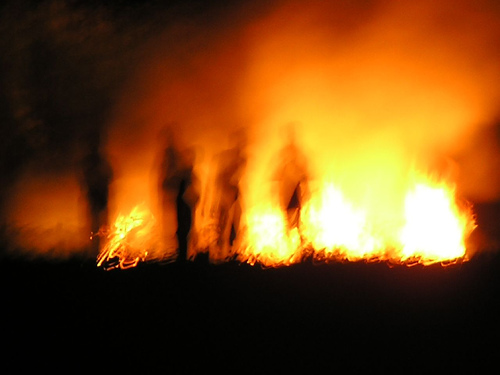
I’m personally convinced that living life is all about “trial and error.” We seem to be working out some holy experiment. More orthodox people call it discipleship, but that really isn’t the whole truth. It seems we are working it out in a spiritual lab keeping the good (like humility) and tossing the bad (like selfishness.)
We also experience blisters from “near-brushes” with God’s flames. About 30 years ago, I set myself on fire. I was in my little cabin in Alaska, and woke up on a January morning. It was cold, beyond cold. I set up the coffee pot and opened the oven door to get warm.
I turned my backside to get warm from the oven heat. It was then the fire set my sweater on fire. I went up like a candle. I couldn’t get the flames off my back. I tried to drop and roll, and all that happened was that I pressed the burning sweater into my back. (I also caught the carpet on fire.)
The pain was intense. I was panicking. We had an inside bathroom, and the shower was one of those massage kind with a long hose. By this time the flames were shooting up my back, over my shoulder and into my hair. I couldn’t pull of the tight sweater (which was acrylic and was melting on my skin.)
It took a little bit of time to get the water to flow through the hose– and I was burning to death! The water finally made its inexorable way to the shower head, and at last I found relief.
“He makes his angels winds,
and his ministers a flame of fire.”
Hebrews 1:7, ESV
The night before I read that particular verse, and spent some time thinking about it. I’m certain I read if before, but somehow it seemed I was reading it for the very first time. “A flame of fire, how very odd,” I thought.
This was of those strategic points for me as I was wondering about any kind of “full-time” ministry. The irony certainly wasn’t lost on me that next morning when I flared up like a torch.
I ended up in the hospital with a lot of 2nd and 3rd degree burns down most of my back. It took a long time to heal, and I have some serious scars. It took many years before I could expose these burned areas to the sun.
Most of what I learned, was that I was a “marked man.” That our Heavenly Father was not adverse to using anything in my life, as long as it didn’t kill me. (I’m thinking of the Book of Job here.) There was such a slow healing, and it hurt so bad, that I must believe it was quite significant. So its trial and error–and sometimes fire.
“The agony of man’s affliction is often necessary to put him into the right mood to face the fundamental things of life. The Psalmist says, ‘Before I was afflicted I went astray; but now I have kept Thy Word.'” Oswald Chambers
“The Lord afflicts us at times; but it is always a thousand times less than we deserve, and much less than many of our fellow-creatures are suffering around us. Let us therefore pray for grace to be humble, thankful, and patient.” John Newton
5
ybic, Bryan
Related articles
- Good Samaritan Uses Forklift to Save Teen’s Life (fox8.com)
- Boy catches fire after getting hit by burning gas can (whas11.com)
- Cleansing Fire (zephyrseas.me)


 Broken Believers