My Faithful Savior

Many things in this life are uncertain, causing even the faithful to struggle and doubt. Even at such times, or maybe even more so then, I am thankful that God has promised that He will never leave me or forsake me.

I am reminded of the words of the Apostle Paul:

Therefore we do not lose heart. Though outwardly we are wasting away, yet inwardly we are being renewed day by day. For our light and momentary troubles are achieving for us an eternal glory that far outweighs them all. So we fix our eyes not on what is seen, but on what is unseen. For what is seen is temporary, but what is unseen is eternal.
2 Corinthians 4:16-18 (NIV).

When times are tough, may this triolet remind you of your faithful Savior Jesus.

My Faithful Savior

My faithful Savior will always be near
In my struggles and pain, when I doubt
that anything will ever change
My faithful Savior will always be near

I know someday He will exchange
the tears I cry for a glorious crown
My faithful Savior will always be near
In my struggles and pain, when I doubt

aasignLinda

Two O’ Clock in the Morning Poetry, #7

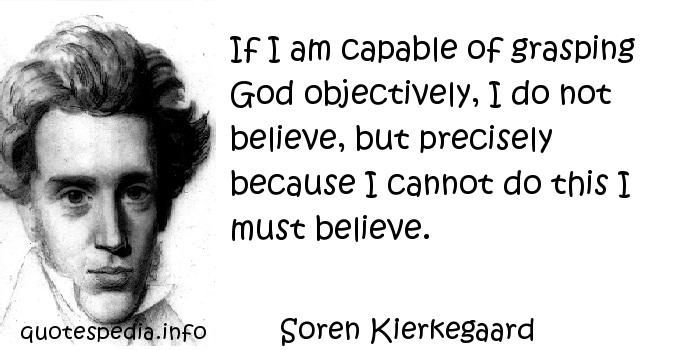
soren_kierkegaard_god_6322


Søren Aabye Kierkegaard (/ˈsɔrən ˈkɪərkəɡɑrd/ or /ˈkɪərkəɡɔr/Danish: [ˈsɶːɐn ˈkiɐ̯ɡəɡɒːˀ] ( listen)) (5 May 1813 – 11 November 1855) was a Danish philosophertheologianpoetsocial critic, and religious author who is widely considered to be the first existentialist philosopher.[5] He wrote critical texts on organized religionChristendommoralityethicspsychology and philosophy of religion, displaying a fondness for metaphor, irony and parables. Much of his philosophical work deals with the issues of how one lives as a “single individual”, giving priority to concrete human reality over abstract thinking, and highlighting the importance of personal choice and commitment.[6] He was a fierce critic of idealist intellectuals and philosophers of his time, such as Swedenborg,[7] HegelGoetheFichteSchellingSchlegel, and Hans Christian Andersen.

Kierkegaard’s Insight into Creative People

“A poet is an unhappy being whose heart is torn by secret sufferings, but whose lips are so strangely formed that when the sighs and the cries escape them, they sound like beautiful music and then people crowd about the poet and say to him: “Sing for us soon again;” that is as much as to say, “May new sufferings torment your soul.”‘

For a person who gives out creatively means to sweat drops of blood; it is torment that teaches us new words. Pain comes surely as the morning sun rises. There maybe a hint of duplicity as the patron sees the pain– but demands his art, nevertheless.

Søren Kierkegaard

Some of Kierkegaard’s key ideas include the concept of Truth as Subjectivity, the knight of faith, the recollection and repetition dichotomyangst, the infinite qualitative distinction,faith as a passion, and the three stages on life’s way. Kierkegaard’s writings were written in Danish and were initially limited to Scandinavia, but by the turn of the 20th century, his writings were translated into major European languages, such as French and German. By the mid-20th century, his thought exerted a substantial influence on philosophy,[16]theology,[17] and Western culture.[18]

Soren-Kierkegaard-quote“Revelation is marked by mystery, eternal happiness by suffering, the certitude of faith by uncertainty, easiness by difficulty, truth by absurdity; if this is not maintained, then the esthetic and the religious merge in common confusion. … The religious lies in the dialectic of inwardness deepening and therefore, with regard to the conception of God, this means that he himself is moved, is changed. An action in the eternal transforms the individual’s existence.”

This was part of Kierkegaard’s theory of “indirect communication.” He wrote:

“No anonymous author can more slyly hide himself, and no maieutic can more carefully recede from a direct relation than God can. He is in the creation, everywhere in the creation, but he is not there directly, and only when the single individual turns inward into himself (consequently only in the inwardness of self-activity) does he become aware and capable of seeing God.” Concluding Unscientific Postscript, Hong 1992 p. 243

Despite everything people ought to have learned about my maieutic carefulness, in addition to proceeding slowly and continually letting it seem as if I knew nothing more, not the next thing — now on the occasion of my new upbuilding discourses they will probably bawl out that I do not know what comes next, that I know nothing about sociality. You fools! Yet on the other hand I owe it to myself to confess before God that in a certain sense there is some truth in it, only not as men understand it — namely, that when I have first presented one aspect sharply, then I affirm the other even more strongly. Now I have my theme of the next book. It will be called: Works of LoveJournals of Soren Kierkegaard VIII 1A4 ~~source, Wikipedia

Soren-Kierkegaard_Design-Crush

Two O’ Clock in the Morning Poetry, #6


Max Ehrmann (1872-1945)
Max Ehrmann
(1872-1945)

Go placidly amid the noise and haste, and remember what peace there may be in silence. As far as possible, without surrender, be on good terms with all persons. Speak your truth quietly and clearly; and listen to others, even to the dull and ignorant; they too have their story. Avoid loud and aggressive persons; they are vexations to the spirit. If you compare yourself with others, you may become vain or bitter, for always there will be greater and lesser persons than yourself.

Enjoy your achievements as well as your plans. Keep interested in your own career, however humble, it’s a real possession in the changing fortunes of time. Exercise caution in your business affairs, for the world is full of trickery. But let this not blind you to what virtue there is; many persons strive for high ideals, and everywhere life is full of heroism. Be yourself. Especially do not feign affection. Neither be cynical about love; for in the face of all aridity and disenchantment, it is as perennial as the shamgrass. Take kindly the counsel of the years, gracefully surrendering the things of youth. Nurture strength of spirit to shield you in sudden misfortune.

But do not distress yourself with dark imaginings. Many fears are born of fatigue and loneliness. Beyond a wholesome discipline, be gentle with yourself. You are a child of the universe no less than the trees and the stars; you have a right to be here. And whether or not it is clear to you, no doubt the universe is unfolding as it should. Therefore be at peace with God, whatever you conceive him to be. And whatever your labors and aspirations, in the noisy confusion of life, keep peace in your soul. With all its sham, drudgery and broken dreams, it is still a beautiful world. Be cheerful. Strive to be happy.

–Desiderata, Max Ehrmann 1927 
n
Max Ehrmann (September 26, 1872 – September 9, 1945) was an American writerpoet, and attorney from Terre Haute, Indiana, widely known for his 1927 prose poem “Desiderata(Latin: “things desired”). He often wrote on spiritual themes.

Ehrmann was awarded Doctor of Letters honorary degree from DePauw University in about 1937.[6] He was also elected to the Delta Tau Delta Distinguished Service Chapter, the fraternity’s highest alumni award.[3]

Max_Ehrmann_statueEhrmann died in 1945. He is buried in Highland Lawn Cemetery in Terre Haute, Indiana. In 2010 the city honored Ehrmann with a life-size bronze statue by sculptor Bill Wolfe. He is depicted sitting on a downtown bench, pen in hand, with a notebook in his lap. “Desiderata” is engraved on a plaque that resides next to the statue and lines from the poem are embedded in the walkway. The sculpture is in the collection of Art Spaces, Inc. – Wabash Valley Outdoor Sculpture Collection.[7]

Ehrmann returned to his hometown of Terre Haute, Indiana in 1898 to practice law. He was a deputy state’s attorney in Vigo County, Indiana for two years. Subsequently, he worked in his family’s meatpacking business and in the overalls manufacturing industry. At age 40, Ehrmann left the business to write. At age 54, he wrote Desiderata, which achieved fame only after his death. –from Wikipedia
n
be-gentle-with-yourself

Two O’ Clock in the Morning Poetry, #3

Collector_Trench

Middle Parts of Fortune, by Frederic Manning

“The air was alive with the rush and flutter of wings; it was ripped by screaming shells, hissing like tons of molten metal plunging suddenly into water, there was the blast and concussion of their explosion, men smashed, obliterated in sudden eruptions of earth, rent and strewn in bloody fragments, shells that were like hell-cats humped and spitting, little sounds, unpleasantly close, lie the plucking of tense strings, and something tangling his feet, tearing at his trousers and puttees as he stumbled over it, and then a face suddenly, an inconceivably distorted face, which raved and sobbed at him as he fell with it into a shell-hole.”

(Accounts of The Great War) 
R
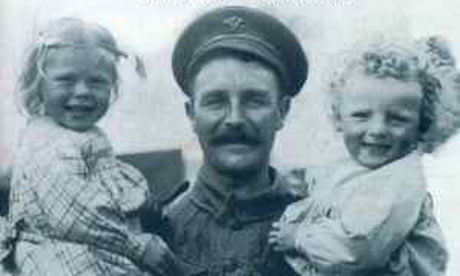
FredricmanningManning was an Australian aspiring intellectual, already in his mid-30s when he enlisted as a private soldier in 1915. His prewar existence in England was dogged by unfulfilled literary hopes and emotional confusions. He served for only a few months in France, and his military career ended in alcoholism and disgrace. But in 1929 he composed a novel, obviously autobiographical, about three soldiers’ experience of the trench nightmare, which is outstanding. Almost certainly the finest work of its kind to emerge from the war. (Penguin)
&

Manning continued to write. In 1917 he published a collection of poems under the title Ediola. This was a mixture of verse predominantly in his former style alongside war poems heavily influenced by the imagism of Pound, which deal introspectively with personal aims and ideals tempered in the crucible of battle. He contributed to anthologies, for example, The Monthly Chapbook which appeared in July 1919 edited by Harold Monro, containing twenty-three poems by writers including John Alford, Herbert ReadWalter De La MareOsbert SitwellSiegfried SassoonD. H. LawrenceEdith SitwellRobert NicholsRose Macaulay and W. H. Davies alongside Manning and Aldington. He wrote for periodicals, including The Criterion, which was produced by T. S. Eliot.

&&&

Poetry did not pay, and so in 1923 Manning took a commission from his publisher John Murray to write The Life of Sir William White, a biography of the man who, as Director of Naval Construction, led the build-up of the Royal Navy in the last years of the nineteenth century. Galton had died in 1921, which not only left Manning effectively homeless, but also lacking a forceful directing influence in his life. He lived for much of the time at the Bull Hotel in Bourne, apart from a short spell when he owned a farmhouse in Surrey. At this time he was friendly with T. E. Lawrence, then serving in the Royal Air Force at RAF Cranwell, some twenty miles (a motorcycle ride) from where Manning was living. In 1926 he contributed the introduction to an edition of Epicurus’s Morals: Collected and faithfully Englished by Walter Charleton, originally published in 1656, published in a limited edition by Peter Davies. — from Wikipedia and Penguin

&

Bonus–

wwi13
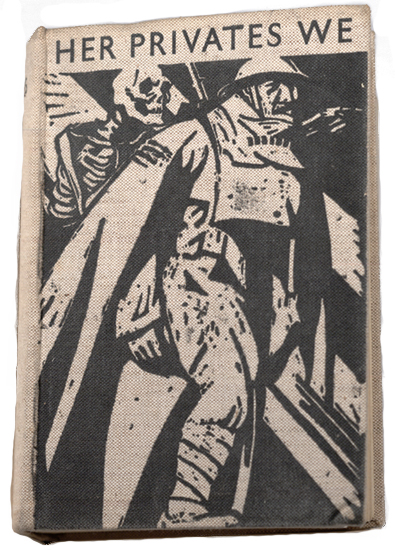
“Her Privates We” 1930, Cover art