We Have No Control

Lord, I know that a man doesn’t control his own life.
      He doesn’t direct his own steps.

Jeremiah 10:23


As we step into what matters, we find this simple verse.  Simply put, we have no idea about control.  We step out in ignorance, we don’t understand this concept of turning one’s life over to someone else.  This grates against everything we profess to understand.

There is no control.  He declares Himself to be completely and utterly in charge.  At this point, we must back-off and just assume that He is in charge. There has been a determination at the highest of points.  We always are available to connect with Him at these levels.  We simply come and ask for all mercy that has been stated.

I don’t turn anything off.  I most certainly open my heart to all that is available and retrievable.  I can’t dwell on anything above and beyond this.  When He comes, He generates a dynamic that works its way into our hearts.

The simple fact is that we have been brought to a definite assurance of a divine life.  It is freely given.  We do nothing to deserve it.  We advance with this concept and idea cemented into our hearts.  Nothing can be offered, it has already been done so.  All we can do is to absorb the kindness that has been offered and then step tentatively forward.

My trust is in His character.   He comes to me and it makes perfect sense.  I start connecting the dots. And it makes me understand His goodness.  His love has been extended to me, and all I can do is turn to Him, and let Him in.  There is nothing but His love for me that can affect me in this way.

The Manna Test

Then the LORD said to Moses, “I will rain down bread from heaven for you. The people are to go out each day and gather enough for that day. In this way I will test them and see whether they will follow my instructions. 

 Exodus 16:4, NIV


Just imagine, for a moment, that it is raining bread outside right now!  We got to see this!  We run outside and and are pelted with rye, and caraway and pumpernickel.  Bread!  Its everywhere, all you want, just pick it up.  It piles up like a yeasty hail, and it doesn’t seem to diminish, its everywhere!  We call the kids, ‘Bring buckets, and clean garbage bags’!

God has directly intervened in the life of Israel.  He becomes the exclusive producer of manna to the children of Israel.  He decides to give, and then He pelts them with His goodness– bread, delicious bread, fresh and warm, and they say it comes from heaven!  This is the ultimate!  BREAD!  This is far beyond anything I could imagine.

But if we clear away the piles, and draw near to those whom we assume know something, we will be struck by a sense of the reality of God.  The others grab on the basic idea; but we are shaken, to the core.  We come out, clinging to a God who loves us and intensely cares for us.  ‘He is real, and He loves us!”  And all others can see– are the piles and piles of bread.

 God has done something drastic, something right  ‘on the edge of reason’.  We encounter Him, (or He encounters us) and we get involved, whether we like it or not.  The decision will be a foundational and a concrete one.  It really is much, much more than bread from heaven. But will we connect the dots?

Even though we see the supernatural bread piling up, we need to be aware we are being ‘tested’.  So much of this test, really isn’t one at all.  It’s the sixth day that catches us.  Do we, who have become dependent on this supernatural supply, trust Him to provide on the Sabbath?  Maybe He will he just ‘blink-out’ and leave us hanging?  Maybe we should gather more, before He fails us?

We have to come to this clear and classic place.  I believe it is the real starting point.  Exactly how will you accept “free bread”?  Will I honor Him through it all?  (We are being ‘tested’ folks.  We are on the ‘clock’.)  The rub comes when we just don’t see it.  We turn, not so much as to reject what is obvious, but to take on that which is authentic.  If we will just do this, we will pass the test.

Photo: Night Sky

The heavens tell us about the Glory that God has.  We look up and see a universe that was created, and is now on display.  I remember on an isolated beach in Mexico.  One night, the entire Milky Way was revealed.  I laid on the sand transfixed by it all.  Suddenly, I got afraid and had the sensation of being very, very small.  That awareness has never left me.

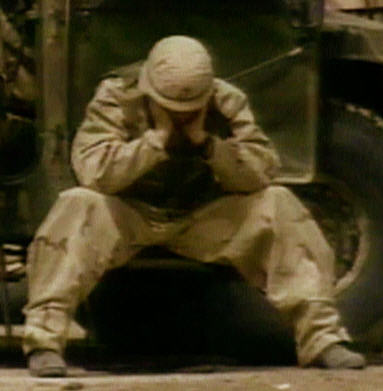
Combat’s Hidden Toll: 1 in 10 Soldiers Report Mental Health Problems

Soldiers Report PTSD Symptoms and Other Mental Health Problems
 
By KIM CAROLLO
ABCNews Medical Unit
June 9, 2010

Even though he’s retired from active military duty, CSM Samuel Rhodes still suffers from deep emotional wounds.

“I had to take this afternoon off from work today because of anxiety,” he said. “And sometimes, if I’m going through a really tough time, I think about suicide.”

He spent nearly 30 years in the Army and recently spent 30 straight months deployed in Iraq where he, like many soldiers, witnessed some of the horrors of war.

“In April 2005, it started to eat me up because I started losing one soldier after another,” Rhodes said. “We lost 37 soldiers that were in my unit.”

He was in charge of the brigade of 37 soldiers, and as time wore on, the loss of life wore him down.

“In April 2007, it came full circle. I considered suicide as an option. I felt guilty about losing those soldiers, even though I had no control over it,” he said.

“And I was sleepwalking. I had to tie myself to my cot to prevent it,” he added.

Later, during his 24th month in Iraq, he was found unconscious, and doctors diagnosed him with exhaustion. At that time, the combat stress doctor told him he was also suffering from post-traumatic stress disorder.

“He started explaining it to me, and I realized he was right,” Rhodes said.

And according to a new study conducted by researchers at Walter Reed Army Institute of Research, Rhodes’ mental health problems are common among soldiers returning from Iraq.

Between 2004 and 2007, researchers gave out anonymous surveys to four active duty brigade combat teams and two National Guard combat team three months and 12 months after deployment. The surveys screened soldiers for PTSD, depression, alcohol misuse and aggressive behavior and asked them to report whether these problems impacted their ability to get along with others, take care of things at home or perform their job duties.”A high number of those that had symptoms of PTSD and depression also reported some aspect of impairment,” said Jeffrey L. Thomas, one of the study’s co-authors. “The range was about 9 to 14 percent.” Depression rates ranged from 5 percent to 8.5 percent.

But by using a less stringent definition of PTSD, they found between 20 and 30 percent of soldiers showed symptoms of PTSD, while they found between 11.5 to 16 percent of them were depressed.

Full article, please go to:  http://abcnews.go.com/Health/MindMoodNews/10-soldiers-fought-iraq-mentally-ill/story?id=10850315&page=2