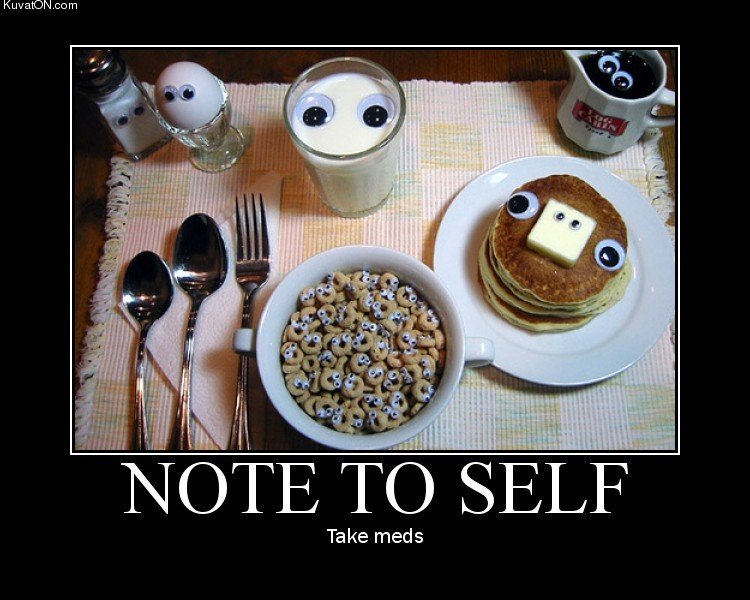
Just a little something to lighten your day. Hope all is well and if you’d like prayer for anything please let me know.

Related articles
- Prayer Request (sharinhislove.wordpress.com)

Serving Rascals, Clumsy Disciples, and Physically and Mentally Ill Believers with the Unconditional Love of Jesus Christ

Just a little something to lighten your day. Hope all is well and if you’d like prayer for anything please let me know.

I came across these and wanted very much to share them with anyone interested in some extracurricular reading. I have hand-picked these out of hundreds of possible posts. I know these will be a blessing.
There is somewhat of a mixture here. Some will be links to articles on mental illness, and others on Christian discipleship. And maybe, this might become a regular feature here on BB. (Who knows what lurks in my brain? lol) But what you find below, may be an incredibly rich blessing for you.
Discover Magazine has always been a good source of fascinating insight. Lithium for 50 years has been the most effective treatment for bipolar disorder.
http://discovermagazine.com/2010/the-brain-2/27-metal-marvel-mended-brains-50-years-lithium
An exceptional site that I use daily. (It’s like a carpenter’s favorite hammer.) Almost 30 translations, search topics or themes. It is fresh and modern. I use it whenever I need to “cut & paste” a passage into a post. I’ve tried many and yet, this remains the best.
Research has indicated that bipolar disorder may be up to four times more common in young people who were straight-A students. A link between high IQ and bipolar disorder has been proposed for many years.
http://psychcentral.com/lib/2010/intelligence-linked-to-bipolar-disorder/
Got Questions? A solid and comprehensive place for anyone to sort things out. It’s easy to navigate. It is a “safe” place to think out loud about hard things. Do you have a question about God, Jesus, the Bible, or theology? Have you ever needed help understanding a Bible verse or passage? Are there any spiritual issues in your life for which you need advice or counsel?
Alltop is essentially a news aggregator— they supply a one page site of continuously updated links, on a topical base. They do a lot of broad subjects (I haven’t used it, except for BP news.) I don’t consult it often, but when I do it is almost always great. ( Alltop has started showing Broken Believer posts, yeah!!)
************

by Julie Anne Fidler, BB Weekly Contributor

Of the many bipolar symptoms I’ve dealt with over the course of my life, sleeplessness has been the toughest. Until I started taking a med called Seroquel, I never slept… ever. I remember telling my doctor that I had no recollection of a full night’s sleep. For nearly two years, Seroquel was sedating enough to provide me with rest. Rest isn’t the word for it. I was semi-comatose because of it, not that I’m complaining.
But the sedating effects wore off and for the past few months I have been stuck between three different kinds of insomnia. There are nights I can’t fall asleep at all and I spend the next day feeling like I’m battling the flu. Some nights I fall asleep only to wake up in the wee morning hours, long before the sun has even decided to wake up for the day and I can’t fall back to asleep. And other nights, I can’t fall asleep until the wee morning hours and I end up sleeping during the day.
Last week I could not sleep at all. I tried an over-the-counter sleep med that did squat. I cut out all the caffeine in my diet (I have a pretty bad coffee habit), and nothing would work. The result was a few days of relative instability. The rubber met the road for me, so to speak. I was feeling miserable, both physically and mentally, and the last thing I wanted to do was praise God or crack open my Bible. I didn’t want to do anything. I have a lot of hobbies but none of them appealed to me.
But I knew that if I wanted to pursue this ministry of helping others with mental illness, I had to do the things I told everyone else to do. And, so, I did. Reluctantly. Little bits at a time. I called a dear friend and mentor of mind and she prayed over the phone with me and I began to see the light at the end of the tunnel. Tears still fell, but I knew “mourning may last for the night, but joy comes in the morning.”
Of course, I knew I needed to do more than that. I knew I needed to solve my sleep problem. Man, everyone likes to make fun of Michael Jackson, but I get it. Not that I would ever inject Propofol into my veins, but I understand the exhaustion and frustration he must have been feeling. It’s hard to be human when you feel like a walking zombie.
I am now the proud owner of a bottle of Ambien. I was a little scared when my doctor prescribed it for me, because I have a friend who once hallucinated on it and thought her bed was surrounded by fairies. (At least it wasn’t ninjas, Taliban, or Chuck Norris.) I kept thinking, wow, the last thing I need is to hallucinate. Here’s one symptom I haven’t had yet, and I’d like to keep it that way.
I’m happy to report I have not hallucinated. I’m also happy to report that for the past three nights, when I go to bed, I fall asleep quickly and stay that way until morning. I’m even happier to report that I feel like a real person again – not a zombie, not emotionally unstable, just me. You know – normal crazy.
Far be it for me to leave you without a lesson, so here it goes.
Sleep disturbances are very common in people with mental illness, particularly bipolar disorder. If you’re waiting around for it to get better or avoiding having to take another pill (I’ve been guilty of this), give in. God made separate days for a reason. When you can’t sleep, they all blur into one big, never-ending day and it’s hard to see the newness and fresh hope of morning when every day is just an extension of the last. It makes sense that a malfunctioning brain would make for a malfunctioning body clock.
God wants you to have rest and hope. So, if you are not experiencing that today, make plans to get your life back.

 Julie Anne Fidler is a contributing writer for Brokenbelievers.com. She comes with a humble and understanding heart for those with a mental illness. Her writing gift is valued greatly. Look for her post weekly, on this blog. She keeps a personal ministry blog at www.mymentalhealthday.blogspot.com. Read more there.
by Julie Anne Fidler, BB Weekly Contributor

I am sitting across from one of my best friends in a trendy little café, sipping coffee as we always do. We have been good friends for years; we can tell each other things. We can screw up and make amends. We know each other’s heart. We both love Jesus and came back to our faith after an extended period of wandering away. She is single and wants to be married. I am married and want to have children. There is a lot we can relate to, except for one issue.
My friend is depressed. I have never known her not to be. I’ve never known her to be suicidal, but she suffers from mild depression most of the time. It permeates her life and while she doesn’t see it as a nagging issue, I do. We have never had a conversation in which she does not bring it up. To her credit, she handles it well. In fact, I’d say she handles it better than I do a lot of the time. She is a social bug who constantly thrusts herself into activities, whereas I am more of an isolationist when I’m depressed.
No, the issue is not how she handles her depression. The issue is that she does not want to acknowledge her depression is an illness. She is stuck in the place I was in for so long – believing that if she could be a better person spiritually, she would not be depressed at all. We’ve had “the talk” many times. I’ve told her about my own trials and tribulations and I’ve gone so far as to look up and explain the brain chemistry behind depression. She always insists she can handle it on her own.
It’s a free country and we can’t force anyone to take medication if they don’t want to. I would even go so far as to say that while I think my friend is suffering needlessly, the fact that she is able to “maintain” and lead a productive life shows that medication might not be a dire necessity. I’m hoping that one day she realizes that 25 mgs of something won’t make her any less of a person or any less of a Christian. But it’s not my place to force that pill down her throat.
When does mental illness go from being a nuisance to a life-snatcher?
Throughout my life, I have had my share of strongholds and I would even venture to call some of them addictions. At one point I realized that whenever I was depressed, stressed, or angry I would automatically reach for the wine bottle. 2 Peter 2:19 says, “…people are slaves to whatever has mastered them.” That single verse influenced me to change my behavior, and I believe it can be applied to mental illness, as well.
Jesus Christ came to free us of our sins, but also to free us from all the things this world uses to hold us back and keep us down. That is the beauty of Christ – we don’t have to wait until eternity to reap the benefits of being Christians. Jesus came to give us life and life more abundantly. That abundant life is, however, a choice.
There are different severities of mental illness. Not everyone needs the same thing. I need insulin for my diabetes, but my husband doesn’t take anything at all. Some choose not to seek help for their problem and that is their prerogative, but when does it cross over into foolishness? When someone asks me how I knew it was time to get help and seek a mental health diagnosis, I tell them I knew it was time when my problems ruled my universe and I lost just about everything and everyone I had. I had become a slave to bipolar disorder, and it had mastered me.
I used to believe that mental illness was in no way a spiritual issue, but I’ve come to realize that it is very much a spiritual issue. God never promised that life would be easy for believers. Come to think of it, the Bible tells us the exact opposite. But if you examine the Word of God, you will see that the Holy Spirit gives us gifts and abilities that enable to us to have inexplicable joy in the midst of painful circumstances. Are you facing your circumstances with a sense of hopelessness and despair? That’s not from the Lord.
Does your entire life feel hopeless? Do you despair when you should be having joy? Take a look at 2 Peter 2:19.
“They promise them freedom, but they themselves are not free. They are slaves of things that will be destroyed. For people are slaves of anything that controls them.”
Are you a slave to hopelessness and despair? Then maybe it’s time to reexamine your views on seeking help.
***
 Broken Believers