This Special Place, Where it is Always Christmas

“This Gospel anticipates a world far different from C.S. Lewis’s Narnia,where it is “always winter, and never Christmas.” But the promise of the Gospel is that it is always Christmas. To be “in Christ” is to enjoy each morning as a Christmas morning with the family of God, celebrating the gift of God around the tree of life.”

–Kevin Van Hoozer

Christmas can be a torment and tribulation for so many. I have no doubt it brings grief. Family, friends, finances– mixed liberally with heavy doses of materialism and manipulation will always bring us issues.  The music and decorations are mostly mere Novocaine (which doesn’t always work). Stress builds up. And we want none of that.

Being mentally or physically ill often accentuates these issues. I’m not sure why exactly, but suicide increases during this season. Perhaps the challenges Christmas brings just overwhelm a person who is struggling hard just to make it.

“Christmas is for children. But it is for grown-ups too. Even if it is a headache, a chore, and a nightmare, it is a period of necessary defrosting of chilled hidebound hearts.”  

–Lenora Mattingly Weber

As I think about Christmas, it is helpful for me to see it as a “mirror.” It is my reflection back to me. What we see, is who we are. If we have issues in our own life, the Season will just magnify them.  But this doesn’t mean its bad, far from it. There is always conflict, but this spiritual combat can bring us success. Some things must be fought for.

I’m convinced that in all of this, there is opportunity.  

The chance to connect to “Christmas”. The very idea is quite strange.  But Christmas can be an exquisite treat.  It is made by mixing love and truth in generous portions. As we look hard for it, there is something that moves us to a place far beyond us. Grace makes us to stand and look, perhaps for the first time.

When we truly process this, we’ll find “Christmas”. And honestly, it is more than a holiday. For the Christian, it is special time. And yes, there will be times when it is trying, but in my own thinking, Christmas has become a time of great joy and anticipation.

It won’t take much, maybe a little imagination on your part.

But those things you do may ignite and become a blaze that will direct them through their lives. Be kinder then you need to.

“The universal joy of Christmas is certainly wonderful. We ring the bells when princes are born, or toll a mournful dirge when great men pass away. Nations have their red-letter days, their carnivals and festivals, but once in the year and only once, the whole world stands still to celebrate the advent of a life. Only Jesus of Nazareth claims this world-wide, undying remembrance. You cannot cut Christmas out of the Calendar, nor out of the heart of the world.”   

Anonymous

bry-signat (1)

‘Sunning Ourselves in the Smiles of God’

kites

A boy stood on a windy hillside, flying a kite.

He continued to release the string of the kite and it went higher and higher until it was completely out of sight. One of his friends walked up and asked how he knew there was still a kite on the other end. He replied. “I know it’s there, I can feel it tugging on the line.”

Like the kite, we can’t see heaven with our eyes, but we can feel it tugging at our souls!

As a person with a mental illness, it’s easier in some ways to think about that place I am journeying to.  Through many cycles of depression I find this present life gets old, and the more I hear about heaven, the more excited I get.  I imagine a life without meds, and the constant monitoring of my moods. This place is going to be good, and that’s just the start!

 Heaven is described as:

  1. a great reward, Col 3:24
  2. present suffering not worthy to be compared with future glory, Rom 8:18 
  3. eternal weight of glory far beyond all comparison, 2 Cor 4:17-18
  4. surpassing riches of His grace towards us, Eph 2:7
  5. beyond all we could ask for or even think, Eph 3:20
  6. a complete and total healing, Rev 21:3-4

I sometimes think of my infirmities and pain.  I can’t wait to “shed” this mental illness. 

To be free from it will be one of best things I can think of.  To take off my depression, like a heavy coat on a warm day. To sit with Jesus in a cool garden with living water, that’s more refreshing than any iced tea. Eternity is my favorite things to think about–

“Where the unveile’d glories of the Deity shall beat full upon us, and we forever sun ourselves in the smiles of God.

—Ezekiel Hopkins 

I want to encourage you who are struggling now, with depression, anger,  schizophrenia, paranoia, abuse, OCD, addictions, PTSD, bipolar or any other handicap. There is a day coming, when we will forget the challenging battles that we’ve had to face. Wait for it.

And I must tell you, with all the strength I can muster–take hope and just journey one more day, and go ahead, dream about heaven.

Love, Bryan


Seeking Truth

Look for It

Words matter. Our choice of words, whether speaking or writing, makes a difference.

And words have meaning. That’s what dictionaries are for—to tell us what words mean. When we try to use words to mean something other than what they really mean, it causes confusion.

Sometimes people do this on purpose. One such misuse of a word that I have encountered lately is the use of the word “true” to substitute for “believe.” A person will say “such and such is true for me” when what they really mean is “I believe such and such.”

According to the dictionary, the word “true” means “being in accordance with the actual state or conditions; conforming to reality or fact.” Truth is not relative and is not affected by what any one person believes. Truth is external, and belief is internal, in origin.

Many years ago, when I was suffering from major clinical depression, there were a number of things I believed about myself. I believed I would always be depressed based on how long I had been depressed already and my doctor telling me I would always have bouts of major depression for the rest of my life. I also believed I would never be able to hold down a full-time job. I believed no one liked me and that I was worthless. In the parlance of relativism, these things were true for me.

But they weren’t true. They aren’t true and they never were, no matter how deeply I believed them.

And trust me, I deeply believed these things about myself.

But here I am, 18 years later, and I haven’t had a bout of major depression since God showed me how to be free. I’ve had the same good-paying full-time job for almost 12 years, and I had a different full-time job that paved the way for this one for 5 1/2 years before that. On top of my full-time job, I’m actively involved in my church and Bible Study Fellowship, have self-published two poetry books, and take care of my family. And I have a lot of friends, people who like me (and some who even love me).

As I look back over the past 20 years, I see God’s hand in my life, lifting me up and leading me to see the truth. I believe that. But it’s not my belief that makes it true. In fact, I could be dead wrong, but I don’t believe I am.

Whether God is real and cares about His creation enough to do all I believe He has for us is either true or not. It can’t be true for me and not for you, or vice versa. Truth is. As humans, our greatest purpose is to seek the truth. To say that truth is relative—that what is objectively true for me is different from what is objectively true for you—negates that essential human drive to know truth, to know our Creator, to know where we come from, and to know our reason for being.

At any rate, that’s what I believe.

Love,

Linda K.

Check out Linda’s site at: anchoredvoices.com.

Sorry, Not Sorry

Have you ever heard someone say those words? “Sorry, not sorry.” It’s kind of annoying. It’s said following a statement or action the speaker knows is unkind or won’t be appreciated by someone else, but they just don’t care. It’s worse than not saying sorry at all.

We humans have a terrible time admitting when we are in the wrong. There’s always some justification for our actions, often that we were wronged first, or we had no choice, or some such nonsense. Misunderstandings escalate into disagreements, which quickly become heated arguments, and nobody really wins in the end. Sometimes good friends end up enemies, all because no one will say those two simple, yet truly difficult, words: “I’m sorry.”

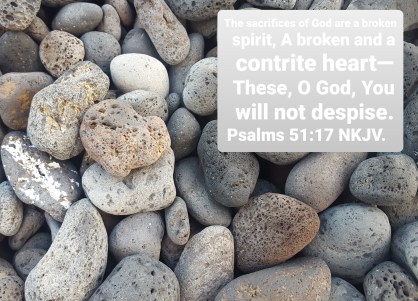
We sometimes have the same problem with God. We know we have not acted as we should, but we can’t let go of pride and say we are sorry. Scripture reveals the truth: a contrite heart is all God wants from us. He desires for us to admit when we’ve missed the mark.

The stories of King David and King Saul illustrate this principle. Both were in the wrong. David committed adultery, and then had the husband of the woman he slept with sent to the front lines of a battle, knowing he would be killed. But when the prophet Nathan brought David’s transgressions to his attention, David’s response was a remorseful attitude. He immediately fell to his knees and confessed his sin. And God forgave David.

Saul, on the other hand, committed a transgression that seems much less serious. He counted his army. Doesn’t sound like much of a sin, does it? But the heart of Saul’s transgression was a lack of trust in God. He didn’t believe he would win a battle even though God had promised him victory. Not only did Saul not trust God, he refused to confess his lack of trust. Instead he made excuses, tried to justify his actions. As a result, God took away Saul’s kingdom and gave it to David. And God did not forgive Saul.

David is remembered as a man after God’s own heart in spite of his many sins because a relationship with God was most important to him. Saul is not remembered so kindly.

What have we lost because we refuse to say we are sorry? A kind word, an admission of our own contribution to a dispute, can go a long way toward healing relationships. Is there someone you need to say “I’m sorry” to today? What’s holding you back? Is it a stubborn nature, like what often holds me back? What do you have to lose? What do I have to lose? More importantly, think what we have to gain.

What about your relationship with God? Is there some transgression you need to confess to restore the intimacy you once enjoyed with your Savior? What do you have to lose? You have the best God intends for you to gain.