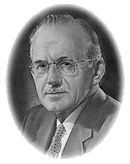
A.W. Tozer, on Having a Personal Revival

How to Have a Personal Revival,
Serious Repentance and Restitution, and
Steps to Spiritual Growth.

by A.W. Tozer

1) Put yourself in the way of the blessing. 

It is a mistake to look for grace to visit us as a kind of benign magic, or to expect God’s help to come as a windfall apart from conditions known and met. There are plainly marked paths that lead straight to the green pastures; let us walk in them.  To desire revival, for instance, and at the same time to neglect prayer and devotion is to wish one way and walk another.

2) Do a thorough job of repenting. 

Do not hurry to get it over with.  Hasty repentance means shallow spiritual experience and lack of certainty in the whole life.  Let godly sorrow do her healing work. Until we allow the consciousness of sin to wound us, we will never develop a fear of evil. It is our wretched habit of tolerating sin that keeps us in our half-dead condition.

3) Make restitution whenever possible. 

If you owe a debt, pay it, or at least have a frank understanding with your creditor about your intention to pay, so your honesty will be above question. If you have quarreled with anyone, go as far as you can in an effort to achieve reconciliation. As fully as possible make that crooked things straight.

*****

Thought 

Repentance and restitution result when we seriously reflect on what God shows us in His Word. What is it of which we need to repent and is there restitution to be made?


Scripture

“Bring forth fruit that is consistent with repentance [let your lives prove your change of heart];”

Matthew 3:8 (Amplified Bible)

Prayer

My tendency, Lord, is not to take seriously my sin that hurts other people and to leave unrepaired the damage I have left in the lives of others. Make me sensitive, Lord!


tozer
Aiden Wilson Tozer was born on April 21, 1897, on a small farm in Western Pennsylvania, the third of six children. And although he would inspire millions with his preaching and writing, he was given very little education during his childhood.

A. W. Tozer was 66 when he died of a heart attack on May 12, 1963. Buried in a small cemetery in Akron, his tombstone simply and appropriately reads, “A Man of God.” He left behind many books that continue to give Christians encouragement and guidance. His writings are as fresh today as when he was alive. His honest and colloquial humor has been known to sweep up congregations in gales of laughter. And his wisdom has left them silent and stunned. For almost 50 years Tozer walked with God, and even though he is gone, he continues to minister to those who are eager to experience God.

He Forgets

“I, I am he who blots out your transgressions for my own sake, and I will not remember your sins.”

Isaiah 43:25, ESV

Sometimes we’ve got a hard time forgiving ourselves for our sin.

Ironically though, the Lord has a hard time remembering them.  Obviously, He isn’t becoming senile on us. He chooses to become “forgetful.”  We’re told repeatedly that he has completely forgot and forgiven all of our darkest evils, and twisted agendas.

“He will again have compassion on us;
he will vanquish our iniquities.
You will cast all our sins
into the depths of the sea.”

Micah 7:9

Once we turn away from those very dark things, we find that the true God is patiently waiting. We discover that his arms are wide open, and he’s running down the path to meet us (Luke 15:20-21.)

There is something noteworthy and special about a forgiven sinner. 

In a deep sense we have been altered.  We have become a new creation (that word can easily be translated as “species.”)  Something tangible has happened, an alteration has taken place.  We’re something completely new and totally different–a forgiven believer now exists! “If anyone belongs to Christ, he is a new creation. The old things have gone; everything is made new!” (2 Cor. 5:17)

By our faith in Christ’s death, we discover that the power of our sin has been shattered.

And for the first time, we have the ability to say “no!”  We can now turn and go the other direction.  We can walk in such a freedom and awareness of being loved, that it really easy to let Him change us from the inside out. Like the prodigal, we must turn our backs on the pigs, and go home (Luke 15:16-17.)

“For I will be merciful toward their iniquities, and I will remember their sins no more.”

Hebrews 8:12, ESV

Sorry, Not Sorry

Have you ever heard someone say those words? “Sorry, not sorry.” It’s kind of annoying. It’s said following a statement or action the speaker knows is unkind or won’t be appreciated by someone else, but they just don’t care. It’s worse than not saying sorry at all.

We humans have a terrible time admitting when we are in the wrong. There’s always some justification for our actions, often that we were wronged first, or we had no choice, or some such nonsense. Misunderstandings escalate into disagreements, which quickly become heated arguments, and nobody really wins in the end. Sometimes good friends end up enemies, all because no one will say those two simple, yet truly difficult, words: “I’m sorry.”

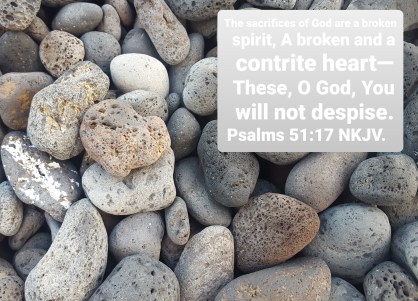
We sometimes have the same problem with God. We know we have not acted as we should, but we can’t let go of pride and say we are sorry. Scripture reveals the truth: a contrite heart is all God wants from us. He desires for us to admit when we’ve missed the mark.

The stories of King David and King Saul illustrate this principle. Both were in the wrong. David committed adultery, and then had the husband of the woman he slept with sent to the front lines of a battle, knowing he would be killed. But when the prophet Nathan brought David’s transgressions to his attention, David’s response was a remorseful attitude. He immediately fell to his knees and confessed his sin. And God forgave David.

Saul, on the other hand, committed a transgression that seems much less serious. He counted his army. Doesn’t sound like much of a sin, does it? But the heart of Saul’s transgression was a lack of trust in God. He didn’t believe he would win a battle even though God had promised him victory. Not only did Saul not trust God, he refused to confess his lack of trust. Instead he made excuses, tried to justify his actions. As a result, God took away Saul’s kingdom and gave it to David. And God did not forgive Saul.

David is remembered as a man after God’s own heart in spite of his many sins because a relationship with God was most important to him. Saul is not remembered so kindly.

What have we lost because we refuse to say we are sorry? A kind word, an admission of our own contribution to a dispute, can go a long way toward healing relationships. Is there someone you need to say “I’m sorry” to today? What’s holding you back? Is it a stubborn nature, like what often holds me back? What do you have to lose? What do I have to lose? More importantly, think what we have to gain.

What about your relationship with God? Is there some transgression you need to confess to restore the intimacy you once enjoyed with your Savior? What do you have to lose? You have the best God intends for you to gain.

The Hiding Place

forgiveness

“Instead, be kind to each other, tenderhearted, forgiving one another, just as God through Christ has forgiven you.”

Ephesians 4:32, NLT

Great hearts are often brought through experiences that demand intense forgiving.

The Father tutors us through out our earthly lives, with many visits to this classroom. It’s here we get our learning. It will happen several times in our walk, and we carry different nuances, or slants. Each time we are required to forgive authentically. The course is set for us. We can’t choose to skip these lessons without injuring ourselves, and harming others.

We are learning to love– it is our calling and destiny. There are no “accidents” or misaligned ‘drop-outs’ here. We step into our classroom, and the Teacher and Comforter begins His instruction. Many things will strike you as diabolical. Deep inside us we have simply no idea of how “this” will turn out for good. And you’d be right. But the power of God steps in, and “all is well”.

Corrie ten Boom-- Writer, speaker, Christian
Corrie ten Boom– Writer, speaker, Christian

Corrie Ten Boom was a Dutch Christian.

After her release from a Nazi concentration camp, she began traveling the world and speaking to any who would have her. The needs of postwar Europe were desperate. She traveled as an evangelist telling people who Jesus is and spoke about His redemption. She gave many people hope.

Through her travels she came in contact with a few of the guards that had been a part of the Nazi regime and had to practice forgiveness that only Jesus can bring. The first encounter with one of her previous jailers proved to be most difficult.

Here is an excerpt from her book, “The Hiding Place”.

“It was a church service in Munich that I saw him, the former S.S. man who had stood guard at the shower room door in the processing center at Ravensbruck. He was the first of our actual jailers that I had seen since that time. And suddenly it was all there – the roomful of mocking men, the heaps of clothing, Betsie’s pain-blanched face.

He came up to me as the church was emptying, beaming and bowing. “How grateful I am for your message, Fraulein,” he said. “To think that, as you say, He has washed my sins away!” His hand was thrust out to shake mine. And I, who had preached so often to the people in Bloemendaal the need to forgive, kept my hand at my side.

Even as the angry, vengeful thoughts boiled through me, I saw the sin of them. Jesus Christ had died for this man; was I going to ask for more? Lord Jesus, I prayed, forgive me and help me to forgive him.

I tried to smile, I struggled to raise my hand. I could not. I felt nothing, not the slightest spark of warmth or charity. And so again I breathed a silent prayer. Jesus, I cannot forgive him. Give me Your forgiveness.

She then took his hand and the most incredible thing happened.

From my shoulder along my arm and through my hand a current seemed to pass from me to him, while into my heart sprang a love for this stranger that almost overwhelmed me.

And so I discovered that it is not on our forgiveness any more than on our goodness that the world’s healing hinges, but on His. When He tells us to love our enemies, He gives, along with the command, the love itself.”

Corrie’s Wisdom for Us

  1. There is no pit so deep, that God’s love is not deeper still.
  2. Forgiveness is an act of the will, and the will can function regardless of the temperature of the heart.
  3. It is not my ability, but my response to God’s ability, that counts.
  4. When a train goes through a tunnel and it gets dark, you don’t throw away the ticket and jump off. You sit still and trust the engineer.
  5. Faith is like radar that sees through the fog-the reality of things at a distance that the human eye cannot see.
  6. Trying to do the Lord’s work in your own strength is the most confusing, exhausting, and tedious of all work. But when you are filled with the Holy Spirit, then the ministry of Jesus just flows out of you.

For her efforts to hide Jews from arrest and deportation during the German occupation of the Netherlands, Corrie ten Boom (1892-1983) received recognition from the Yad Vashem Remembrance Authority as one of the “Righteous Among the Nations” on December 12, 1967.

#

aabryscript

A Member of Faithful Bloggers