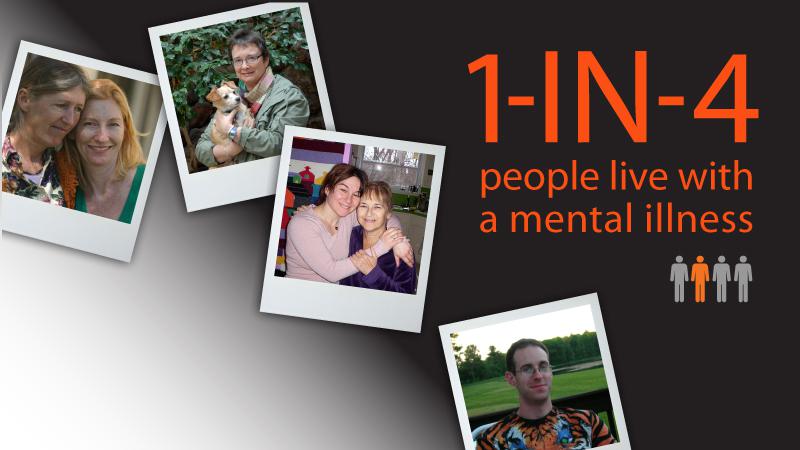
Today’s Suicide Toll: Put Faces to the Numbers

It’s time to attach faces to numbers. In less than 24 hours, 1577 will commit suicide. If you look closely, you can see faces.

As believers, these are our business. They are God’s business. Be aware of this. And pray.


For more valuable information see:

http://www.facebook.com/puttingafaceonsuicide AND http://nami.org/

1 in 4 Church Homes Are Dealing With This!

By Carlene Hill Byron

How many families in your church have a loved one who struggles with mental health problems? That’s kind of a trick question. People don’t talk about mental health problems. You’re more likely to hear them describe their child’s condition as “something like autism,” as the elder of one church we know says.

Or they might cover up entirely, as does an elder’s wife in another congregation. When her bipolar disorder swung into mania after childbirth, her family, already managing the added responsibilities of a newborn, had to manage her condition as well. But because her condition is a secret, they did so without any support beyond the usual “new baby” dinners.

The answer to the question is, if your congregation is representative of the U.S. population, one in four households will struggle with someone’s mental health problems over their lifetime. That’s schizophrenia, bipolar disorder, obsessive compulsive disorder, disabling chronic depression, and various anxiety disorders.  Look at the faces seated around you this Sunday.  Someone is probably hurting. And they’re probably afraid to tell you.

The least acceptable disability

Schizophrenia2
Out of Control

A study where people ranked disabilities by their “acceptability” returned these results, in order–most acceptable: obvious physical disabilities, blindness, deafness, a jail record, learning disabilities, and alcoholism.

Least acceptable: mental health problems. People with mental health problems frighten us because when people become mental ill, they become someone we don’t know. A bright boy who was his family’s bright hope may find he just can’t cut it anymore as schizophrenia turns him paranoid, disoriented, unmotivated in the extreme, and overwhelmed by delusional voices that tell him, over and over, how worthless he is.

Or, in the case of bipolar disorder, a girl who was a well-liked and active member of her Teen Challenge group may suddenly turn promiscuous, run away from home, and make a new home in the streets of a strange city. Laziness. Promiscuity. Violence. Sin. That’s what many people see when they look at those with mental health problems. It’s hard to believe that people may behave in such unacceptable ways and not be in control of their behavior.

Having a mental health problem is a lot like being on alcohol or drugs, without being able to stop. Medications “work” for about two-thirds of us. That means that a third of us can’t ever get off the chemical ride that our brains produce.

For those of us who can use medications, the side effects can be daunting. I have lost about 20 percent of my small motor functionality as a result of one of the five medications I take for bipolar disorder. I prefer that to losing large motor control and having another auto accident, being so disoriented I can’t find my way home from the store, losing bowel control in a busy bookstore, gaining 45 pounds, or any of dozens of side effects I’ve experienced on other medications.

Many people become so frustrated with side effects that they stop taking medications. Only about half of us accept treatment. Even when we are treated, not everyone regains their status as a fully functioning adult. In our extended family, six people have diagnoses. Those with bipolar disorder and chronic depression are successfully medicated and work full-time. Those with panic disorder and schizophrenia are on permanent disability. Nothing has pulled them through.


What the Bible says

The Bible talks about mental illness, as well as physical illness.

  • It describes a king who was made mentally ill until he would recognize the sovereignty of God (Dan. 4:29-34).
  • It describes demonized men who lived among the tombs and terrorized everyone until Jesus set them free (Matt. 8:28-33).
  • It also describes as demonized a young boy that most scholars today say had epilepsy (Matt. 17:15-18). Jesus delivered him, too.
suicide_germs
What was once believed

What does this tell us about illness?

First, that God is able to heal. Second, that some physical and mental illnesses are caused by demons. Third, that some mental illnesses are caused by sin. But are all mental illnesses caused by demons or sin, and is seeking God our sole resource for physical and mental healing?

Since the 1950s, we have usually sent church members with epilepsy to doctors for effective treatment with anti-convulsant drugs. In a similar way, we’ve learned that medicines can effectively treat many cases of mental illness. So if all mental illnesses were caused by demons and sin, medicine would be exorcising demons and turning hearts to repentance. That is certainly untrue, for those are the works of the Holy Spirit.

Instead, we now know that most if not all mental illnesses are biological in origin, with environmental factors possibly triggering an existing genetic predisposition to the illness. Mental illnesses, just like epilepsy, are biological disorders of the brain.

What can the church do?

Compassionate service is one of our core charges as Christians. We observe it almost daily in the experience of one man we know with schizophrenia. His life is confined almost entirely to his home due to the fear, indecision, and lethargy that have become the shape of the illness in his body. But neighbors bring him occasional meals. The secretary of his small church talks to him by telephone every weekday. Several other members take weekly calls at designated times to help break his isolation. If he doesn’t feel up to driving to his Bible study meeting or Sunday services, some member will give him a ride. Nearby relatives help him plan and manage his finances, and come by to clean occasionally and for DVD “movie nights.” Phone cards given as gifts allow him to call his mother nightly. There’s much more that could be done—more frequent house cleaning and more meals and more visits—but he enjoys far more contact with many more loving people than many shut-ins.

The challenging good news is that when people with mental illness turn to someone outside “the system” for help, the church is first to get the call 40 percent of the time. Is your church ready?

…………………..

Carlene Hill Byron is the former Director of Communications for Vision New England. Through NAMI—the Nation’s Voice on Mental Illness, she and her husband, James, train churches to effectively serve people within the congregation with mental health problems and also teach NAMI’s class for families of people with mental health problems. They are members of Asbury United Methodist Church in Raleigh, North Carolina, where James serves on staff. First published by Vision New England’s Ministries with the Disabled, Acton, Massachusetts.

http://www.mentalhealthministries.net/index.html

Surviving the Suicide of a Loved One

“I love you. God, I miss you. And I forgive you.”

~from the film Remember Me

“When I saw that scene in the movie, I stumbled out of bed and fell to the ground as my whole body trembled in anguish and agony — and I started and screaming like a wild, wounded animal.

It has been six years now since my friend, Britany, committed suicide. I thought, by now, I would be better. I thought I would have been able to let go. And move on.

At the very least, I had hoped that I would have felt the loss a little less now than I did when I first got the news.

I was wrong.”

Grief lulls you into a stupor. It hides inside you as you go about your business, working and doing the laundry and, Yes, even falling in love. You tell yourself, subconsciously, that if you’re not in tears then you must have moved past the mess. If you can function, you must be okay. Besides, you don’t eat out of cans anymore — and that has got to be a sure sign you’ve finally let go of your loss.

And if you say it out loud, you’re that much more convinced it’s true. I got over it. But when that lingering sadness creeps in, you’re right there with the excuse: Well, I’ll never really get over it until I’m in Heaven, but that doesn’t mean I have to spend all my time dwelling on it.

Those are the calling hours of grief, but you won’t answer the door. You’re scared to death of being weak, of being afraid, of feeling that way again. You were taught that God is gracious and loving, that He cares about you in ways you cannot begin to fathom, but the lies of a false religion have you believing that no gracious and loving God would ever want you to feel sad or desperate or crazy — to the point of falling to the ground in agony like a wild, wounded animal, begging Him for help with all your heart, all your soul, all your strength, and all your mind.

Like religious legalism equates the avoidance of sin with goodness, you thought everything would be all right if nothing appeared to be wrong. So you learn to speak casually of your loss. You dismiss your own grief. You learn to act, to hide. Your prayers start to sound like you’re talking to your Best Friend from childhood — whom you haven’t seen in years — but you have grown so detached from the Person you once thought you knew so very well that the relationship now lacks any kind of depth and every sort of substance. God has become a casual convenience. Because in the deepest, darkest caverns of your heart, you harbor a hidden resentment rooted in your loss.

And maybe, like me, you’ve screamed in tears of anguished rage as you ripped your Bible to shreds, only to buy a new one the next day because you’ve discovered — in that moment — that living without God is the one thought you cannot bear. To be absolutely alone in your pain, without hope, without His Presence, His forgiveness, and His eternally tenacious Love is an unspeakable horror. Nevertheless, you soon pretend such a moment never happened, stuffing it in the back of your mind like a distant memory. You can’t tell your friends about it because you know they’ll think you’re crazy. Worse, they’ll question your faith.  But you stay silent because you have enough doubts as it is.

Before long, the act becomes the reality. And you start to take a certain pride in what, you think, you have overcome. And every time that lingering sadness starts to creep in, you’re still right there with an excuse. You have become a master of self-rationalization, basking in the cheers and applause of your family and friends and church because your life is now a grandiose testimony to what, you think, God has done. But you don’t realize that basking in such glory is heresy, usurping the glory that belongs to God — and to God alone — because you want it yourself. It is foolish to presume this glory is somehow yours, as if you had earned it through your pain.

But, God won’t have it. The Lord of Heaven and Earth will not tolerate the lies you’ve been living in your relationship with Him. You are His child and you are His treasure. He delights in you in ways that go light years beyond your comprehension — and that includes making your life in a fallen world easy. Christ suffered, and you will certainly will as well. And it does not matter how fast you run or how well you hide. Even if it takes six years — or ten or twenty or eighty years — for you to realize that you need Him in ways you never thought possible.

You are broken. And that means there is no going back to the way things were. The loss has changed you. It has shattered your heart and bent your head and stolen every last ounce of strength and all sense of reason.  But somewhere, — somehow — in the midst of the mess, you found a faith so strong it defies logic and denies reason. You see what cannot be seen and you hear what cannot be heard — because you have felt the distant visions and echoes of eternity placed upon your heart. You can see through the storm. And you know sun rises beyond the dark clouds.

You don’t get over it. And you never do get used to it. The beast of grief you have kept buried inside for years will hunt you down and, without a doubt, leave you reaching for God in ways and means you never imagined. But you have now the one thing you’ve been missing all this time: a faith that has been shaken so hard it cannot be shaken. Even if God leads you to the floor crying and screaming like a wild, wounded animal — broken — you believe.

I have tried, determinedly and tenaciously, to give up on God, to forsake a life of service to our Father.  It just hurts that much.  It really does.  But, if I have learned anything in the past six years — it is, quite simply, that it is impossible for God to forsake His children.  He has pursued me through the darkest nights and my monsoons of tears.  And He will absolutely will not give up on you — ever.  And so it is with a sincere, agonizing gratitude that I offer our Father a sacrifice of praise:

Pstorm 243

The Lord is The Most High God!

He is bigger than our sins,
and greater than our troubles —

He who stretched the sky above the Earth
and set the stars in their place  —
He sees, He knows, He hears.
He watches, He plans, He listens.

Is the One who made the mountains
smaller than your very own troubles?
Is the One who carved the valleys
hidden from the caverns of your hearts?

Is the One who levelled the plains
ignorant of your very own despair?
Is the One who commands the seasons
unable to direct your ship in the storms?

Look up, you precious daughters of The Most High!
Lift your heads, you adopted sons of The Almighty!

Is the One who paints a seaside sunset
deaf to your cries of infertility?
Is the One who turns the Earth every day
blind to the pleas of your petitions?

Is the One who renews the trees each spring
paralyzed to restore your heavy hearts?
Is the One who guides the birds with the winds
silent amidst your anguished prayers?

The Lord our God is The Most High God!

He is bigger than our sins,
and greater than our troubles.
He sees, He knows, He hears.
He watches, He plans, He listens —

And He promises

“When everything is ready, I will come and get you
so that you will always be with me where I am.”

Love,

The NorEaster


Check out TheNorEasters home page at:

http://thenoreaster.wordpress.com/

In Pursuit of Happyness

By CARONAE HOWELL, From the New York Times, dated July 20, 2009

flight1
To fly away

I’m the kind of woman who spends entire days thinking of nothing but birds: woodcocks, goldfinches, kingfishers. I look for loons everywhere I go. Sometimes I find herons in Central Park and they are mysteries. There is one thing in this world that I envy: the hollowness of bird bones. In the three milliseconds of liftoff, a bird separates itself from its problems. The sky is the freest part of the world.

I have always been depressed, and I have always wanted to fly — not to emulate Superman or to travel faster. I want to fly because of the elation. In my dreams I am a butterfly or a fairy or a honeybee. Depression, for me, is when you want to be a bird, but can’t.

There is a specific moment in which I became a woman. It was February — always the worst month with its aching light and its slip-induced bruises. I had been trying to fall asleep for at least four hours. At 3 a.m., I found myself sobbing and shaking and confused, sitting on my metal dorm bed in the bird-with-a-­broken-wing position. I dug my fingernails into my forearms, leaving shell-shaped trenches behind. I have the kind of skin that refuses to heal, just stays eternally raw and mottled. It was five weeks into my fourth semester.

In late January, a freshman hanged himself in my old dorm. I found myself asking, really, how hard is it to suddenly find yourself perched on a sink, rope around your beautiful neck, ready to fly? How hard? My dad drove through four states to pick me up the next week. On the way home I had tea and ice cream. He asked me if I remembered the time he took too many of his antidepressants. I did not. Nor did I remember my uncle’s suicide (gun to the cerebrum) or my sister’s delicately sliced arms and hips. These were things I had only been told. The space between my skull and my irises hurts sometimes — hurts like the shatter of a tiny bird that has fallen midflight.

And so it was that sour February night that I took the delicate step into the adult world: realizing that I was too depressed to stay at college was realizing I had not only lost my flock; I had fallen from the air entirely. Michigan has many birds. My favorite might be the wood duck, with its banded neck and flat little wings. When I watch birds take off, I hold my breath. They always make it to the sky.

Every Monday morning at 9 I see my therapist, mug of green tea and honey close at hand. I take new pills now. I have a routine: oatmeal in the morning, Wednesday nights with my father. I tell my therapist about Toni Morrison’s “Song of Solomon.” Who isn’t searching for their people? I arrange my thoughts. (No, I have never been in love and I am, in fact, afraid of men; I panic in Times Square; I grow attached to almost everyone I meet.) I have feathers and questions.

I moved to New York City for college in 2007. School did not grow me into an adult, nor did voting for the first time or doing my own banking. These things were not confrontations. How did I arrive at the place where I could look at my disease and say, “Yes, you are here, but I will not let you take the joy out of looking for birds”? I like to think it was New York, or my newfound discipline, but it was a more internal revolution. I acknowledged my traumas: I was not crazy, just damaged. I was molting. Columbia gave me many new things: a copy of the “Iliad” with a note saying the first six books should be read before orientation, a job in the oral history office, a sense of time management.

But without my sanity — without joy — these things had little value. I knew nothing until I knew I was hardly living. Hobbes and Locke and all the philosophers in the world could not matter when each day was insurmountable and burning. In my year and a half at Columbia, I began to learn how to love myself. I tell my therapist about my earliest memories and the bizarre geography of my family. I’m anxious and I have no self-esteem. But I am mending. Fifteen lost credits is a small price to pay for happiness. Perhaps I am learning how to fly. My bones may not be hollow, and joy will never come easily, but the beauty is in the struggle. The birds are everywhere.

Caronae Howell, Columbia, class of 2011, history major