“Therefore He is also able to save to the uttermost those who come to God through Him, since He always lives to make intercession for them.”
Hebrews 7:25
This defies reason. No matter how diseased your spirit, or black and vile your sin, Jesus reaches you. He takes extreme cases, and loves each person who comes. Mercy is the real currency of the Kingdom of God.
“Our Saviour kneels down and gazes upon the darkest acts of our lives. But rather than recoil in horror, he reaches out in kindness and says, ‘I can clean that if you want.’ And from the basin of his grace, he scoops a palm full of mercy and washes our sin.”
Max Lucado
The Kingdom is thriving. “Where sin abounds, grace abounds even more.” The behavior of our Lord is astonishing. He cleanses us daily from the sin and darkness we commit. He stands in a place of intense intervention for us. He is a gifted intercessor and prays consistently and efficiently.
Dialysis is a medical procedure that works to cleanse and purify a person’s blood. Those with sick kidneys can hook up to a device that filters out toxins and wastes out. It is an intervention that exists until a healthy kidney can be found. Often, in times of prayer and worship, I picture my own heart being cleansed from sin. People sometimes miss their dialysis– this can lead to confusion and mental impairment. You might say that Jesus is God’s mechanism for healing my soul.
Being touched by Him is the only reason we live. We have no reason and there is no relevance without being with Him. Our issues (which some call weaknesses) are His way of blessing us. “In our weaknesses, we become strong”.
“I am not praying just for these followers. I am also praying for everyone else who will have faith because of what my followers will say about me.”
John 17:2o
Here is where we watch Jesus weave an intercessory web of prayer for His followers. This is significant in three ways.
First, He bestows on intercessory prayer its breadth and width. What Jesus is doing is showing us the perimeters of prayer, revealing to us what it can do. The scope is pretty much everyone, in every generation, and nation. The last few months I’ve been praying for the Ukraine. I don’t know why, I have no contacts there. But I believe I have been recruited to pray. And it has been good for me to do this.
Secondly, Jesus displays His confidence that His message will work in the hearts of people. His followers will be ultimately effective with the Gospel. He is making spiritual provision for them, helping them, if you will, all the way down the corridors of time. Reaching each one, each believer.
What if you knew Jesus was praying for you? That you could hear Him in the next room, praying for you by name? That would be totally awesome! But He is praying, and has prayed for you. (That should pump you up!)
Thirdly, Jesus reveals His love. He is mere hours from a torturous death. He will be beaten severely, scorned and mocked. Yet Jesus is still “on-duty” as the Good Shepherd. He is thinking about us, and remembering our needs. You know, I’m not like Jesus at all. I think of myself, my needs, my situation all the time. But Jesus is teaching me to love, just like He does. He is teaching me JOY.
How many families in your church have a loved one who struggles with mental health problems? That’s kind of a trick question. People don’t talk about mental health problems. You’re more likely to hear them describe their child’s condition as “something like autism,” as the elder of one church we know says.
Or they might cover up entirely, as does an elder’s wife in another congregation. When her bipolar disorder swung into mania after childbirth, her family, already managing the added responsibilities of a newborn, had to manage her condition as well. But because her condition is a secret, they did so without any support beyond the usual “new baby” dinners.
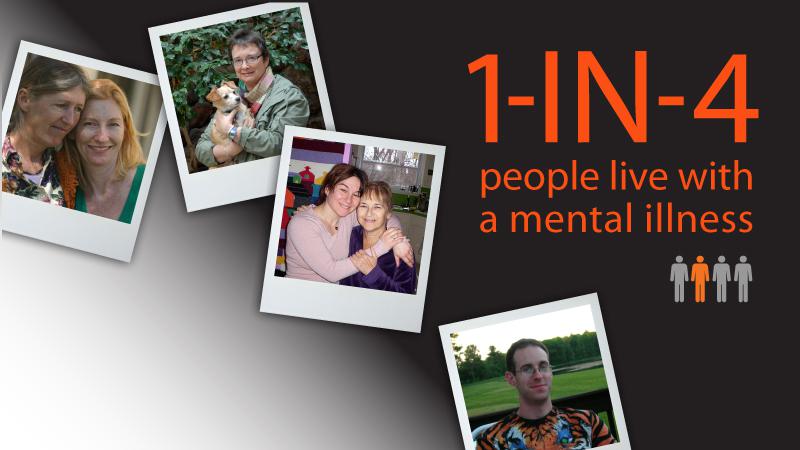
The answer to the question is, if your congregation is representative of the U.S. population, one in four households will struggle with someone’s mental health problems over their lifetime. That’s schizophrenia, bipolar disorder, obsessive compulsive disorder, disabling chronic depression, and various anxiety disorders. Look at the faces seated around you this Sunday. Someone is probably hurting. And they’re probably afraid to tell you.
The least acceptable disability
Out of Control
A study where people ranked disabilities by their “acceptability” returned these results, in order–most acceptable: obvious physical disabilities, blindness, deafness, a jail record, learning disabilities, and alcoholism.
Least acceptable: mental health problems. People with mental health problems frighten us because when people become mental ill, they become someone we don’t know. A bright boy who was his family’s bright hope may find he just can’t cut it anymore as schizophrenia turns him paranoid, disoriented, unmotivated in the extreme, and overwhelmed by delusional voices that tell him, over and over, how worthless he is.
Or, in the case of bipolar disorder, a girl who was a well-liked and active member of her Teen Challenge group may suddenly turn promiscuous, run away from home, and make a new home in the streets of a strange city. Laziness. Promiscuity. Violence. Sin. That’s what many people see when they look at those with mental health problems. It’s hard to believe that people may behave in such unacceptable ways and not be in control of their behavior.
Having a mental health problem is a lot like being on alcohol or drugs, without being able to stop. Medications “work” for about two-thirds of us. That means that a third of us can’t ever get off the chemical ride that our brains produce.
For those of us who can use medications, the side effects can be daunting. I have lost about 20 percent of my small motor functionality as a result of one of the five medications I take for bipolar disorder. I prefer that to losing large motor control and having another auto accident, being so disoriented I can’t find my way home from the store, losing bowel control in a busy bookstore, gaining 45 pounds, or any of dozens of side effects I’ve experienced on other medications.
Many people become so frustrated with side effects that they stop taking medications. Only about half of us accept treatment. Even when we are treated, not everyone regains their status as a fully functioning adult. In our extended family, six people have diagnoses. Those with bipolar disorder and chronic depression are successfully medicated and work full-time. Those with panic disorder and schizophrenia are on permanent disability. Nothing has pulled them through.
What the Bible says
The Bible talks about mental illness, as well as physical illness.
It describes a king who was made mentally ill until he would recognize the sovereignty of God (Dan. 4:29-34).
It describes demonized men who lived among the tombs and terrorized everyone until Jesus set them free (Matt. 8:28-33).
It also describes as demonized a young boy that most scholars today say had epilepsy (Matt. 17:15-18). Jesus delivered him, too.
What was once believed
What does this tell us about illness?
First, that God is able to heal. Second, that some physical and mental illnesses are caused by demons. Third, that some mental illnesses are caused by sin. But are all mental illnesses caused by demons or sin, and is seeking God our sole resource for physical and mental healing?
Since the 1950s, we have usually sent church members with epilepsy to doctors for effective treatment with anti-convulsant drugs. In a similar way, we’ve learned that medicines can effectively treat many cases of mental illness. So if all mental illnesses were caused by demons and sin, medicine would be exorcising demons and turning hearts to repentance. That is certainly untrue, for those are the works of the Holy Spirit.
Instead, we now know that most if not all mental illnesses are biological in origin, with environmental factors possibly triggering an existing genetic predisposition to the illness. Mental illnesses, just like epilepsy, are biological disorders of the brain.
What can the church do?
Compassionate service is one of our core charges as Christians. We observe it almost daily in the experience of one man we know with schizophrenia. His life is confined almost entirely to his home due to the fear, indecision, and lethargy that have become the shape of the illness in his body. But neighbors bring him occasional meals. The secretary of his small church talks to him by telephone every weekday. Several other members take weekly calls at designated times to help break his isolation. If he doesn’t feel up to driving to his Bible study meeting or Sunday services, some member will give him a ride. Nearby relatives help him plan and manage his finances, and come by to clean occasionally and for DVD “movie nights.” Phone cards given as gifts allow him to call his mother nightly. There’s much more that could be done—more frequent house cleaning and more meals and more visits—but he enjoys far more contact with many more loving people than many shut-ins.
The challenging good news is that when people with mental illness turn to someone outside “the system” for help, the church is first to get the call 40 percent of the time. Is your church ready?
…………………..
Carlene Hill Byron is the former Director of Communications for Vision New England. Through NAMI—the Nation’s Voice on Mental Illness, she and her husband, James, train churches to effectively serve people within the congregation with mental health problems and also teach NAMI’s class for families of people with mental health problems. They are members of Asbury United Methodist Church in Raleigh, North Carolina, where James serves on staff. First published by Vision New England’s Ministries with the Disabled, Acton, Massachusetts.
I’m personally convinced that living life is all about “trial and error.” We seem to be working out some holy experiment. More orthodox people call it discipleship, but that really isn’t the whole truth. It seems we are working it out in a spiritual lab keeping the good (like humility) and tossing the bad (like selfishness.)
We also experience blisters from “near-brushes” with God’s flames. About 30 years ago, I set myself on fire. I was in my little cabin in Alaska, and woke up on a January morning. It was cold, beyond cold. I set up the coffee pot and opened the oven door to get warm.
I turned my backside to get warm from the oven heat. It was then the fire set my sweater on fire. I went up like a candle. I couldn’t get the flames off my back. I tried to drop and roll, and all that happened was that I pressed the burning sweater into my back. (I also caught the carpet on fire.)
The pain was intense. I was panicking. We had an inside bathroom, and the shower was one of those massage kind with a long hose. By this time the flames were shooting up my back, over my shoulder and into my hair. I couldn’t pull of the tight sweater (which was acrylic and was melting on my skin.)
It took a little bit of time to get the water to flow through the hose– and I was burning to death! The water finally made its inexorable way to the shower head, and at last I found relief.
“He makes his angels winds, and his ministers a flame of fire.”
Hebrews 1:7, ESV
The night before I read that particular verse, and spent some time thinking about it. I’m certain I read if before, but somehow it seemed I was reading it for the very first time. “A flame of fire, how very odd,” I thought.
This was of those strategic points for me as I was wondering about any kind of “full-time” ministry. The irony certainly wasn’t lost on me that next morning when I flared up like a torch.
I ended up in the hospital with a lot of 2nd and 3rd degree burns down most of my back. It took a long time to heal, and I have some serious scars. It took many years before I could expose these burned areas to the sun.
Most of what I learned, was that I was a “marked man.” That our Heavenly Father was not adverse to using anything in my life, as long as it didn’t kill me. (I’m thinking of the Book of Job here.) There was such a slow healing, and it hurt so bad, that I must believe it was quite significant. So its trial and error–and sometimes fire.
“The agony of man’s affliction is often necessary to put him into the right mood to face the fundamental things of life. The Psalmist says, ‘Before I was afflicted I went astray; but now I have kept Thy Word.'”Oswald Chambers
“The Lord afflicts us at times; but it is always a thousand times less than we deserve, and much less than many of our fellow-creatures are suffering around us. Let us therefore pray for grace to be humble, thankful, and patient.” John Newton







 Broken Believers