Let the Church Be the Church

Brennan Manning

“Any church that will not accept that it consists of sinful men and women, and exists for them, implicitly rejects the gospel of grace. As Hans Kung wrote, “it deserves neither God’s mercy nor men’s trust”.

The church must constantly be aware that its faith is weak, its knowledge dim, its profession of faith halting, that there is not a single sin or failing which it has not in one way or another been guilty of.

And though it is true that the church must always disassociate itself from sin, it can never have any excuse for keeping any sinners at a distance. If the church remains self-righteously aloof from failures, irreligious and immoral people, it cannot enter justified into God’s kingdom. But if it is constantly aware of its guilt and sin, it can live in joyous awareness of forgiveness. The promise has been given to it that anyone who humbles himself will be exalted.”

Brennan Manning

The Scream

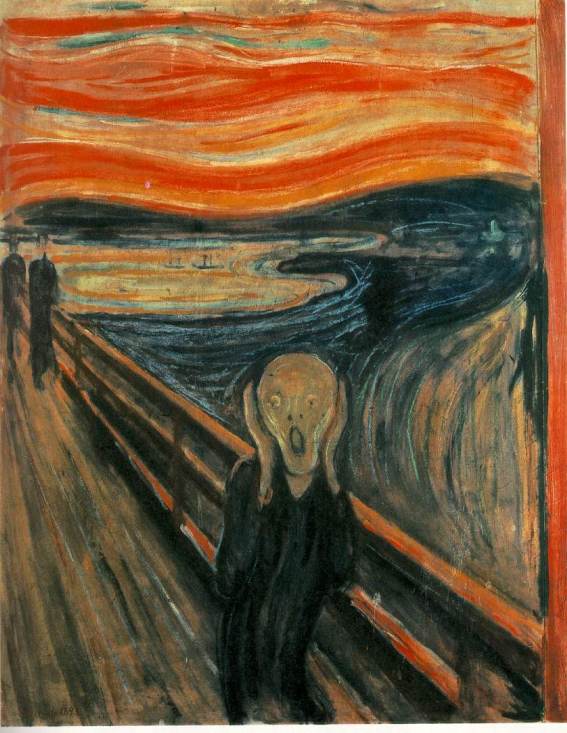
You’re probably familiar with Edvard Munch’s painting The Scream yesterday it sold at auction for 120 million dollars. It is a profound painting, but do you know its inspiration? From the venerable Wikipedia, a quote from Munch’s own diary, written January 22, 1892:

“I was walking along a path with two friends—the sun was setting—suddenly the sky turned blood red—I paused, feeling exhausted, and leaned on the fence—there was blood and tongues of fire above the blue-black fjord and the city—my friends walked on, and I stood there trembling with anxiety—and I sensed an infinite scream passing through nature.”

“… an infinite scream passing through nature.”  That’s quite terrifying.  With this message, from those who know how things shall be.  We have to realize that ‘The Scream’ is a manifestation of a hellvalot of emptiness and confusion.  Once understood, we will try to move forward.  But the image of a man screaming on a pier, has ‘cut the nerve’ of our attempts to move ahead.

‘The Scream’ is like a razor blade, that is wielding an agenda that opens us up, and drives us to this place of desperation.  Rather than turn from the pain, we turn to the place where “we think we understand”.  But the panic and frightfulness are not easily subtracted out of our lives.  We try to advance, but are shackled by our own confusion.

Looking at this painting, we can identify with the ‘frozenness’ of the image.  We turn in refusal, for we understand the darkness.  We come to the place that we fully intend to open ourselves up.  But the captivity of our hearts becomes open and something that is available and accessible. It seems the ‘horror’ has an influence on our mental health.

‘The Scream’  becomes to be incredibly predictive.  Any strength we might have has become empty and hollow, we are left with confusion and disorientation.  The emptiness and desperation of being alone on the pier, puts us in a sense of lostness.  But this painting can lead us to God.  Jesus has taken our horror and absorbed it in Himself.


ybic, Bryan


My Deliverer

My Deliverer

So Jehoahaz pleaded with the Lord, and the Lord listened to him, for He saw the oppression of Israel, because the king of Syria oppressed them.”  2 Kings 13:4

“Then the Lord gave Israel a deliverer, so that they escaped from under the hand of the Syrians; and the children of Israel dwelt in their tents as before.”  2 Kings 13:5

I see this:
Our pleading + God’s listening = Our Deliverance

Lord, I’m pleading with You for deliverance of those who are being oppressed today.  And here’s a simple poem . . .

Pleading

The oppression is so great
they can but hardly pray

and so I’m pleading with You
to please take it away

lift the heaviness
that keeps pushing them down

let them see their Deliverer
has come to save them now.

Amen.

Deb’s Blog of Simple Poems and Faith

http://iftodaywehear.wordpress.com/2012/03/12/my-deliverer/

Chutzpah!

chutz·pah

  http://sp.dictionary.com/dictstatic/d/g/speaker.swf

A word from the Hebrew

1. unmitigated effrontery or impudence; gall. 2. audacity; nerve.  3. shameless audacity; impudence.

****

The essence of “chutzpah” has been described as the man who murders his parents, and then throws himself on the court because he is now an orphan. (At least that is what I have heard.) Chutzpah is most often found when things seem unattainable. It is an intelligent response to things that are ugly and desperate, and yet somehow making them available. And it is typically and completely “out-of-hand.” It seems to step-up when things are bleak, and you make certain things negotiable again.

It’s like healing and deliverance are stored on the top-shelf.  Chutzpah goes and comes back with a ladder.  It simply will not be dissuaded or denied.

“Let us then with confidence draw near to the throne of grace, that we may receive mercy and find grace to help in time of need.”

Hebrews 4:16, ESV

There is the special need for a definite form of chutzpah here. We “get close.” And then we push closer. And we are totally beyond our place and status. But all we can see, is the “mercy and grace.” So because we see such wonders, we audaciously step into His presence.

“So, friends, we can now—without hesitation—walk right up to God, into “the Holy Place.” Jesus has cleared the way by the blood of his sacrifice, acting as our priest before God. The “curtain” into God’s presence is his body. So let’s do it—full of belief, confident that we’re presentable inside and out. Let’s keep a firm grip on the promises that keep us going. He always keeps his word.”

Heb. 10:19-21, MSG

I must admit, my preference is this– I just don’t like people with chutzpah. They seem arrogant, and I distrust arrogance. I don’t like it, and it is hard for me to see it as a virtue. But as I read the Word, I discover that the people of true faith seem very conceited. They swagger in, and will receive all (and more) of what they request (or demand.)

All of there behavior seems smug and superior to a sceptical heart. And yet I must reflect on all those in the Word who were outrageous, who stepped totally out-of-line. Jacob who wrestled. Moses who negotiated. Esther who persuaded. The adulterous woman who anointed. The leper who begged. There are quite a few others, we can find. They all were “cheeky” and dauntless.

What role does “chutzpah” have in our personal walk? Should we step out into this faith that is inherently susceptible to our incredible demands?  It is outrageous that we should demand an entrance into the presence of the Most High. And then when we finally stand in this place, we insist on complete and total forgiveness. Now that, dear friends, is a chutzpah kind of  arrogance!

If we should be “chutzpah-believers” we need to know the promises in the Bible. That alone will be the only place we can stand. Our faith must exclusively be based on what God has proclaimed in the Word. To come forward without a promise is very foolish.

In the Gospels we will find a blind man whose name was Bartimaeus. He steps up and clearly insists on a healing. “Jesus, Son of David, have mercy on me.” Jesus turns at this act of chutzpah. “What would you have Me do for you?” There is a profound audaciousness in his reply. “Heal me!”

As believers, sometimes we simply take the “humble route.” But if you want God, then you must step up, be bold and take what you need from Him. It seems that our Father insists we enter His presence quite “boldly.”

Over and over, we read of Bible characters who pronounced that boldness was an incredible virtue. But faith at its essence simply will not conform to any other definition. Faith insists that we be audacious and bold, way beyond any logic or reasoning. They might think we are quite outrageous, but we know that we are only being faithful.