Who Am I? by Dietrich Bonhoeffer

bonhoeffer-ins1

From the Journal of Dietrich Bonhoeffer

Dietrich Bonhoeffer (1906-1945)

Dietrich Bonhoeffer was a German Lutheran pastor and theologian. He was also a participant in the German Resistance movement against Nazism, a founding member of the Confessing Church. His involvement in plans by members of the Abwehr (the German Military Intelligence Office) to assassinate Adolf Hitler resulted in his arrest in April 1943 and his subsequent execution by hanging in April 1945, shortly before the war’s end.

Protestant theologian Dietrich Bonhoeffer stands out among the Christian leaders during the Nazi era, for he was one of the few to actively resist the racist actions of the Nazi regime. In addition to his legacy of courageous opposition to Nazism, Bonhoeffer’s theological writings are still widely read in Christian communities throughout the world. “At the place of execution, he again said a short prayer and then climbed the steps to the gallows, brave and composed. His death ensued after a few seconds. In almost fifty years that I worked as a doctor, I have hardly ever seen a man die so entirely submissive to the will of God.” Source: Prison doctor witness to Bonhoeffer’s death  

From His Writings–

Who am I? They often tell me

I stepped from my cell’s confinement

Calmly, cheerfully, firmly,

Like a squire from his country-house.

Who am I? They often tell me

I used to speak to my warders

Freely and friendly and clearly,

As though it were mine to command.

Who am I? They also tell me

I bore the days of misfortune

Equally, smilingly, proudly,

Like one accustomed to win.

Am I then really all that which other men tell of?

Or am I only what I myself know of myself?

Restless and longing and sick, like a bird in a cage,

Struggling for breath, as though hands were

compressing my throat,

Yearning for colors, for flowers, for the voices of birds,

Thirsting for words of kindness, for neighborliness,

Tossing in expectation of great events,

Powerlessly trembling for friends at an infinite distance,

Weary and empty at praying, at thinking, at making,

Faint, and ready to say farewell to it all?

Who am I? This or the other?

Am I one person today and tomorrow another?

Am I both at once? A hypocrite before others,

And before myself a contemptibly woebegone weakling?

Or is something within me still like a beaten army,

Fleeing in disorder from victory already achieved?

Who am I? They mock me, these lonely questions of mine.

Whoever I am, Thou knowest, O God, I am Thine!

–July 18, 1944

cropped-cropped-cropped-christiangraffiti1-11.jpg


Waiting for the Green Light

“But I tell you that I am going to do what is best for you. That is why I am going away. The Holy Spirit cannot come to help you until I leave. But after I am gone, I will send the Spirit to you.”

John 16:7, CEV

The disciples are distressed.  They are now starting to realize that Jesus is leaving them.  In the recesses of their minds they can’t accept this.  It makes no sense at all.  (After all, we just got started.)  They have been with Jesus almost “night and day” for three years.  They can’t imagine life without Him present and available.

Jesus starts saying things to help His friends.  I am going “to do what is best for you.”  With this concise idea Jesus wants His dear ones to understand and accept His decisions.  They must accept “this is why I am going away.”  He starts to link His absence with the rich goodness of the Holy Spirit.  On strictly basic level, the disciples have a reason for anxiety.  The disciples are thinking. “He will not be here when I wake up.  Jesus has left!  I am alone, what will I do?”

We have a tendency to think of the Holy Spirit like a telephone.  The dynamic is this–someone calls me from a great distance.  When I pick up the ringing phone, that person is still a long way away– but the voice is close.  To think this way though, is to think wrongly.  We mistakenly think of Him in technological terms.  But Jesus is insisting it is a whole lot better than this. He isn’t on the phone– The Spirit is at the door, and He is ringing your doorbell.

“As soon as we see the Lord Jesus on the Cross, we know our sins are forgiven ; and as soon as we see the Lord Jesus on the Throne, we know the Holy Spirit has been poured out upon us.”   Watchman Nee

The doctrine of the Holy Spirit is meant to “upset apple-carts” and change the flow of nations.  The Holy Spirit is first and foremost personal.  He comes and draws in closer than a person could.  He fills us, and our spirits and His are mixed in a new way.  Was it nice to have Jesus bodily present?  Yes. Of course.  But it is also awesome to have the Spirit connecting with us in a most spiritually wonderful way.

When Jesus ascends, the Holy Spirit is given the “green light” to come, and deepen the special relationship that the Father now has for us.  However, we can still be a little confused.  We think that Jesus physically present would be superior to having the Holy Spirit inside of our hearts.  And it is easy to think that way. Who hasn’t dreamed of having Jesus sit down with us over a cup of coffee at our dinner table?  But, it’s not really “better”– not even slightly so!

As we examine Acts 1-2, we are escorted the the real and very active world of the Holy Spirit.  His presence turns these disciples into a “tossed salad” of the Holy Spirit and humanity.  What happens can never be undone or reversed.  The Holy Spirit has followed Jesus and is now transforming everything.  Essentially, we must trust in what God has done, and we should bow our hearts and knees to all the Father has done for us.  Please, Spirit, come and help us.

“If the Holy Spirit was withdrawn from the church today, 95 percent of what we do would go on and no one would know the difference. If the Holy Spirit had been withdrawn from the New Testament church, 95 percent of what they did would stop, and everybody would know the difference.”  A.W. Tozer

*

ybic, Bryan

kyrie elesion.

image by He Qi

Drink Up!

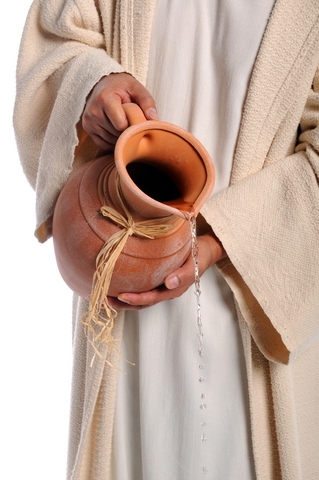
water-running from-hand

Now on the final and most important day of the feast, Jesus stood, and He cried in a loud voice, If any man is thirsty, let him come to Me and drink! 

John 7:37,   Amplified

The strangeness of this metaphor has never really been resolved in my thinking.  There is one other which strikes me as incredibly odd; it is when Jesus declares that He is “the Bread of life” whom we must eat.  With both of these I’m content right now to think that I am reaching through a cultural airlock, and things will resolve.  It isn’t doubt, I’m just content to wait for it to be sorted out.  I’m certain it shall be.

hands_of_jesus_pouring_waterBut I cannot minimize these declarations, and their significance.  “I am the Water for this parched world.  Come with your buckets and cups.”  If we but think about this, there is an implied exclusivity.  He has everything we need.  And there is no one else.  Also reading the text over again, I’m struck by the setting for this announcement.

They were standing in the Temple.  Jesus had been unveiling His ministry to be messianic, and His presence to be divine.  And the Temple and the feasts created the atmosphere for this dramatic revelation.  And the best part was this, “everyone, anyone who understands having a thirst, can come to me, and drink me.”

I lived for three years in the deserts of Baja, Mexico.  I learned about heat, and the exquisite value of water, and savoring it to the last mouthful.  I saw spring rains soak the desolate terrain, and saw the awesome results of a blooming desert.  And it was all about the water.

The world has been confronted by the real spiritual, and most don’t even understand this.  But yet we all know there exists a powerful thirst.  And thirst,  is perhaps the best word to use.  We walk through life parched and dried out, and nothing we’ve tried to drink has helped.  There has been a joint effort by many brilliant minds, but it has completely and definitely failed.

     “Is anyone thirsty?
      Come and drink—
      even if you have no money!
      Come, take your choice of wine or milk—
      it’s all free!”    -Isa. 55:1

Isaiah the prophet used the imagery of thirst.  He has shown us that thereis somewhere (or more precisely “someone”) who has the fantastical ability of meeting our needs.  I can’t say a lot about the “wine”, (but I’m sure it’s something good.)  And the milk? Well growing up in rural Wisconsin, I drank lots and lots of wholesome raw milk, straight from the cow. With the cream four inches thick in our gallon jar. It was grand, I loved it!

When we follow Jesus, He provides what we need.  When I come, as one of His flawed ones, He pays extra attention to me (at least that is what it feels like).  Satan’s lies fall away, and my understanding grows as I drink Jesus.

7

ybic, Bryan

kyrie eleison.

A Teflon Faith


teflon-frying-pan
The reality called “teflon.’

“That I will accept nothing belonging to you, not even a thread or the thong of a sandal, so that you will never be able to say, ‘I made Abram rich.’ “

Genesis 14:23

“But Daniel resolved not to defile himself with the royal food and wine, and he asked the chief official for permission not to defile himself this way.”

Daniel 1:8

There is something that certain men and women face when their faith is flourishing.  It is an authentic commitment to walk exclusively in the will of God, no matter where it takes us.  But both Abraham and Daniel had considered the ‘pros and cons’ of having a faith that would bend.  They chose however not to become this flexible.

As people who call themselves ‘believers’.  We need to figure out exactly how we are to emulate Abraham and Daniel.  How bold are we to become?  That question reverberates through us, and demands that we seriously deal with this issue.  Exactly when will we compromise, where is the line?

The Bible gives us the distinct impression that our compromise will lead us into a period of confusion and doubt.  Compromise is presented as a deadly choice, a decision that will irrevocably bring us to a death–of sorts.  For believers who consider themselves as flexible, there may lift to us some immediate consequences, but the end result is brutal.

We cannot trade to get a temporary peace and comfort to enable ourselves to walk in the place of harmony and successfulness.  If we try we will discover ourselves to be unfaithful and negligent to the Lord’s purposes and will.  This is a place of shame, and comes incredibly close to outright denial.  In this present ‘day and age’ perhaps our faithfulness might matter more then our ‘results’.

&

ybic, Bryan