Sorry, Not Sorry

Have you ever heard someone say those words? “Sorry, not sorry.” It’s kind of annoying. It’s said following a statement or action the speaker knows is unkind or won’t be appreciated by someone else, but they just don’t care. It’s worse than not saying sorry at all.

We humans have a terrible time admitting when we are in the wrong. There’s always some justification for our actions, often that we were wronged first, or we had no choice, or some such nonsense. Misunderstandings escalate into disagreements, which quickly become heated arguments, and nobody really wins in the end. Sometimes good friends end up enemies, all because no one will say those two simple, yet truly difficult, words: “I’m sorry.”
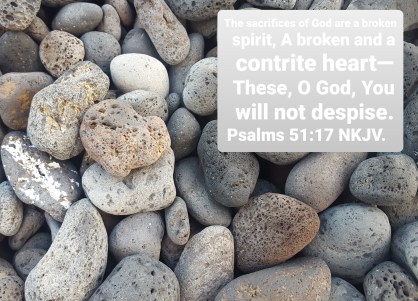
We sometimes have the same problem with God. We know we have not acted as we should, but we can’t let go of pride and say we are sorry. Scripture reveals the truth: a contrite heart is all God wants from us. He desires for us to admit when we’ve missed the mark.

The stories of King David and King Saul illustrate this principle. Both were in the wrong. David committed adultery, and then had the husband of the woman he slept with sent to the front lines of a battle, knowing he would be killed. But when the prophet Nathan brought David’s transgressions to his attention, David’s response was a remorseful attitude. He immediately fell to his knees and confessed his sin. And God forgave David.

Saul, on the other hand, committed a transgression that seems much less serious. He counted his army. Doesn’t sound like much of a sin, does it? But the heart of Saul’s transgression was a lack of trust in God. He didn’t believe he would win a battle even though God had promised him victory. Not only did Saul not trust God, he refused to confess his lack of trust. Instead he made excuses, tried to justify his actions. As a result, God took away Saul’s kingdom and gave it to David. And God did not forgive Saul.

David is remembered as a man after God’s own heart in spite of his many sins because a relationship with God was most important to him. Saul is not remembered so kindly.

What have we lost because we refuse to say we are sorry? A kind word, an admission of our own contribution to a dispute, can go a long way toward healing relationships. Is there someone you need to say “I’m sorry” to today? What’s holding you back? Is it a stubborn nature, like what often holds me back? What do you have to lose? What do I have to lose? More importantly, think what we have to gain.

What about your relationship with God? Is there some transgression you need to confess to restore the intimacy you once enjoyed with your Savior? What do you have to lose? You have the best God intends for you to gain.


But I Do It Anyway

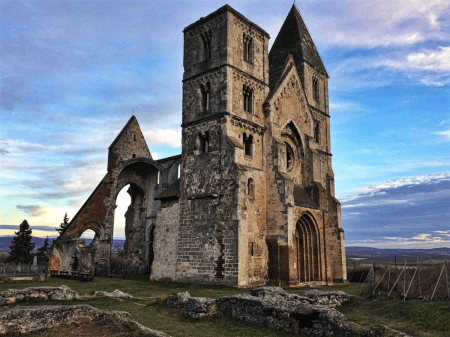
A collapsed church, a struggling life

“And I know that nothing good lives in me, that is, in my sinful nature. I want to do what is right, but I can’t.  I want to do what is good, but I don’t. I don’t want to do what is wrong, but I do it anyway. But if I do what I don’t want to do, I am not really the one doing wrong; it is sin living in me that does it.”

Romans 7:18-20, NLT

I hesitate to tell you this, but I have not found any hidden secrets to becoming a holy person.

To be sure, I wish I had figured this out sooner. I would very much like to come to you with the secret formula of godliness. I would easily latch on to this idea of a “magic wand” for every hurt. I think it would be good–and then again, maybe not. I’m certain it would be too much power for me to wield.

But the authentic Christian life is hardly formulaic. It seems to defy any attempt to explain, and then guide anyone else into that special place of true obedience or holiness. I’m supposing that you are just like me. I truly want to be right. I would love to be holy. But it ain’t happening. I always seem to end up back in the place I started from. Always, defeat and failure. (Rats!)

Romans 7 is not an excuse to sin, but it seems to be an observation of our present condition.

I’ve always been mystified by the conundrum that is Romans 7. You see, I really want chapter 8, but I’ll settle for 6, and even 5 would be good. But poor Romans 7 never gets considered. It’s been in limbo, I don’t really know what to do with it. (I honestly avoid it, after all chapter 8 is so good!) But way deep down, I have a strong sense I’m missing something vital and important.

Many good teachers and preachers view chapter 7 as parenthetical. They suggest that Paul is describing his life before coming to Christ, and certainly not in a ‘present-tense’ discipleship. (Definitely a brain-twister.)

When I look at the Gospels, I see, across the board that those– the healed, forgiven, cleansed and made whole were always the most desperate. They have nothing, they bring nothing– they meet no requirement, but stepping out into pure poverty. They are the “zeroes.”

I don’t believe, at this point anyway, that there is a singular doctrine of sanctification.

Perhaps we can truly do nothing in precise alignment. There is no such thing as a microwavable discipleship, and no instant breakfasts to be had. We truly come with a desperate faith– and we will end up with just a desperate faith.

This should be incredibly humbling to us all. It seems it takes some real repetitive lessons to learn humility as we meander down the way of God’s road of discipleship.

“I have discovered this principle of life—that when I want to do what is right, I inevitably do what is wrong. I love God’s law with all my heart. But there is another power within me that is at war with my mind. This power makes me a slave to the sin that is still within me. Oh, what a miserable person I am!”

Romans 7:21-24, NLT

Please (someone?– anyone?!) challenge me on this. I tell you, chapter 7 chafes, and then disrupts my comfortable life. Will I always be so misaligned? Or am I just a lousy excuse for a Christian disciple? If I’m out of line and screwed up– please let me know. “Simon Peter answered him, “Lord, to whom shall we go? You have the words of eternal life,” (John 6:68.)  This happens to be my cry at this present moment.

“The power of the Church is not a parade of flawless people, but of a flawless Christ who embraces our flaws. The Church is not made up of whole people, rather of the broken people who find wholeness in a Christ who was broken for us.”

–Mike Yaconelli

%

bry-signat-1-1


Stigma Sucks

anit-stigma-campaign-names

Mental illness doesn’t necessary mean exotic or strange– but it does mean different. It doesn’t make one bizarre, or odd. Coming to faith in Christ really settles this issue for most. While our mental illness is flaring up, yet we are still being changed by the Holy Spirit. He’s still at work–perhaps hidden, but he still is there.

We can’t really nullify the work of God. It takes as much grace to change a “normal” man as a mentally challenged one. God does not have to work any harder; there are no lost causes or last chances. All require the same grace. I really must thank God for this. Seriously.

Since I fight with depression I’ve become aware of mental illness throughout history. Many painters and poets, inventors and doctors have come from the ranks of bipolar disorder. Because many of those with manic depression and sufferers of depression have excelled; we would not have harnessed electricity if it wasn’t because a bipolar/ADHD created the light bulb.

But we are different. But we also can bring a giftedness that is necessary. We are not pariahs or leeches, but rather we are unique. Typically we may be passionate and sensitive. We are touched by something creative. Some have called depression and bipolar disorder as those “touched by fire.”

Mental illness can be seen as more of a mental difference, than a liability. We are not crazy or lunatics running amok. Sometimes others pity us; often when they do they shut us off, and permanently seal us up into a weird sense of extreme wariness. This should not be.

13 “You made all the delicate, inner parts of my body
    and knit me together in my mother’s womb.”

14 Thank you for making me so wonderfully complex!
    Your workmanship is marvelous—how well I know it.”

Psalm 139:13-14, NLT

God has created each one. We are all “knit together” by the hand of God. There are no second rates– never prototypes, not quite His best work. The blood of Christ works in spite of handicaps and personality quirks.

Some may hesitate about this. But it’s essentially an act of faith. The treasures of the Church are unique. They are the blind and the lame, the ones not always stable. What others consider marginal, or lacking, are really the valuable ones. It’s these that the Church should glory in.

During the middle ages a large church was surrounded by vandals. The priest was told that by noon the next day he must bring out the treasure of the church and pile them out on the steps. The next day, the vandals found a group of lame, weak, sick and mentally ill out on the steps. “What are these,” the leader demanded. The priest calmly said–these are the treasures of the church. 

We’ve become the audio/visual department of the Church. They see us and understand God’s gift of grace.

I encourage you to broaden your thinking on this. To stigmatize others is never a healthy, or a God honoring attitude. It indicates a small heart. If you pass false judgement, He will deal with you.


bry-signat (1)


Mending Your Nets

Tools used to mend nets

“And going on from there he saw two other brothers, James the son of Zebedee and John his brother, in the boat with Zebedee their father, mending their nets, and he called them.”

Matthew 4:21, ESV

“And immediately they left their nets and followed him.”

Mark 1:18

To mend nets was tedious but necessary. You would take your net and spread it on the ground in an open space. Every knot would be carefully examined. All holes would be repaired. Nothing was overlooked. Fishing nets were painstakingly maintained. Every day, without fail.

Fish would school, and if your gear was right, and you were in a prime place, you could catch a lot. But simultaneously, you could let hundreds of fish escape through a hole in your net. Each fish that escaped meant money lost.

Jesus walking along the beach surveyed the boats and crews. Since most of these guys had worked through the night, they were tired and maybe a bit “punchy.” Some had gotten somewhat lucky, while others had little to show for working so hard. Most likely the different crews teased each other as they unloaded.

Jesus walked through the bunches of fishermen. He looked at their hauls to see what they had caught. But it wasn’t the catch He was looking at, it was the men. It was from these laboring fishermen that He would choose. These men were rough-and-tumble rednecks. If they had chewing tobacco back then, they would use it.

He stands, looks, and then commands them.

Now if you are looking for disciples– future apostles and leaders, the seashore is not the best place to recruit. They really have a rudimentary education. No theology, and just a meager understanding of Jewish ritual and religion. Essentially there was no time for them to think outside their occupation. Sure there just might be one, or two that possessed more, but that would be the exception.

But Jesus had no desire to interview them, and take the best of the lot. He didn’t have a Human Resources Department, and there were no tests and no forms that had to list references. He simply commanded, and those who understood followed. Only after they left it all did He get their names and addresses. I think that it is the same today.

Will we leave our boat, with your nets? Really, you can keep mending or follow Him– it’s your choice. Most of the time though, decisions have a tendency to be irrevocable. Perhaps you have a moment, an instant of time to decide.

Sometimes mending nets can be back-breaking and tedious. But following the Lord Jesus is an unknown; too many choose to keep fixing. Others are launched into something new, and eternally significant.

The glaring truth is the necessity of obedience to Jesus’ command. There is no other voice we must hear. As a matter of fact, hearing (and really apprehending) is the only foundation we can trust to make our obedience true.

You can keep mending your nets and preparing for another night on the water. That is always your prerogative. But if you decide to follow you will need to leave what you know behind. That is authentic discipleship.

“Rest in this – it is His business to lead, command, impel, send, call or whatever you want to call it. It is your business to obey, follow, move, respond, or what have you.”

-Jim Elliot, missionary to the Auca Indians