Grief Sucks but God Restores Hope

It’s been 15 days since I got the news. My sister Suz passed away at 4:00 a.m. on a Thursday morning.

I hate that phrase, “passed away.” It makes it sound like she floated off in a gondola across the sea.

She died. Why do we shroud death in such wishy-washy language?

I never went to visit her before she died. I had plans to visit Memorial Day weekend. But that was a week too late. I really need to stop planning to visit loved ones who are sick and just do it.

The cards and condolences all give me permission to grieve this terrible loss. But I’m scared to let myself grieve. I can’t think about this loss of my oldest sister without remembering the loss of our sister Peggy (who also died on a Thursday), and Daddy before her, and Mom before him. The grief seems too much to bear.

Grieving is doubly difficult when every impulse to let tears fall feels like teetering on the rim of the pit of depression. What if I let the grief run free and it drags me into that hell I haven’t really known in over 20 years? I remember that place of desperation all too well and I refuse to go back there.

It’s not that I haven’t cried about her being gone. I definitely have, but it terrifies me when I do. And why do the tears keep coming back once they’ve been cried? How do I grieve but continue to live? 

I know this deep sadness is different from major clinical depression. I know the reason for these tears. When my depression was at its worst I had no idea why I couldn’t stop crying. The incessant tears served no discernible purpose. But the head knowledge that my tears of late do have a purpose—the loss of someone I dearly love—doesn’t alleviate the fear that they may drag me into another bout of depression.

The other day I queued up a few Chris Stapleton songs on YouTube while I worked on a relatively mindless project. I fondly reminisced about when she bought us tickets to see him at a small venue in Portland. Then a song came on that I hadn’t heard him sing before called “Drink a Beer.” The next thing I know I’m bawling and my heart feels like it’s breaking into a million little pieces and being compressed in a vise all at once.

Today, as every day for the last two weeks, the hard cider in the fridge calls to me. I usually wait until after work to have one. But I’m on vacation this week and today 3:00 p.m. seemed like a good time to have one. It’s 5:00 p.m. somewhere, right? And at least I’m not drinking tequila in her honor.

Maybe it’s the compound grief that is making it harder for me to cope with this loss. I don’t remember it being quite so unbearable when Peggy died, but then Suz was there with me for that loss. We began the grieving together. Now all my family support it on the other end of a telephone line.

When Mom and then Dad died, I was already depressed. My grief was fused with the vague despair of my mental illness. I suppose it could be that fusion that makes grieving so difficult now. I can’t seem to separate the two states of sorrow.

And yet this spiritual discipline of writing my thoughts and fears on paper helps me to gain a clearer perspective. I’m reminded as I write of a favorite Bible verse. John 11:35 says, “Jesus wept.” The occasion was the death of his dear friend Lazarus. Even though Jesus knew he was about to raise Lazarus to life again, Jesus modeled grief over the loss of a loved one. He declared in that shortest verse that tears are a normal part of this broken life we live in a world of sorrow upon sorrow.

The same apostle who recorded this verse penned the book of Revelation where we are told God “will wipe every tear from their eyes. There will be no more death or mourning or crying or pain, for the old order of things has passed away.” Revelation 21:4 NIV.

These tears I cry for my sister are normal. This grief is okay. Today won’t be the last time I grieve this loss. This will likely not be the last loss I will know in this broken world.

“We will never be the same as we were before this loss, but are ever so much the better for having had someone so great to lose.”

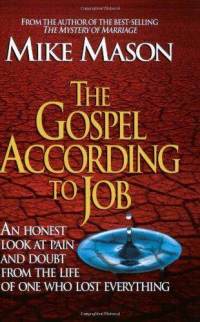
The Gospel According to Job

Today, I want to bring out this book, out into the spotlight.  It is a tremendous devotional that makes its way through the book of Job.  I have leaned on it, and it has held me nicely.  I challlenge you to get a copy of this, and to let it work in the confines of your spirit and mind. ––Bryan

A

Excerpt from “The Gospel According to Job,” by Mike Mason


“An Honest Look at Pain and Doubt from the Life of One who Lost Everything”

_______________________

A“Once I met a man who, like Abraham, had moved his entire household halfway around the world on the strength of a vision from God. When I asked him to tell me the story, he answered that there were three versions of that story, and which one did I want to hear? First, there was the version of the story that he told to Christians. Then there was the version he told to non-Christians. Finally, there was the truth. Job is a book that tells things from the third point of view. Probably, along with Ecclesiastes, it does this better than any other book in the Bible.

Not that the other Scriptures do not tell the truth. But Job tells the truth in a way that makes it almost impossible to pervert the truth into pious pabulum. A few years ago I went through a difficult time. Never mind what the problem was. It was nothing compared to the trials of Job. In fact, it was nothing at all compared to the sufferings of many of my neighbors right there on the quiet street where I lived.

But pain is pain, and suffice it to say that my pain was enough to drive me to my knees, totally defeated, half-crazy at times, and crying out for relief. Month after month the battles raged on, thick, dark, agonizing. I prayed, but somehow prayer did not ‘work.’ Usually nothing at all worked, except lying low and gritting my teeth until, for reasons entirely obscure to me, the straightjacket of oppression began to loosen a little––at least enough for me to get on with my life for another day or so before the screws tightened again. What else could I do? How was I to fight this?

In retrospect I can see that a large part of my anguish was rooted in the fact that there really was nothing I could do to control what was happening to me. I was absolutely helpless, and it is this, perhaps, that is the soul of suffering, this terrifying impotence. It is a little taste of the final and most terrifying impotence of all, which is death.

We Christians do not like to think about being absolutely helpless in the hands of our God. With all of our faith, and with all of His grace, we still prefer to maintain some semblance of control over our lives. When difficulties arise, we like to think that there are certain steps we can take, or attitudes we can adopt, to alleviate our anguish and be happy. Sometimes there are. But anyone who has truly suffered will know that when it comes to the real thing there is no help for it, no human help whatsoever.

Simply put, when we are in a deep dark hole we cannot think our way out; neither can we hope, sing, pray, or even love our way out. In fact there is absolutely nothing either we or anyone else can do to better our situation. We can have faith, yes; but in itself faith will not change anything. Neither faith, nor any other good thing that a person might have or do, can actually lift the cloud, move the mountain, or bring about an end to the problem.

Only the Lord Himself can do that, and when He does, as Exodus 6:6 puts it, “Then you will know that I am the Lord your God, who brought you out from under the yoke.” How will we know? Simply because nothing and no one else could possibly have done it. In this kind of crucible, therefore, we come to a new understanding of what it means to be saved, what it means to be snatched away from the brink of destruction.

Here we get down to the bedrock of the gospel. During my night of anguish, I turned to the book of Job, and there I began to make contact with the gospel in a way that somehow I never had in studying the New Testament. Reading Job, I found myself experiencing in new and astonishing depth the reality of Jesus’ promise in John 8:32,

 “You will know the truth, and the truth will set you free.”


cropped-christiangraffiti1.jpg