
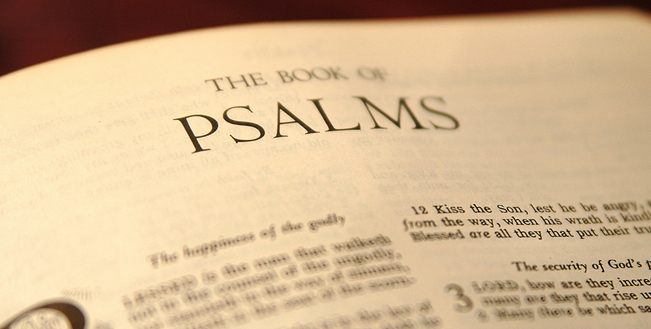
My Favorite Psalm

psalms_2

Probably the best known Psalm in the Bible is Psalm 23: “The Lord is my shepherd, I shall not be in want . . .” And I do like this Psalm. I particularly like the part that says “Even though I walk through the valley of the shadow of death, you are with me.” I like this part because of the preposition “through,” which indicates the valley of the shadow of death is not a permanent dwelling place, but rather a place we travel through to get somewhere else. But this is not my favorite Psalm.

Psalm 22 is also another popular one, especially since Jesus quoted it on the cross when he said, “My God, my God, why have you forsaken me?” I like this Psalm because of it’s prophetic nature. Looked at closely you can find many of the things that would later happen to Jesus talked about by David in this Psalm even though David did not know that is what he was doing. But this is not my favorite Psalm either.

Psalm 27 is another favorite of many because it gives courage when it says, “ The Lord is my light and my salvation; whom shall I fear? The Lord is the stronghold of my life; of whom shall I be afraid?” In a sometimes terrifying and wearying world, this Psalm provides great comfort to those enduring trials. But this is not my favorite either.

If you ask most Christians (and even some non-Christians), they will have a favorite Psalm, and I am no different. My favorite is Psalm 116. This Psalm starts in verse 1 with: “I love the LORD, for he heard my voice; he heard my cry for mercy.” This is a Psalm of David when he was in great anguish and danger. The verses that speak to me the most are 3-4 and 8-9.

3 The cords of death entangled me,
       the anguish of the grave came upon me;
       I was overcome by trouble and sorrow.

 4 Then I called on the name of the LORD :
       “O LORD, save me!”

8For you, O LORD, have delivered my soul from death,
       my eyes from tears,
       my feet from stumbling,

 9 that I may walk before the LORD
       in the land of the living.

Reading this Psalm reminds me of my journey through major depression and how God was with me in it all. It reminds me why I trust in Him – because He has proven Himself faithful to me in the past and has heard my cries for mercy. I supposed Psalms 23, 22, or 27 could serve the same purpose, but the language of Psalm 116 more closely fits the trouble and sorrow I went through, especially the part about delivering my eyes from tears. If you have ever experienced major depression, or known someone who has, you know that tears are an almost constant companion, and yet there is no understanding of why they are there.

I still have times of melancholy, and I certainly cry from time to time. But now I can identify what is making me blue and my tears have a reason and purpose when they come. And my God is always there to hear my cries of mercy.

So this is my favorite Psalm. What’s yours?

ysic, Linda K.

flourish15


The Day Jesus Sang

hqdefault

“Then they sang a hymn and went out to the Mount of Olives.” 

Matt. 26:30

This is the only place in scripture where it was recorded that Jesus sang.  There is no question that He sang on other occasions, we just don’t know the specifics.  The hymn on the way to the Mount would’ve been from the Book of Psalms, and most likely one of the Psalms of Ascent that would of coincided with that particular date. These hymns were known as the Hallel Psalms (meaning “Praise” psalms), and consisted of Psalms 113-118.

Jesus ‘singing’ tells us a lot of His frame of mind while heading for His death in just a few hours.  When a man is about to be executed at a definite place and time its unlikely that you will find him to be musically inclined.  Yet Jesus joined His brothers in singing to the Glory of God. He sings from darknesses depth.

“But the time is coming—indeed it’s here now—when true worshipers will worship the Father in spirit and in truth. The Father is looking for those who will worship him that way.”

John 4:23, NLT

The search in on!  The Father looks into our hearts to find something special.  Is it there?  Will He choose you?  Let’s not foolishly think that because you play the piano or the guitar you’ll be a “shoe-in.”  “Spirit and truth” is the awareness needed.  Being ‘filled with the Spirit’ is the only thing that is really necessary.

“Be filled with the Holy Spirit, singing psalms and hymns and spiritual songs among yourselves, and making music to the Lord in your hearts.”

Ephesians 5:19, NLT

An insincere heart can’t worship sincerely.

God is looking for worship that’s sincere and strong.  If we are not “spirit and truth” worshippers we can’t fake it. It is malfunctioning. But we can commence to begin.  We can start by preparing our hearts.  Putting them under the spigot of the spirit and of truth.  Let them soak like a sponge in God’s grace.  Things that are dry, will saturate themselves in God.

aabryscript

Flourish-61

Sin Boldly, But Believe in God More Boldly Still

Sinners-Wanted-1024x682

“If you are a preacher of mercy, do not preach an imaginary but the true mercy. If the mercy is true, you must therefore bear the true, not an imaginary sin. God does not save those who are only imaginary sinners. Be a sinner, and let your sins be strong, but let your trust in Christ be stronger, and rejoice in Christ who is the victor over sin, death, and the world. We will commit sins while we are here, for this life is not a place where justice resides.”

Martin Luther, From the Melanchthon Letter no. 99, 1 August 1521

 flourish1

Luther is essentially communicating the things that are real to us.  He takes it down to bare wood.  We are given an understanding of this World, an a sense of what we can expect from the hearts of all those who surround us.  Sin is the issue, and we need to accept that from our brothers and sisters.  We should not be surprised when someone we love intentionally blindsides us with their disobedience to God.

Dramatic words, ‘sin boldly’.  We instantly see this as a way to sin, without restraint.  And let’s face it, sinning is fun.  At times perhaps, even a whole lot more pleasure than walking out godliness.  Luther recognized the inevitably of sin.  As fallen people we should accept that fallenness.  We sin, it’s what we do, and we do that very well. And the Lord knows that.

“If we say we have no sin, we deceive ourselves, and the truth is not in us.”

1 John 1:8

Our ‘religious’ hearts often go into this ‘deception mode.’  We endeavor not give in to the viciousness of sin.  “We will overcome!” And yet we are so infected with sin, and rebellion that we try to minimize the problem.  If the truth be known, we are sick, infested and condemned.  There are no ‘quick fixes’ for us.  Evil runs rampant.  It is the ultimate epidemic.

picture-17
Looking at our salvation

“Let your trust in Christ be more boldly still.’  The Lord Jesus has decisively interrupted our lives.  He has wholesale entered into our darkness and sin.  In a way it’s like a ‘roadside’ bomb, and needs a direct intervention of a specialist to disarm it.  As people who are completely saturated with sin, we need a third party to step-in and to save us from all the embedded darkness.

Often there is a sense of boldness when we completely understand our depravity.  We ‘know’ our sin.  For the most part can grasp its deadliness, and its infectiousness.  The Holy Spirit’s ministry is to bring us to this transparent moment when we can see the darkness and harm we’ve caused.  The fact is, that we are to accept this, it’s all true.  We have been this evil and awful to those around us. Most believers would curiously admit that ‘they have sinned more as a believer’ than before they were first saved.

Luther declares a significant point when he tells us ‘to believe in Christ more boldly still’. Simply, our ‘sin’ awareness must never exceed our Christ awareness.  We must have a stronger sense of Jesus’ victory then our sinfulness.  Our confidence, which has taken a hit on our sinfulness, now shouts ‘hallelujah’ at His victory.

“If we claim we have no sin, we are only fooling ourselves and not living in the truth. 9 But if we confess our sins to him, he is faithful and just to forgive us our sins and to cleanse us from all wickedness. 10 If we claim we have not sinned, we are calling God a liar and showing that his word has no place in our hearts.”

1 John 1:8-10, NLT

“You need not fear because sin still plagues you – instead rejoice that by God’s grace you are on a journey toward eternal life and sin will finally fade into the distant past.”

Luther

“May it be the real me, that seeks and finds the real You.”

aabryscript

Further info, and source:  http://www.scrollpublishing.com/store/Luther-Sin-Boldly.html

http://www.lectionarysermons.com/june_30_02.htm

http://www.internetmonk.com/archive/a-luther-quote-to-wake-up-the-sleepers

Tangled Up in Sin (and Death)

vines-statue18 “Where is another God like you, who pardons the guilt of the remnant, overlooking the sins of his special people? You will not stay angry with your people forever, because you delight in showing unfailing love.

19 Once again you will have compassion on us. You will trample our sins under your feet and throw them into the depths of the ocean!”

Micah 7:18-18, NLT

These verses speak of the sin and guilt of God’s people. But even more importantly we hear of the extravagance of God to forgive so readily. Micah speaks directly to us who need to understand exactly what has been done for us. He knows what God is really like, and encourages not to give up hope.

I find that people as a whole understand sin. As they survey their lives, they are conscious of many flaws and shortcomings. Although we resist the label– ‘sinners’– we all admit a certain failure. It is this that Micah is speaking of. The Bible tells us “that all have sinned.” From the lost wino to the president of the United States, we are all cut from the same cloth. All means everyone. And we each have the same problem.

We are all in need of someone who will save us from our sin. These verses speak of the greatness of God to intervene. Without His intervention we are all buried in our sin. In a colorful way (so typical of Micah), we visualize God trampling down our iniquities, and forgiving us of so much sin. This is no small task. Generally, people are grateful for the intervention.

Like intertwined and tangled vines cover a marble statue, completely enmeshing it, we plead for release. There are many attempts at extricating ourselves. (Some rather heroic efforts). But nothing ever really works.

The wonder is that God has already done this. He has cut us free and trampled our sins underfoot. He has gathered up all our iniquity and dumped it in the Marianas Trench. We are now free to go. Our sin is forgiven. What a wonderful God!

Upon release we are free to help Him free the others. Isn’t this is what ‘evangelism’ is all about? What a noble task it is to assist the sons of Adam and the daughters of Eve.   1brobry-sig