The Frustration of Autism

What are Autism Spectrum Disorders?

Autism Spectrum Disorders (ASD), also known as Pervasive Developmental Disorders (PDDs), cause severe and pervasive impairment in thinking, feeling, language, and the ability to relate to others. These disorders are usually first diagnosed in early childhood and range from a severe form, called autistic disorder, through pervasive development disorder not otherwise specified, to a much milder form, Asperger syndrome. They also include two rare disorders, Rett syndrome and childhood disintegrative disorder.

Signs & Symptoms

Parents are usually the first to notice unusual behaviors in their child. In some cases, the baby seemed “different” from birth, unresponsive to people or focusing intently on one item for long periods of time. The first signs of an autism spectrum disorder can also appear in children who had been developing normally. When an affectionate, babbling toddler suddenly becomes silent, withdrawn, self-abusive, or indifferent to social overtures, something is wrong.

Possible Indicators of Autism Spectrum Disorders

  • Does not babble, point, or make meaningful gestures by 1 year of age
  • Does not speak one word by 16 months
  • Does not combine two words by 2 years
  • Does not respond to name
  • Loses language or social skills

Some Other Indicators

  • Poor eye contact
  • Doesn’t seem to know how to play with toys
  • Excessively lines up toys or other objects
  • Is attached to one particular toy or object
  • Doesn’t smile
  • At times seems to be hearing impaired

Social Symptoms

From the start, typically developing infants are social beings. Early in life, they gaze at people, turn toward voices, grasp a finger, and even smile.

In contrast, most children with ASD seem to have tremendous difficulty learning to engage in the give-and-take of everyday human interaction. Even in the first few months of life, many do not interact and they avoid eye contact. They seem indifferent to other people, and often seem to prefer being alone. They may resist attention or passively accept hugs and cuddling. Later, they seldom seek comfort or respond to parents’ displays of anger or affection in a typical way. Research has suggested that although children with ASD are attached to their parents, their expression of this attachment is unusual and difficult to “read.” To parents, it may seem as if their child is not attached at all. Parents who looked forward to the joys of cuddling, teaching, and playing with their child may feel crushed by this lack of the expected and typical attachment behavior.

Children with ASD also are slower in learning to interpret what others are thinking and feeling. Subtle social cues—whether a smile, a wink, or a grimace—may have little meaning. To a child who misses these cues, “Come here” always means the same thing, whether the speaker is smiling and extending her arms for a hug or frowning and planting her fists on her hips. Without the ability to interpret gestures and facial expressions, the social world may seem bewildering. To compound the problem, people with ASD have difficulty seeing things from another person’s perspective. Most 5-year-olds understand that other people have different information, feelings, and goals than they have. A person with ASD may lack such understanding. This inability leaves them unable to predict or understand other people’s actions.

Although not universal, it is common for people with ASD also to have difficulty regulating their emotions. This can take the form of “immature” behavior such as crying in class or verbal outbursts that seem inappropriate to those around them. The individual with ASD might also be disruptive and physically aggressive at times, making social relationships still more difficult. They have a tendency to “lose control,” particularly when they’re in a strange or overwhelming environment, or when angry and frustrated. They may at times break things, attack others, or hurt themselves. In their frustration, some bang their heads, pull their hair, or bite their arms.

Treatment

There is no single best treatment package for all children with ASD. Decisions about the best treatment, or combination of treatments, should be made by the parents with the assistance of a trusted expert diagnostic team.

Transcript of and interview with Dr. Bearman on Autism

Dr. Peter Bearman is the professor of Sociology at the College of Arts and Sciences at Columbia University. He also serves as co- director of the Robert Wood Johnson Foundation Health and Society Scholars program at Columbia. Recently, Dr. Bearman came to the National Institute of Mental Health to talk about the focus of his work, autism prevalence. NIMH’s Director, Dr. Thomas Insel, sat down with Dr. Bearman to discuss autism research and began by referencing recent studies that indicate an increase in autism prevalence.

Dr. Insel:  So, as you look at this that question that everyone is asking is when they see the numbers now from the CDC where it’s gone from 1 in 1500 to 1 in 150 and apparently here in the fall of 2009 the figure that’s emerging is closer to 1 in 100. Meaning, that even since 2002 there has been a very profound increase in the number of children being diagnosed with autism.

Dr. Bearman: And Autism Spectrum Disorders.

Dr. Insel:  Autism Spectrum Disorders?

Dr. Bearman: Well that’s, an important distinction. I mean obviously there’s a profound increase in Autism and Autism Spectrum Disorders.

Dr. Insel: Is there an increase in the number of children with the disorder or with the Autism Spectrum Disorder or does this largely reflect the change in the way the diagnosis is used or some sort of increase in ascertainment?

Dr. Bearman: Well, I think that’s the big million dollar question. Our work which arises from California can, show that changes in diagnostic processing and diagnostic criteria I would say the period from 1992 to 2005 the changes in diagnostic criteria over that period that operate on the border between autism and mental retardation can be associated with about a quarter of the increase prevalence. Over that same period there has been a really fundamental change in the ascertainment, you can see that in lots of ways, but the most obvious way to see the changes in ascertainment, is to see that the social economic status gradient that used to be present for autism, the fact that children living and residing in wealthy communities are more likely to get a diagnosis, and that gradient largely disappears.

Dr. Insel: What seems important Peter in the way you’ve done this rather than you answering the question to say it’s increase, not increased your answering the question by what proportion of increase can be explained by separate factors because everybody’s pointing to changes in diagnosis, changes in ascertainment the way in which services may affect the use of the diagnosis. So what everybody really wants to know at the end of all this, is that actually are more children affected with the disorder or will 100 percent of this increase in prevalence be explained by these other factors?

Dr. Bearman: Our strategy is to try to decompose this increase into its constituent elements. Some component of that is increased ascertainment, some component of that is diagnostic change in diagnostic criteria, some component of that arises from already known risk factors, such as increases in parental age are associated with greater probability of genome mutations that could lead to copy errors that are associated with neurodevelopmental disorders. So social demographic changes that are affecting all western countries, the United States, and also California, can express themselves in increased incidence of autism on top of diagnostic ascertainment dynamics. I think the trick to figuring out how to decompose this increase into its constituent elements is to pay attention to the two dimensions that are important. The first dimension is temporal just the fact of temporal change, we are in the period of increased prevalence and if we’re in a period of increased prevalence and at the same time for example there’s also an increase in older parents. The risk associated with older parents will naturally appear to be greater now than it was a decade ago. So paying attention to temporal heterogenic is important. The other part of our work I think that’s  the most exciting is to pay attention to the spacial heterogenic and the fact that we can observe very strong,  very distinct, very stable clusters of increased risks for autism at very fine spacial resolution. For example, in California, there’s a very clear cluster in about 20 kilometers by 50 kilometers in which the relative risk for autism not, Autism Spectrum Disorders but autism itself is significantly higher over every year of observation that we make than any other place in California. That invites a couple of considerations, first, it invites the recognition that if you observe local spacial clustering whatever causes some components of the increased prevalence in autism it is not a global treatment. Secondly, it invites us to ask, well is there something in that local area that is driving an increased prevalence that could be a shared toxicological environment, it could be a virus that moves through and spreads from person to person and affects children in utero. Or it could be a piece of an ascertainment process which would be the diffusion of information from parent to parent as they learn how to recognize some symptoms for autism which have no biological markers.

Dr. Insel: From what you know now when you add all of those together how much of the increase can you explain?

Dr. Bearman: Well that’s a complicated question, but I think we can pretty uniquely associate about a quarter of the increase from the birth cohorts from 1992 to 2001 which is a lot, to diagnostic change on the border between diagnosis and mental retardation in autism. I think we can associate about 16 percent of the increase on the other border between autism and other neurodevelopmental disorders on the spectrum: Asperger’s, PPDNOS etc. And those are largely non over-lapping components of increase, so that’s about 40 percent. I think the spacial clustering itself adds another few percent. I would say I am confident that 40 percent of the increase I think I know what caused that. That leaves a lot of increase left, 50 percent is a lot to look for still.

Dr. Insel: Any ideas about what’s driving that other 50 percent?

Dr. Bearman: Well, some is genetic. I think that the increased parental age accounts were 11 percent of the increase over this period and that’s a lot and the mechanism by which increased parental ages expressing itself I think likely largely genetic. I think the tricky part is going to recognize that it would be harder now to find that 50 percent. It would look like it should be some toxicological environment that’s shared because of the spacial clustering. Because there’s a very strong process of amplification of the understanding of autism that leads to increased diagnosis as parents learn how to recognize symptoms a very, very, small event that would transform the environment five years ago, ten years ago, even you could imagine, 40 years or 50 years ago, when the moms of children with autism now were in utero as eggs- a very small event could cascade into a larger epidemic now.

Dr. Insel: So what do you tell parents who ask about this if you have friends who have autistic children and they say “What’s going on here? Why this epidemic?” What do you say in response?

Dr. Bearman: Well, I think parents are struggling to just enormously difficult to have a child with autism. It makes it very hard. I think parents are naturally searching for explanations, and I think that the message now is the search for a quick and dirty explanation might not be advancing science.

Dr. Insel: Thank you very much.  Good discussion.

Links on Autism

http://www.nimh.nih.gov/health/publications/autism/index.shtml

A Woman’s Depression [Honesty]

Depression Fits the Hearts of Women

Women experience twice the rate of depression as men.

Women have twice the chances as men

Everyone experiences disappointment or sadness in life. When the “down” times last a long time or interfere with your ability to function, you may be suffering from a common medical illness called depression.

Major depression affects your mood, mind, body and behavior. Nearly 15 million Americans — one in 10 adults — experience depression each year, and about two-thirds don’t get the help they need.

Women experience twice the rate of depression as men, regardless of race or ethnic background. An estimated one in eight women will contend with a major depression in their lifetimes.

Researchers suspect that, rather than a single cause, many factors unique to women’s lives play a role in developing depression. These factors include: genetic and biological, reproductive, hormonal, abuse and oppression, interpersonal and certain psychological and personality characteristics.

Symptoms of depression include:

  • Little interest or pleasure in doing things
  • Feeling down, depressed or hopeless
  • Trouble falling or staying asleep or sleeping too much
  • Feeling tired or having little energy
  • Poor appetite or overeating
  • Feeling bad about yourself, that you are a failure or have let yourself or your family down
  • Trouble concentrating on things, such as reading the newspaper or watching television
  • Moving or speaking so slowly that other people could have noticed or the opposite in that you are so fidgety or restless that you have been moving around a lot more than usual
  • Thoughts that you would be better off dead or of hurting yourself in some way

Women may be more likely to report certain symptoms, such as…

  • anxiety
  • somatization (the physical expression of mental distress)
  • increases in weight and appetite
  • oversleeping
  • outwardly expressed anger and hostility
 
Stay close to your friend

Helping a Woman with Depression

People with depression aren’t the only ones who suffer. Their friends and loved ones may experience worry, fear, uncertainty, guilt, confusion or even be more likely to go through depression themselves.

The situation may be especially trying if your loved one doesn’t realize that she is depressed. You can help by recognizing the symptoms of depression and pointing out that she has changed.

Recognize even atypical signs of depression. Women may be more likely to report certain symptoms, such as anxiety, physical pain, increases in weight and appetite, oversleeping and outwardly expressed anger and hostility. Women are also more likely to have another mental illness-such as eating disorders or anxiety disorders-present with depression, so be alert for depression if you know a woman with a history of mental illness.

To point out these changes without seeming accusatory or judgmental, it helps to use “I” statements, or sentences that start with “I.” Saying “I’ve noticed you seem to be feeling down and sleeping more” sounds less accusatory than “you’ve changed.”

Talking to a Woman with Depression

If a friend or loved one has depression, you may be trying to figure out how you can talk to her in a comforting and helpful way. This may be difficult for many reasons. She is probably feeling isolated, emotionally withdrawn, angry or hostile and sees the world in a negative light.

Although you may feel your efforts are rebuffed or unwelcome, she needs your support. You can simply be someone she can talk to and let her share her feelings.

It’s important to remember that depression is a medical illness. Her symptoms are not a sign of laziness or of feeling sorry for herself. She can’t just “snap out of it” by taking a more positive outlook on life.

Helpful responses include, “I am sorry you’re in so much pain” or “I can’t imagine what it’s like for you. It must be very difficult and lonely.” Instead of simply disagreeing with feelings she conveys, it is more helpful to point out realities and hope.

A woman with depression often expects to be rejected. You can reassure her that you will be there for her and ask if there’s anything you can do to make her life easier.

If your loved one is not diagnosed or not in treatment, the most important thing you can do is encourage her to see a health care professional.

*Never ignore statements about suicide.* Even if you don’t believe your loved one is serious, these thoughts should be reported to your friend’s doctor. If this is an emergency, call 9-1-1.


http://www.nami.org/Content/NavigationMenu/Mental_Illnesses/

Depression/Women_and_Depression/Women_and_Depression_Facts.htm


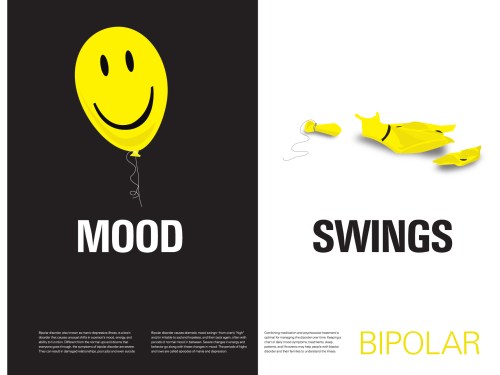
Bipolar Disorder– Basic Stuff


If you have bipolar disorder, you may recognize many below. Not everyone has exactly the same symptoms. Talk with your healthcare provider about your symptoms at each visit.

  • Feeling sad or blue, or “down in the dumps”
  • Loss of interest in things you used to enjoy, including sex
  • Feeling worthless, hopeless, or guilty
  • Sleeping too little or too much
  • Changes in weight or appetite
  • Feeling tired or having little or no energy
  • Feeling restless
  • Problems concentrating or making decisions
  • Thoughts of death or suicide


Symptoms of mania may include:

  • Increased energy level
  • Less need for sleep
  • Racing thoughts or mind jumps around
  • Easily distracted
  • More talkative than usual or feeling pressure to keep talking
  • More self-confident than usual
  • Focused on getting things done, but often completing little
  • Risky or unusual activities to the extreme, even if it’s likely bad things will happen

Here are some behaviors that may be seen in people with bipolar disorder. Please note some of these behaviors may also indicate a different problem, so proper diagnosis is important.

  • Agitation
  • Alcohol or drug abuse
  • Irritability
  • Excessive gambling
  • Violence
  • Poor judgment with decisions
  • Careless spending, buying sprees
  • Talking about hurting oneself
  • Risky sex or change in sexual activity
  • Impulsive financial investments
  • More arguments
  • Change in energy level, appetite, or sleep pattern
  • Relationship problems at home or work
  • Mounting debt
  • Drinking or drugging for ‘escape’ or maintenance purposes
  • Legal/criminal issues
Visit http://www.webmd.com/depression/guide/bipolar-disorder-manic-depression for more detailed information about bipolar disorder and its symptoms.

bry-signat-1

cropped-christiangraffiti1 (2)


Understanding Suicide

Getting a Grip on Suicide

"Suicide" by Manet, 1877

 Can a Christian believer attempt suicide?  My own first-hand experience rings out a resounding YES!  We can be so driven by major depression that it effects our relationship with the God who loves us and pushes us into a place of complete hopelessness. Very often, it is an attack by evil upon our lives.

 Suicide is not a mental illness in itself, but a serious potential consequence of many mental disorders, particularly major depression.

Who is most likely to commit suicide? Suicide rates are highest in teens, young adults, and the elderly. People over the age of 65 have the highest rate of suicide. Although women are more likely to attempt suicide, men are more likely to be successful.

 Suicide risk also is higher in the following groups:

•Older people who have lost a spouse through death or divorce  

•People who have attempted suicide in the past

•People with a family history of suicide

•People with a friend or co-worker who committed suicide

•People with a history of physical, emotional, or sexual abuse

•People who are unmarried, unskilled, or unemployed

•People with long-term pain, or a disabling or terminal illness

•People who are prone to violent or impulsive behavior

•People who have recently been released from a psychiatric hospitalization (This often is a very frightening period of transition.)

•People in certain professions, such as police officers and health care providers who work with terminally ill patients

•People with substance abuse problems

What are the warning signs for suicide? Following are some of the possible warning signs that a person may be at risk for suicide:

•Excessive sadness or moodiness — Long-lasting sadness and mood swings can be symptoms of depression, a major risk factor for suicide.

 •Sudden calmness — Suddenly becoming calm after a period of depression or moodiness can be a sign that the person has made a decision to end his or her life.

  •Withdrawal — Choosing to be alone and avoiding friends or social activities also are possible symptoms of depression. This includes the loss of interest or pleasure in activities the person previously enjoyed.

 •Changes in personality and/or appearance — A person who is considering suicide might exhibit a change in attitude or behavior, such as speaking or moving with unusual speed or slowness. In addition, the person might suddenly become less concerned about his or her personal appearance.  

•Dangerous or self-harmful behavior — Potentially dangerous behavior, such as reckless driving, engaging in unsafe sex, and increased use of drugs and/or alcohol might indicate that the person no longer values his or her life.

•Recent trauma or life crisis — A major life crises might trigger a suicide attempt. Crises include the death of a loved one or pet, divorce or break-up of a relationship, diagnosis of a major illness, loss of a job, or serious financial problems.  

•Making preparations — Often, a person considering suicide will begin to put his or her personal business in order. This might include visiting friends and family members, giving away personal possessions, making a will, and cleaning up his or her room or home. Some people will write a note before committing suicide.

 •Threatening suicide — Not everyone who is considering suicide will say so, and not everyone who threatens suicide will follow through with it. However, every threat of suicide should be taken seriously.

Can suicide be prevented? Definitely. In many cases suicide can be averted. Research suggests that the best way to prevent suicide is to know the risk factors, be alert to the signs of depression and other mental disorders, recognize the warning signs for suicide, and intervene before the person can complete the process of self-destruction.

Praying for and listening to the afflicted should be something we practice.  The despair of the suicidal is intense, but it gets dangerous when that despair turns into resignation and calmness (without a resolution).