Yearning for Sonship

InnerStruggle

The world is an intensely flawed place. Nothing is as it should be, yet. Our hope is in God”s will to recast it a new heavens and new earth. The Lord has started to redeem it, commencing with us.

Things aren’t in order yet. But they will be very soon. We pray, “thy kingdom come, thy will be done.” This earnest prayer echoes and resounds in heaven. It is the believer’s heart-cry. It is our dream. Soon– but not yet.

22 “We know that the whole creation has been groaning as in the pains of childbirth right up to the present time. 23 Not only so, but we ourselves, who have the firstfruits of the Spirit, groan inwardly as we wait eagerly for our adoption to sonship, the redemption of our bodies. 24 For in this hope we were saved. But hope that is seen is no hope at all. Who hopes for what they already have? 25 But if we hope for what we do not yet have, we wait for it patiently.”

Romans 8:22-25, NIV

We add our groans to a creation already groaning. We lament together with the cry of a woman giving birth. It is a holy agony. But the contractions have started, and soon there will be a new birth.

 “As we wait eagerly for our adoption to sonship” is our passion– it is what we are waiting for. I suppose this is at the core of our faith– sonship. And to walk out of this present darkness as whole men and women, cloaked in the Father’s holy glory.

As a man who struggles with mental illness here I am. I deal with this everyday. The meds, the hopelessness, and the depression. I have to be reminded that this is temporary, and that I will be redeemed completely. I will not be bipolar forever. My shuffling and scootching will get me to my goal eventually. I trust Him implicitly.

Brokenbeliever, don’t lose hope. Hold on to the faith that will fully redeem you. It won’t be long now.

aabryscript

Flourish-61

Brutal Honesty: Self-Control

broken-walls

“A person without self-control
    is like a city with broken-down walls.”

Proverbs 25:28

“For God has not given us a spirit of fear and timidity, but of power, love, and self-discipline.”

2 Timothy 1:7

There is no harder subject for me to broach than this one. It splits wide open a Number 10 “can of worms.” The issue is this: what is my mental illness, and what is my “flesh?” I suffer from Bipolar Disorder (and a mild form of epilepsy). But I am also an evangelical Christian believer.

So what is what? If this BP is causing extreme behavior, am I somehow exempt from the control of the Holy Spirit in my life? (Now this maybe easy for some of you to figure out, but I’m still contemplating here. Please bear with me on this.) I like things explained to me.

People are very complicated, and there are seldom any lines drawn between emotion/spirit/body. At any given time we all operate on different levels. For instance, my body maybe cold; but I’m praying quite fervently in the spirit. I can have a toothache and be really angry at Lynn (my wife). I never feel the need to analyze these actions.

Having zilch self-control is one of many bipolar symptoms. Believe me, my life has been completely devastated by snap decisions that carry terrible implications. I also habitually excuse my impulsive behavior by…

  • compartmentalizing, (categorizing everything as different)
  • rationalizing, (reasons behind ‘bad’ behavior)
  • and justifying my bad choices, (The devil made me do it).

My Bible tells me that the Holy Spirit is present to give me self-control. I believe this truly. But way too often (actually, most of the time) I’m focusing on trying to eliminate the negatives like bingeing, isolating, obsessing or plotting. I completely ignore the positives, like worshipping, praying, reading devotionally, or fellowshipping.

The vaunted “fruit of the Spirit” cannot be found in my carnal life. (If I may, allow me to change metaphors on you.) Suppose you had a real nice car sitting in your drive-way. It’s a real beaut. But since you don’t have the key, you must push it to make it go. It’s really tiring and you feel like giving it up all the time. (A trip to the store takes hours and hours.)

Silly you say? Yes. But no sillier than trying to live a Christian  life without the Holy Spirit. You see its his presence that allows you to live an impossible Christian life. My mental illness causes me a lot of grief. It affects me tremendously, as well as my friends and family. I must take meds to ease the worst of its disturbing symptoms. But there is supernatural help.

16 “So I say, let the Holy Spirit guide your lives. Then you won’t be doing what your sinful nature craves. 17 The sinful nature wants to do evil, which is just the opposite of what the Spirit wants. And the Spirit gives us desires that are the opposite of what the sinful nature desires. These two forces are constantly fighting each other, so you are not free to carry out your good intentions.”

Galatians 5:16-17, NLT

To be guided into the “fruits of the Spirit” is imperative (see Gal. 5:22-23). We’ve a tendency to accentuate the “deeds of the flesh” to our own detriment. As mentally ill people we must turn this on its head and invite the Holy Spirit to energize us.

My BP symptoms are no match for His presence. If anything they force me to helplessly call out to Him. This is a supernatural transaction that is mandatory to becoming Christlike. My physical weakness can be the backdrop for walking out convincing discipleship. Trust me, to live like a “receiver” is far better than trying to live like a “generator.” (But you  probably already knew that.)

aabryscript

Rolling Stones Theology

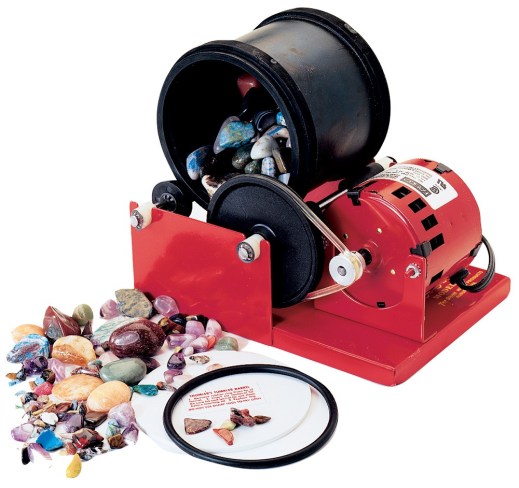
I was time travelling today.  I journeyed back to Christmas, 1972.  I had told my parents that life could only have meaning, if I could have just one thing.  I held out in hope that on Christmas morning, that I would open up a “rock tumbler.”

I was an 11 year old boy, and I imagined that I could turn gravel from the driveway into polished gems.  I would make jewelry for my mom, and then I would go on to know the thrill of turning ugly stones into precious jewels.  Somehow, doing this would give me a profound purpose. I guess I wanted to become a alchemist– turning gravel into gems.

This is all I wanted.  I dreamed of having my polisher– a rock tumbler that would be all and everything I wanted.  I was fixated, and just knew this was my destiny.  I would become a lapidarist! Today, I haven’t changed, I am always looking for the right stone.

Opening up our gifts, I had eyes only for my new rock tumbler.  I ripped open my present and tore into the box.  Within 10 minutes I had it up and going.

The principle was simple:

  • Step 1— Add the stones, and the “grit.” Resist putting in too many stones.
  • Step 2— Measure out the water.  The idea is to make a “slurry.”
  • Step 3— Let the machine run, don’t open the drum every 30 minutes. This takes time, and patience.
  • Step 4— A trick– add a tablespoon of sugar to the final polishing stage. It adds an extra gleam.

The Church is a lot like a rock tumbler.  The Holy Spirit places us in a fellowship with others.  We are rough and drab, we show nothing that would suggest a polish or gleam.  There is nothing beautiful about us.  We really understand this.

We join others who have been picked up.  Different grit is then added.  There are special types– some are very coarse and others are quite fine.  Water is added.  (The whole process is to parallel what happens at the beach, but purposefully accelerating it in your drum.)

As the drum rotates, things are constantly changing as they move.  The water and grit roll between the stones.  The stones themselves move with each other, sometime counter, but they smooth out all roughness and coarseness.  Some rocks are harder, and not easily polished.  Sometimes, the grit will need to be changed to speed up the process.  Whatever happens, we need to trust Him to do the right thing.

I really don’t want to bore you with all the different details.  But each step has a connection to authentically spiritual things.  We are a mixture of stones with different shapes and angles. There are a lot of variables, and it gets tedious.  The polishing takes a lot of time. There is the need for patience.  We often bring ‘a thirst for the instant,’ and for the quick work.  Polishing a rock takes a lot of time– months.  And we take years– maybe sometimes even decades.

“And you are living stones that God is building into his spiritual temple. What’s more, you are his holy priests. Through the mediation of Jesus Christ, you offer spiritual sacrifices that please God.”  1Peter 2:5, NLT

We are all in this process, what is hidden is being revealed.  We may bounce off each other, (here comes that ‘flinty’ sister again!)  But the Spirit is the superintendent of the process.  He will change the grit, add more water, or add others to the tumbler. He knows exactly what He is doing. No one will get overlooked.

Related articles

Tobacco Use: Putting Down the Cigarette

By Brendan McLean, NAMI Communications Manager

Studies have shown that individuals living with mental illness die 25 years earlier than the general population. Part of the reason is due to smoking related diseases. At the end of July, the Smoking Cessation Leadership Center held a webinar on the importance of quitting smoking.

“Peers Helping Peers: Ways to Quit Tobacco with Rx for Change” consisted of a panel of experts from around the country, including Ken Duckworth, M.D., medical director of NAMI, and discussed the addictive power of tobacco, ways that will help people quit smoking and the role peer counselors can play.

Individuals living with mental illness are disproportionately represented among those who smoke. Forty-four percent of people who smoke have a mental illness. However, this percentage can be much higher when compared to a specific mental illness. For example, studies have shown that between 62 and 90 percent of individuals living with schizophrenia smoke.

This high rate of smoking means that one-half of the 435,000 tobacco related deaths that occur in the U.S. each year are people who have a mental illness. NAMI Hearts & Minds was created to offer resources on quitting smoking and other healthy lifestyle choices that promote wellness in both mind and body.

So why is smoking common among people who live with mental illness? As Frank Vitale, the National Director of the Pharmacy Partnership for Tobacco Cessation, states in the webinar , smoking was often used as a reward in psychiatric hospitals. “The culture has promoted smoking in a sense,” he said. “I remember working in a psychiatric hospital and we were literally told to tell patients that if you take your medication you can smoke. Or if you go to group you can smoke.”

Helping individuals living with mental illness who smoke can produce a number of benefits. As described by Vitale in the webinar, there are six benefits.

  1. It can improve the overall quality of life.
  2. It can increase the length and number of healthy years of life.
  3. It can improve the effects of medication. Hydrocarbons, which are produced when anything is burned, cause the body to metabolize medications faster than you normally would. As a consequence, many people who smoke often need more medication than if they did not smoke. However, if the individual decides to quit, their clinician should be alerted so they can adjust the amount of medication the individual is receiving.
  4. It can decrease social isolation. Many people who don’t smoke are often hesitant to socialize with those who do.
  5. It can save money—lots of money. Cigarette packs cost nearly $8 in D.C. and upwards of $15 in Manhattan. Over the course of 50 years, if a person were to only smoke one pack of cigarettes a day, at $6 a pack, one would spend nearly $110,000.
  6. It helps promote recovery.

The problem is that there has been lack of focus on smoking cessation by mental health providers. Some providers believed that doing so caused an increased risk of relapse: symptoms would worsen or the individual would return to abusing drugs or alcohol. However, research has shown that there is no truth to either of these claims.

The truth, though, is that people want to quit. Nearly 75 percent of current smokers have said they want to quit and 65 percent have tried to quit in the last year. But sometimes you just need a little help. To learn more about the importance of quitting smoking and how peers can help, listen to a recording of the webinar online.

Thank You, Nami

This is a terrific post dealing with a major issue with those of us who struggle so hard, with mental illness. Think this through and let me know what you think. Pastor Bryan can be reached at,  flash99603@hotmail.com

“How I finally quit smoking!” A Great Blog and a Super Post.

http://wp.me/p1rYch-ZN