Our (Eternal) Compulsion

eternal-view

Strangely compelling. This morning I found waiting for me a series of verses that link with each other. Together they are both irresistible and indispensable. Combined, they form and establish the eternal perspective for the believing Christian. And it is all very real.

Look for what links them. (All verses are from the New Living Translation.).

flourish1

“Because I am righteous, I will see you.
When I awake, I will see you face to face and be satisfied.”

Psalm 17:15

“Your eyes will see the king in all his splendor,
and you will see a land that stretches into the distance.”

Isaiah 33:17

 “Father, I want these whom you have given me to be with me where I am. Then they can see all the glory you gave me because you loved me even before the world began!”

John 17:24

“Now we see things imperfectly, like puzzling reflections in a mirror, but then we will see everything with perfect clarity. All that I know now is partial and incomplete, but then I will know everything completely, just as God now knows me completely.

1 Corinthians 13:12

“Dear friends, we are already God’s children, but he has not yet shown us what we will be like when Christ appears. But we do know that we will be like him, for we will see him as he really is.”

1 John 3:2

“And they will see his face, and his name will be written on their foreheads.”

Revelation 22:4

Living forever, and being changed irrevocably is the sole privilege of the believer. It’s what we long for– sort of a (good) divine madness that continues to drive us; a splinter in our hearts that we can’t expel. But even if we could, would we?

Eternal life has already started for us; I believe far more awaits.

Ecclesiastes 3:11

aabryscript

A Cup of Cold Water in Jesus’ Name— by Jonathan Coe

Not everyone who is wounded is a wounded healer. Put another way, it’s possible to be wounded and suffer significant loss and not use that wound to minister healing to others. Much of this is related to how we go through the grieving process associated with our wound and loss. I learned this when I went through a divorce in 2008–2009. Not everyone agrees with how many stages of grief there are, but everyone agrees that it involves working through different phases of denial, anger, bargaining, depression, and acceptance and often sorting through accompanying feelings of pain, guilt, loneliness, and hope.

I didn’t go through the grieving process associated with my divorce perfectly. There were missteps, stumbles, and things I wish I could do over. However, by the grace of God, I reached acceptance and hope and noticed that I was able to help other people who were working through broken relationships. Out of my wounds others were receiving healing and comfort.

In changing metaphors, rather than speaking in terms of wounds and healing, I’d like to talk in terms of water and refreshment: out of my experience I was able to, in an imperfect way, give thirsty people a cup of cold water. However, I’ve noticed that in both giving and receiving water over the years, how we go through the grieving process affects both the volume and quality of the water we give to others.

Before we drink it, water travels through rock and soil and can pick up large amounts of calcium and magnesium and becomes what we call “hard water.” If I grieve about a broken relationship and my forgiveness of the person who hurt me is incomplete, then I become hardened and end up giving hard water to those I share with about my experience. It may help a thirsty person, but God is calling me to buy a “water softener” and finish the forgiveness process so I can give better water to people I know and love.

If significant depression linked to my divorce still plagues me years after the dissolution of the marriage, that would definitely affect the volume of  water I can give to others. When I’m depressed, I can barely take care of me so how can I give you a cup of refreshing water for what you’re going through? The volume of water I can give is greatly reduced. I will need to revisit my grieving process and do some “emotional detective work,” perhaps with a therapist, to find out why I’m still depressed.

This is not a condemnation of those who have depression because of a chemical imbalance or some other issue. My heart goes out to you and I rejoice that there are medications that can help you find an emotional equilibrium and enable you to give others a cup of cold, clean water in the name of Jesus. Your fight with depression is a different fight than mine and I’m rooting for you as God upholds you through a difficult trial.

For many, the most dangerous stage in the grieving process is the one involving anger. We may be angry at someone who hurt us and how we feel they let us down. We may be angry at God because we thought life was going to be “X” and it turned out to be “Y.”

Anger, for a season, is a healthy response for someone who has been wounded and suffered loss. The Bible says, “Be angry and sin not” (Ephesians 4:26). But if the anger devolves into bitterness, then we have a major problem. The Bible also warns us against missing the grace of God and allowing a bitter root to grow up, cause trouble, and defile many (Hebrews 12:15). Sometimes water supplies get poisoned by arsenic, radon, or uranium. This is a grave matter because the water we have has been poisoned and will poison others.

In Exodus 15: 22–25, the Israelites had traveled three days without finding water. When they finally did find water at Marah, it was bitter. God told Moses to throw a particular piece of wood in the water. When he did this, the water became sweet. We have hope because in brokenness and in a radical dependence on Christ (the Piece of Wood), our waters too can be made sweet.

If you liked this post by Jonathan Coe, you might also like his new book, Letters from Fawn Creek, that is now available at this link:

https://www.tatepublishing.com/bookstore/book.php?w=9781628542035

Letters from Fawn Creek

Gifts are Nice, But There is Something Better

blue-dress1

This is my first attempt at writing a story. I’m not sure it belongs here, and I apologize for any deficiencies. Please be merciful.

A father stood by his young daughter’s bed. She was clearly tired from a busy day, but because her Dad was with her– that at the moment mattered most. “Dad, tell me a story… please?”

“I’m sorry dear heart, I can’t” he said sadly. “I must travel to Chicago, and then to St. Louis. I’m afraid I’ll be gone for three days. The girl responded, “But Daddy, you’re my best friend. You can’t leave.”

“Honey, if you are good and brave, I will bring you home a special present.” She looked up at him. “A ring?” “Yes, darling. A beautiful ring. Now go to sleep and have sweet dreams, good night. I love you so much.”

When the father returns he finds her at the door, eagerly waiting him. She runs and hugs him, wrapping her arms around his neck. “Oh papa, you are really home!” Setting down his suitcase, the Father reaches into his breast pocket. “Here you go, dear one. One special ring!”  It was silver with a small garnet stone, and it was so beautiful. And it sparkled.

Sometime later the father had to make another trip, this time to Akron. “Oh father, please don’t go again. Tell me another story.” (For the father was very good at telling such interesting tales of rabbits and ponies and storms and such.) “Please, stay!” the girl begged.

“Honey, if you’re good and brave, I will bring you home a special present.” The child  grew quiet for a few seconds. “Papa… maybe a dress? A blue one, with lace and puffy sleeves?” Yes love-heart,” he said, “with puffy sleeves. Now you need to go to sleep, dear.”

The trip to Akron was terribly uneventful, but he did stop by a J.C. Penny to buy a little blue dress. Arriving home he found his daughter waiting for him. Setting down his bags, he received so many kisses he wondered if he wasn’t the luckiest man alive.

“And here, young lady, is the dress I promised.” Out of the box, and with lots of ‘ooohs and aahs.’ She lifted it out and modeled it under her chin. It was blue and had puffy sleeves. It was wonderful. (She would wear that dress until it was worn out.)

One day the daughter grew quiet and still. “Father, I don’t want the ring. I don’t want the dress. I don’t want them anymore. I really want you!”

The father smiled, with tears in his eyes, “Dear heart, I love you so much.”

flourish2

The Father awaits you to come to this point, when you stop seeking His blessings and start to seek His face.

recite-4295-45802551-tvf8xa (1)

Charred Cinders

fire1
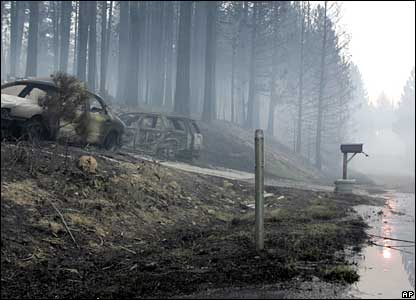
Aftermath of a forest fire in California

“When you pass through the waters, I will be with you;
And through the rivers, they will not overflow you.
When you walk through the fire, you will not be scorched,
Nor will the flame burn you.”

Isaiah 43:2, NASB

This will not be a typical commentary on this verse. (But it will be brief.)

The word I emphasize is “through.” I feel it is the salient point of the whole thought. Through implies a temporary state of being. We “pass through.” In a sense it is the state of being ‘between,’ and it is rarely, or ever comfortable.

Life is all about transitions– a job, children, marriage, health. We’re fine when things are steady and sure. However we feel the strain when things suddenly change. We are compelled to go through some things. Plain and simple. There are three simple things to think about.

  1. God is very present in those moments.
  2. Seldom do they vanish.
  3. They are never welcome.

The One who made the intricacies of our hearts stands by. Floods rage, trees float by. Fires get hot, and all becomes a blackened and charred cinder. Still God holds you. You will pass through this, and come out to the other side. Wiser and more compassionate.

recite-4295-45802551-tvf8xa (1)