

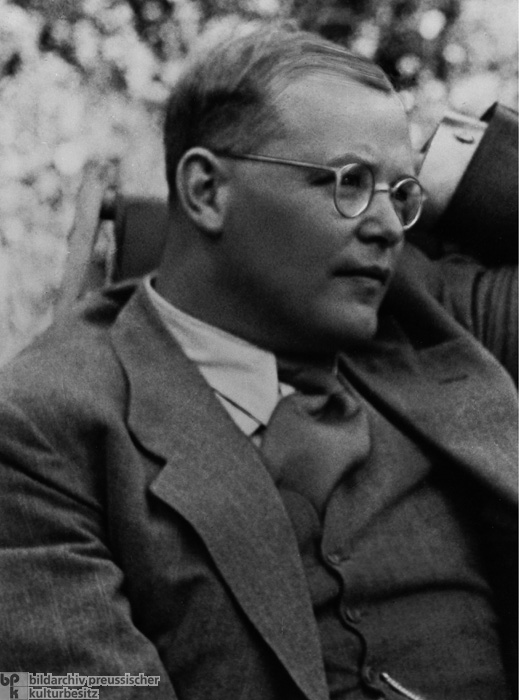
Dietrich Bonhoeffer (1906-1945) is known for his leadership role in the Confessing Church, efforts on behalf of peace and justice, opposition to antisemitism, and writings on theology and ethics that have been influential far beyond his German Lutheran context. He was was hanged by the Nazis on April 6, 1945 in the Flossenburg concentration camp.
Dietrich Bonhoeffer quotes:
In normal life we hardly realize how much more we receive than we give; life can be rich only with such realization. source: Letters and Papers from Prison
To be silent does not mean to be inactive; rather it means to breathe in the will of God, to listen attentively and be ready to obey. Meditating on the Word
It is not necessary that we should discover new ideas in our meditation. It is sufficient, and far more important, if the Word, as we read and understand it, penetrates and dwells within us. Life Together
When we come to a clearer and more sober estimate of our own limitations and responsibilities, that makes it possible more genuinely to love our neighbor. Letters and Papers…
There is not a place to which the Christian can withdraw from the world, whether it be outwardly or in the sphere of the inner life. Any attempt to escape from the world must sooner or later be paid for with a sinful surrender to the world. Ethics
You have granted me many blessings; let me also accept what is hard from your hand. Prayers from Prison
The first call which every Christian experiences is the call to abandon the attachments of this world. The Cost of Discipleship
Earthly possessions dazzle our eyes and delude us into thinking that they can provide security and freedom from anxiety. Yet all the time they are the very source of anxiety. The Cost of Discipleship
The first service that one owes to others in the fellowship consists of listening to them. Just as love of God begins with listening to his word, so the beginning of love for our brothers and sisters is learning to listen to them. Life Together
From God we hear the word: “If you want my goodness to stay with you then serve your neighbor, for that is where God comes to you.” In the anthology, No Rusty Swords
Judging others makes us blind, whereas love is illuminating. By judging others, we blind ourselves to our own evil and to the grace which others are just as entitled to as ourselves. The Cost of Discipleship
I can no longer condemn or hate a brother [or sister] for whom I pray, no matter how much trouble he causes me. His face that hitherto may have been strange and intolerable to me is transformed through intercession into the countenance of a brother for whom Christ died. Life Together
We have learned a bit too late in the day that action springs not from thought but from a readiness for responsibility. Letters and Papers from Prison
Which of us has really admitted that God’s goodness can also lead us into conflict. In the Anthology, No Rusty Swords
Our enemies are those who harbor hostility against us, not those against whom we cherish hostility… As a Christian I am called to treat my enemy as a brother and to meet hostility with love. My behavior is thus determined not by the way others treat me, but by the treatment I receive from Jesus. The Cost of Discipleship
So long as we eat our bread together, we shall have sufficient even for the least. Not until one person desires to keep his own bread for himself does hunger ensue. Life Together
In a world where success is the measure and justification of all things, the figure of him who was sentenced and crucified remains a stranger. Ethics
A Prayer written by Bonhoeffer
In me there is darkness,
but with you there is light;
I am lonely, but you do not leave me;
I am feeble in heart; but with you there is help;
I am restless, but with you is peace.
In me there is bitterness, but with you there is patience;
I do not understand your ways, but you know the way for me.
Amen.
Related articles
- Dietrich Bonhoeffer on “grace” (imaginewithscripture.wordpress.com)
- Listening When Others Speak a God Word – Bonhoeffer’s Life Together (davehershey.wordpress.com)
- Bonhoeffer: “Jesus Christ lived in the midst of his enemies.” (lifeondoverbeach.wordpress.com)
 Broken Believers