Back When We Were Grown Ups


“I promise you that you cannot get into God’s kingdom, unless you accept it the way a child does.”  Mark 10:15, CEV

“So Jesus called the children over to him and said, “Let the children come to me! Don’t try to stop them. People who are like these children belong to God’s kingdom.”   Luke 18:16, CEV

One of the essential tenets of real discipleship is Jesus’ insistence on his disciples becoming children.  It actually is the entry point for all believers.  Everyone who really believes begins here, at ‘childlikeness’.

It’s interesting to note that ‘religion’ moves in the opposite direction– a level of sophistication is cultivated.  One becomes intellectual, emphasising the ‘academics’ over gentleness and goodness or love.

I think that there is an excessively high appreciation for broad-mindedness, but it is a cultivated, savoir-faire that is really is nothing but an embarrassment to the Kingdom of God.  It seems our discipleship is strongest when it is simplest.  Humbling ourselves is what makes us incredibly authentic– at least from His point-of-view.

And maybe–  just maybe, ‘becoming small’ is exactly what ‘the doctor has ordered’.  We need this, it needs to be imbedded into our hearts, and altering the way we encounter life.  If we are going to be real, then we must become children.  Becoming a child is an imperative.

Who do we think we are?  Often, we start out ‘broken’.  We esteem gentleness and brokenness.  We understand that the most valuable possession we can possess is a ‘childlikeness’. This can be understood by everyone we encounter– especially believers.  But this is only our starting point, we do not outgrow this, never.

Christians are set apart by their childlike heart.

“But I am calm and quiet,
like a baby with its mother.
I am at peace, like a baby with its mother.”

Psalm 131:2

ybic, Bryan

Prone to Fall, I Feel It

Art by Lynda Finch

“It is true I am weak in faith, and prone to fall, but my very feebleness is the reason why I should always be where thou feedest thy flock, that I may be strengthened and preserved in safety beside the still waters. Why should I turn aside? There is no reason why I should, but there are a thousand reasons why I should not, for Jesus beckons me to come.”

“If he withdraw himself a little, it is but to make me prize his presence more. Now that I am grieved and distressed at being away from him, he will lead me yet again to that sheltered nook where the lambs of his fold are sheltered from the burning sun.”


–Charles Spurgeon
Art by Lynda Finch,

Getting to Know Your “Sheepiness”

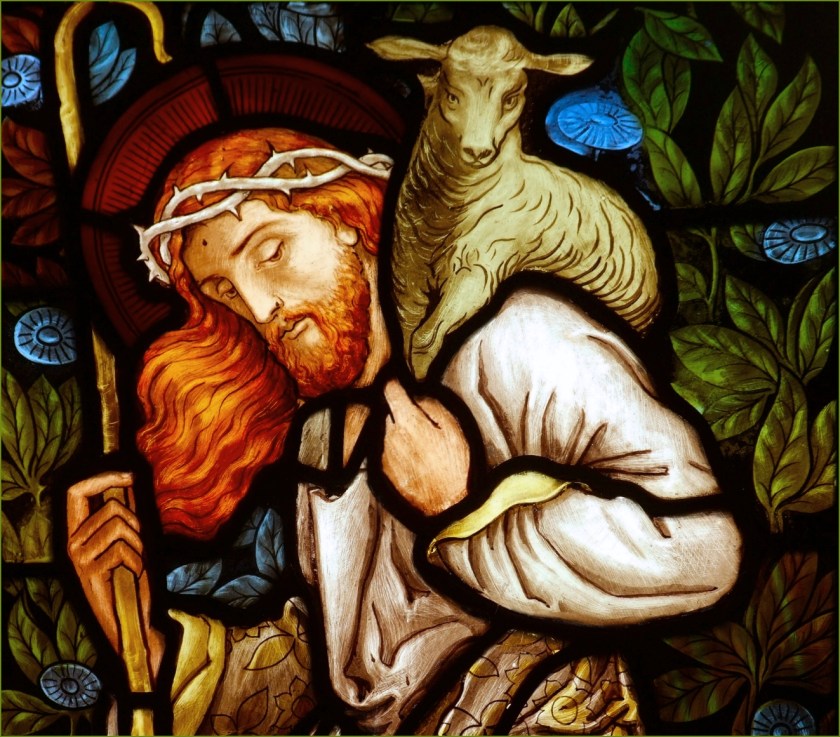
I am the good shepherd. I know my sheep, and they know me. 

–John 10:14

The shepherds of Israel have a custom of marking their sheep to make them distinct from each other.  Each bears a unique notch or brand that makes them distinguishable from their companions.  It is not done for aesthetics, but recognition.  Christ gives each person who follows Him a certain recognizable characteristic.  He “knows His sheep.”

He recognizes their faces.  All have a common demeanor, a family resemblance.  No matter where they go, they are marked as His follower.  The Prodigal fed the pigs from his abject poverty, yet he belonged to his Father.  Our voices also mark us, they are recognizable by those who are aware.  When we speak there is a heavenly inflection and tone.  I have a dear friend from Tennesee, and he couldn’t pretend to be from Boston.  You might say we have a believer’s accent that IDs us as His own.

Last of all, He knows us by our hearts.  Peter was one who not only betrayed his Lord, but he betrayed himself.  He was not quite Peter the Rock, but Peter the weak.  Jesus sees our hearts, the flaws and weaknesses are quite obvious to Him.  We may feel like we are damaged goods.  But His power to transform is legendary and without peer.

Jesus knows His sheep, He just does not tend the best, but seeks out the least.  All who are weak and pathetic are cared for with a tender love.  Those of us who are flawed and lame are given preferential treatment, but all are loved, all needs are met.

We have no power without Jesus as our Shepherd to lead  us.  We cannot manage on our own.  Solitary sheep are nothing more than a wooly snack for predators, or they will fall desperately seeking pasture.  I encourage each to merge with a local flock, a group of imperfect believers who are following the Shepherd of love.

“The LORD is my shepherd, I shall not be in want.

 2 He makes me lie down in green pastures,
       he leads me beside quiet waters,

 3 he restores my soul.
       He guides me in paths of righteousness
       for his name’s sake.”

 Psalm 23:1-3

ybic, Bryan

Compatibility for Dummies

____________________

Believers are to learn the skills of compatibility.  The classic definition is “to be able to exist harmoniously.”  The word is used in a dozen different fields, from agriculture to zoology.  But the particular area we are to look at is the “spiritual.”

The Holy Spirit is the prime teacher.  The same Spirit that holds me is holding you as well.  As a result we connect in a way that is profound.  This is all done supernaturally, and it is one of best arguments for the existence of God I know of.  The world is full of discord.  It is fractious and divided.  But believers can walk in harmony and love.

I was just 17 when I enlisted in the Army.  It truly was a learning experience. One of the basic principles is conforming by adaptation.  We all wore the same clothes.  Wore the same boots.  We ate together, and developed military skills together.  We also marched together in both large and small formations, keeping in step as a group.  We did lots and lots of marching, hours and hours a day.  It had a definite purpose.

Compatibility is learned; but it also is supernaturally given.  A piano player may play Mozart, because the gift lies within.  But that same musician must practice.  You could say what they have is both a talent and a skill.  In the very same way, the agreement I have with you is supernaturally easy—and physically hard.  However it is a skill to be learned.  Once we learn to do this, it will become easier and easier.

The essential foundation for this is the “Word of God.”  We can’t walk with a brother who is clearly at odds with the Bible’s teachings.  But we all know that sin is at epidemic levels, and we are all affected.  I suppose “humility” plays a huge part of staying in step with another saint.  The Lord is so gentle with the strugglers, can’t I do the same?

Finally, all of you, have unity of mind, sympathy, brotherly love, a tender heart, and a humble mind.”  1 Peter 3:8, ESV

Nevertheless (even with this in mind) we must be committed to the Word—first and foremost.  Everything must proceed from this common point.  Loving someone else will almost always involve servanthood.  Washing someone elses feet will almost always develop compatibility.

In Bible college I had a running feud with a fellow student.  He seemed to me to be incredibly arrogant.  Things came to an ugly head and the animosity was thick.  One day in prayer I heard the Holy Spirit speak.  “Go to your brother and wash his feet.”  I charged into his dorm room and became a servant.  I became connected to him in a profound way.

Being compatible does not mean we all do the same things.  We share the same Spirit but we don’t have the same gifts.  My theory is we are all designed with certain strengths, and proscribed weaknesses.  These make us vulnerable and open to another.  In Nehemiah 4, we read of men who built, and men who guarded.  Both were necessary.

The main issue for us is learning compatibility—and all the skills that enable us to practice unity.  We must understand, we are already connected in an amazing way.  But we must “practice” it.

“Do nothing from rivalry or conceit, but in humility count others more significant than yourselves.”   Phil. 2:3, ESV