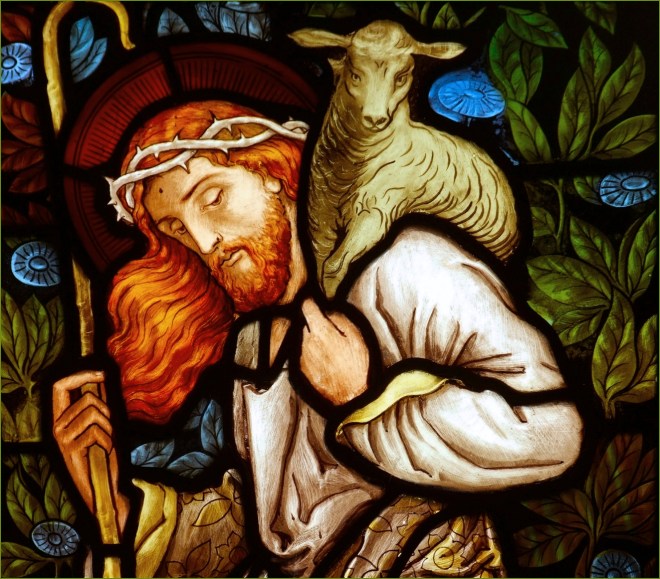
Getting to Know Your “Sheepiness”

I am the good shepherd. I know my sheep, and they know me. 

–John 10:14

The shepherds of Israel have a custom of marking their sheep to make them distinct from each other.  Each bears a unique notch or brand that makes them distinguishable from their companions.  It is not done for aesthetics, but recognition.  Christ gives each person who follows Him a certain recognizable characteristic.  He “knows His sheep.”

He recognizes their faces.  All have a common demeanor, a family resemblance.  No matter where they go, they are marked as His follower.  The Prodigal fed the pigs from his abject poverty, yet he belonged to his Father.  Our voices also mark us, they are recognizable by those who are aware.  When we speak there is a heavenly inflection and tone.  I have a dear friend from Tennesee, and he couldn’t pretend to be from Boston.  You might say we have a believer’s accent that IDs us as His own.

Last of all, He knows us by our hearts.  Peter was one who not only betrayed his Lord, but he betrayed himself.  He was not quite Peter the Rock, but Peter the weak.  Jesus sees our hearts, the flaws and weaknesses are quite obvious to Him.  We may feel like we are damaged goods.  But His power to transform is legendary and without peer.

Jesus knows His sheep, He just does not tend the best, but seeks out the least.  All who are weak and pathetic are cared for with a tender love.  Those of us who are flawed and lame are given preferential treatment, but all are loved, all needs are met.

We have no power without Jesus as our Shepherd to lead  us.  We cannot manage on our own.  Solitary sheep are nothing more than a wooly snack for predators, or they will fall desperately seeking pasture.  I encourage each to merge with a local flock, a group of imperfect believers who are following the Shepherd of love.

“The LORD is my shepherd, I shall not be in want.

 2 He makes me lie down in green pastures,
       he leads me beside quiet waters,

 3 he restores my soul.
       He guides me in paths of righteousness
       for his name’s sake.”

 Psalm 23:1-3

ybic, Bryan

Compatibility for Dummies

____________________

Believers are to learn the skills of compatibility.  The classic definition is “to be able to exist harmoniously.”  The word is used in a dozen different fields, from agriculture to zoology.  But the particular area we are to look at is the “spiritual.”

The Holy Spirit is the prime teacher.  The same Spirit that holds me is holding you as well.  As a result we connect in a way that is profound.  This is all done supernaturally, and it is one of best arguments for the existence of God I know of.  The world is full of discord.  It is fractious and divided.  But believers can walk in harmony and love.

I was just 17 when I enlisted in the Army.  It truly was a learning experience. One of the basic principles is conforming by adaptation.  We all wore the same clothes.  Wore the same boots.  We ate together, and developed military skills together.  We also marched together in both large and small formations, keeping in step as a group.  We did lots and lots of marching, hours and hours a day.  It had a definite purpose.

Compatibility is learned; but it also is supernaturally given.  A piano player may play Mozart, because the gift lies within.  But that same musician must practice.  You could say what they have is both a talent and a skill.  In the very same way, the agreement I have with you is supernaturally easy—and physically hard.  However it is a skill to be learned.  Once we learn to do this, it will become easier and easier.

The essential foundation for this is the “Word of God.”  We can’t walk with a brother who is clearly at odds with the Bible’s teachings.  But we all know that sin is at epidemic levels, and we are all affected.  I suppose “humility” plays a huge part of staying in step with another saint.  The Lord is so gentle with the strugglers, can’t I do the same?

Finally, all of you, have unity of mind, sympathy, brotherly love, a tender heart, and a humble mind.”  1 Peter 3:8, ESV

Nevertheless (even with this in mind) we must be committed to the Word—first and foremost.  Everything must proceed from this common point.  Loving someone else will almost always involve servanthood.  Washing someone elses feet will almost always develop compatibility.

In Bible college I had a running feud with a fellow student.  He seemed to me to be incredibly arrogant.  Things came to an ugly head and the animosity was thick.  One day in prayer I heard the Holy Spirit speak.  “Go to your brother and wash his feet.”  I charged into his dorm room and became a servant.  I became connected to him in a profound way.

Being compatible does not mean we all do the same things.  We share the same Spirit but we don’t have the same gifts.  My theory is we are all designed with certain strengths, and proscribed weaknesses.  These make us vulnerable and open to another.  In Nehemiah 4, we read of men who built, and men who guarded.  Both were necessary.

The main issue for us is learning compatibility—and all the skills that enable us to practice unity.  We must understand, we are already connected in an amazing way.  But we must “practice” it.

“Do nothing from rivalry or conceit, but in humility count others more significant than yourselves.”   Phil. 2:3, ESV


Dealing with Arguers

“Make every effort to live in peace with everyone and to be holy”

Hebrews 12:14, TNIV


For me personally, someone in my face can be nasty and irritating.  It seems I can never say enough.  I simply don’t get any sense of having “convinced” them of my position or views.  I maintain composure (I try, anyway) and then ignite when its all over.

Inevitably, I start playing the whole ugly argument over and over.  Often, if I feel quite vulnerable, I will enlist my dear wife’s availability.  She comes to my side, where I find the support I wanted.

Intense arguments can derail me from so much.  Going to scripture in this frame of mind does me no good at all.  When I’m in this place, prayer becomes unplugged (kind of like my exercise “treadmill.”)  I sit in my chair and simmer, and occasionally boil over.

What do I need most?

  • Humility
  • Gentleness, and sensitivity
  • Kindness  
  • Pre-planning, or pre-alignment of my heart
  • A sense of humor
  • Renunciation of my “rights” and privileges


A lot of things could be added to my quick list, that would be helpful.  Making cookies, or doing new chores also sort out things.  If the issue is more mountain than molehill, find your way to an elder or a pastor.  But whatever you do, it’s best to keep moving.  So much is working to solidify you in one place.  It’s like walking through wet cement! (It’s best not to linger too long, in one place.)

Know this though.  Being in an argument or conflict is not sin.  They may disturb us, but we don’t necessarily have to sin.  Jesus had some whoppers in His day.  He walked into these conflagrations without a diminishing of peace or joy.  He walked out of them the same way.  He can teach us, by showing us how He did it.

Just one more thing (I’m trying hard to write a essay here.)  You don’t hear or read it very often–but, we all are models and examples to someone else.  Our children, neighbors, friends, the bank teller and our gym instructor.  Not that everyone knows of our issue, our frustration.  But that our lives are filled with a “joyous humility.”  I think what hurts me most is that I fear my witness or testimony has been damaged by my words and actions.

God is God of my everything.  He knows what happened.  He knows me, and knows them.  The sin does not impede His vision of you.  When he was on earth, he was never disturbed by any confict.  Today, he is the same.  Disputing with someone else– no problem.  He doesn’t get loose and cut you down in embarassment.  Brilliantly and lovingly, He absorbs all that concerns you.  He is more gentle than you know and kinder than any man, or woman. 

Seek Out the Gold

In the vault of the Holy Spirit
“He returned to Nazareth, his hometown. When he taught there in the synagogue, everyone was amazed and said, “Where does he get this wisdom and the power to do miracles?”
Matthew 13:54, NLT


Chapter 13 of Matthew is your very own gold mine.  There are veins of precious ore throughout these parables.  They will give their riches to anyone humble enough to seek them.  They each are concentrated truth–these parables are gold!

Parables are a fascinating way to impart teaching that requires a quiet and gentle heart.  Not everyone will gain access to them.  The truth in them will only touch the hungry heart, the real seeker.  It’s like they are locked up, and the Holy Spirit has the combination, but He will gladly share it with the sincere heart.

At this point in Jesus’ ministry, He arrives in His hometown.  He goes to the synagogue and begins to teach. (What an awesome time to be in the congregation.)  Their teacher Jesus is absolutely astounding!  They stand and watch Him; they are astonished and amazed.  The text tells us that Jesus not only taught them, but He performed supernatural healings.

The people in Nazareth who were witnesses in such a direct way, begin to draw false conclusions about Jesus.  They can’t deal with His youth and can’t believe what He has come from God–as their Messiah. 

However the general consensus was profound;  “everyone” was in agreement with what they had just witnessed.  For a few, they would never be the same.  When we encounter Jesus, and hear His wisdom, and see His wonders–it has the power to change us.  And that is no mean feat.