Frailty Doesn’t Disqualify Us

by Terry Powell,

“God keeps a person usable by keeping him weak.”

– Ron Dunn

An incident in Jack Murray’s life showed that weakness is not a hindrance to usefulness in God’s kingdom. His son, George, told this story in chapel while he served as President of Columbia International University.

Jack, a traveling evangelist decades ago, was coming off back-to-back weeks of meetings in local churches. He boarded a plane, headed to yet another week-long engagement. The intensive delivery of messages and constant interactions with people had depleted his mental, physical, and emotional reserves. Craving a nap so he could recoup, he was delighted to hear that seating was “open” rather than assigned. Since the plane was only half-full, to signal his desire for privacy, he sat by a window, placing his coat and hat on the two adjacent seats.

Surprisingly, a sharply-dressed business woman asked to sit in the aisle seat next to him. She tried to engage Jack in conversation, but he cited the exhausting week behind him and said he needed to rest during the flight. He pushed the seat-recliner button, closed his eyes, and leaned his head against the bulkhead. That’s when someone else started talking to him.

“Jack, there’s a woman sitting next to you,” whispered God’s Spirit.

“Yea, I know. And of all the places she could have selected, she sat next to me!”

“Don’t you think that’s significant?” asked the Lord.

“But Lord, You know how tired I am!” Jack countered. He contended with the Lord for several minutes, then yielded to His wooing. After asking forgiveness for his attitude, he pushed the seat button, sat upright, and opened his eyes. Immediately the lady blurted, “Oh, are you feeling better?”

A casual conversation ensued. When she said she lived and worked in Charlotte, North Carolina, Jack mentioned a friend of his: Henderson Belk, then president of the Belk department store chain, headquartered in her city. Excitedly, she announced that she worked for Mr. Belk in the corporate office. “Have you noticed anything different about your boss lately?” Jack inquired.

“Oh, yes. Everybody is talking about him. He ‘got religion’ or something,” she said. That’s when Jack explained how Mr. Belk had recently put his faith in Christ. He shared the gospel with her, and her heart began to melt. She wept, revealing a broken heart over dysfunction in her family. She didn’t pray to receive Christ on the plane, but Jack made her promise to ask her boss about what happened to him. Within a week, Henderson Belk cultivated the soil where Jack had planted a seed, and led his employee to faith in Christ.

When Jack was at the end of himself due to physical frailty, he and the woman were at the beginning God’s grace. Instead of stemming the flow of God’s power, his weariness merely created a dependency on it.

We have the gospel message in fragile earthen vessels. But we’re still candidates for usefulness, for God puts His word in weak vessels, “so that the surprising greatness of the power will be of God and not from ourselves” (2 Cor. 4:7).

When has God surprised you by using you in ministry when you felt weak, needy, or burdened? That’s when we’re more likely to praise Him and give Him the credit, rather than assume our experience or gifts explain the fruitfulness.

your brother,

Terry


Terry teaches in the areas of Church Ministry and Ministry Leadership at Columbia International University in South Carolina. He has served as a Christian Education staff member for three  churches, and he’s a licensed preacher in the Presbyterian Church of America.  His current books in print are Serve Strong:  Biblical Encouragement to Sustain God’s Servants, and  Now That’s Good A Question!  How To Lead Quality Bible Discussions. Terry has been married for 46 years, and has two sons, a daughter-in-law, one grandson, and a dachshund.  His constant prayer is, “Lord, make me half the man my dog thinks I am!”

Check out his blog at https://penetratingthedarkness.com/. His ministry is focused on Christians experiencing clinical  depression and other mental issues.


Worship is All that Really Matters

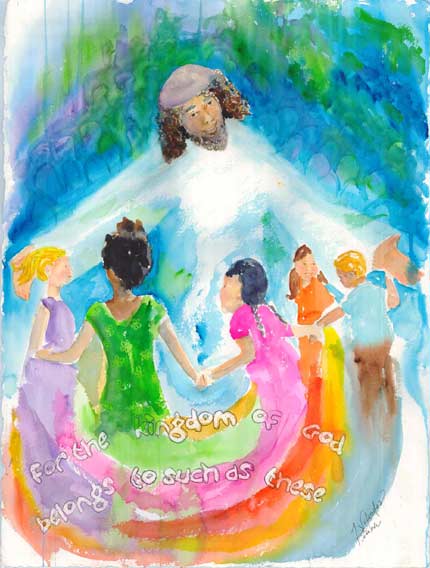
Art by Lynda Finch
He leads us in His dance, Lynda Finch

“Jesus replied, “Do wedding guests fast while celebrating with the groom? Of course not. They can’t fast while the groom is with them.” 

Mark 2:19

This whole idea of celebrating is often at odds with religious sensibilities.  “Too much liberty and too much freedom, and not enough control.  People won’t know how to behave, and it’ll ruin everything.” This argument has been used for generations, and will continue to perpetuate itself.

People just don’t know what to do when the presence of Jesus becomes activated in their midst.

There is a wedding!  Like all weddings this alters the present status-quo.  He has attached Himself to a bride, she is simple, and yet beautiful.  Room is made for the outcasts and mentally ill. For she is the Church, made up of rascals and ragamuffins who have had their many sins forgiven! All are invited.

We are limited in our religious duty of fasting.  It is definitely not appropriate in the light of this good news.  Simply put, we cannot advance our religious reputation in this new environment. It’s not about us at all!  Joy has taken over, and we can do nothing but stand in wonder. Jesus Christ has become “all, and in all”.

To follow Jesus must mean we are people of joy and celebration!  The old concepts of religious effort are nullified, plain and simple.  It really isn’t required, but it is understood that we will rejoice.  We will begin to party!

Joy is to infuse our understanding, and it will lift us to the place where life becomes infected with the contagion of heaven.  It is an epidemic spreading to every believer. The Universe has become the stage when worship is the only solution to the history of man.

His Presence has tipped the scales, and He has formulated Himself as the center of the whole ‘kit and caboodle.’  A joyful romance is at the very essence of everything.  C.S. Lewis once said that “Joy is the serious business of heaven.”

When it all comes down, we are transferred into the status of the amazed.  What has happened has caused us to take a breath, and step back in wonderment.  Jesus is the Revolution!  We are brought to the place where we belong, we are nothing more than  witnesses and participants in His exaltation.  We must rejoice in the joy of the Bridegroom!

bry-signat-1-1

cropped-christiangraffiti1-2

When Rags Became Grace

ebedmelech

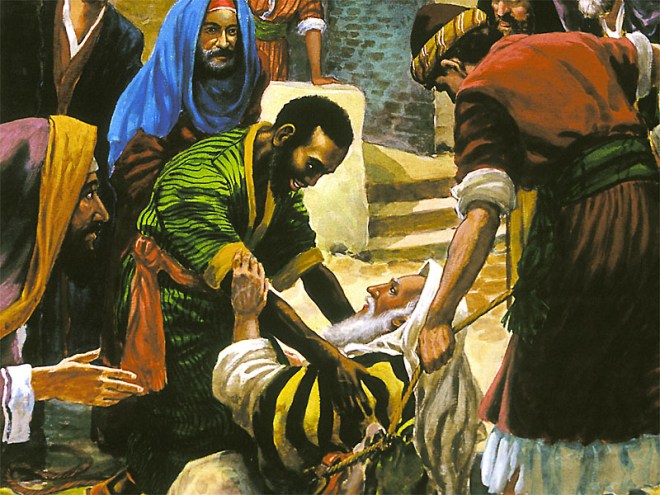
“Ebedmelech from Ethiopia was an official at the palace, and he heard what they had done to me. So he went to speak with King Zedekiah, who was holding court at Benjamin Gate. Ebedmelech said, “Your Majesty, Jeremiah is a prophet, and those men were wrong to throw him into a well. And when Jerusalem runs out of food, Jeremiah will starve to death down there.” 10 Zedekiah answered, “Take thirty of my soldiers and pull Jeremiah out before he dies.”

11 Ebedmelech and the soldiers went to the palace and got some rags from the room under the treasury. He used ropes to lower them into the well. 1Then he said, “Put these rags under your arms so the ropes won’t hurt you.” After I did, 13the men pulled me out. And from then on, I was kept in the courtyard of the palace guard.

Jeremiah 38:8-13, CEV

At the very last, there was just one remaining.  A single man, Ebedmelech.  He was a Ethiopian; made a eunuch by the will of the king.  The situation in Jerusalem has gotten very difficult.  In an action of revenge and reprisal, certain men intend to kill the prophet Jeremiah.  They take a certain satisfaction in this, and Jeremiah is thrown into a very deep cistern.  They intend for him to starve to death, which is a terrible way to die.

The king in these last pathetic days is being manipulated by the surviving leadership of the city.  Zedekiah gives tacit approval for the destruction of Jeremiah.  He just lets it happen without a good reason.  The prophet is lowered in the muddy cistern.  Without food, he will soon starve.  In the minds of this evil mob, they have taken care of the any last vestiges of a godly ‘righteousness.’

But there is one, he is a wild card.  And no man would have guessed it.  Ebedmelech, the Ethiopian eunuch steps forward and decides to change history.  Not only his ethnicity, but his state as a castrated man are definite issues.  This mob never recognized him as someone who would intervene.  He was a non-entity, a non-factor. He was black, and a eunuch, and a nobody.

But Ebedmelech is intervening, in the face of terrible risk, he steps out boldly to make an intercession.  He doesn’t appear to be intimidated, and makes a cry for the truth.  He becomes an intense and strong advocate for the release of Jeremiah from the deep mud.

Ebedmelech is given the ‘green-light’ by king Zedekiah. Ebedmelech rounds up thirty men to assist him as he delivers the prophet.  Ropes are brought out, and out comes Ebedmelech with a big armload of rags.  They shout down to Jeremiah.  The instructions are called down to him of what needs to take place for the extraction.

It’s interesting, but the rags are the most interesting. 

They are really an extra touch, not a necessity.  The rags become essentially, a form of grace.  They would pad the ropes, providing a degree of comfort as the prophet is pulled up out of the mud.  Ebedmelech showed the heart of God in what he did.  There was his desire to somehow make the prophet comfortable.  In doing so he communicated a kindness and concern that was saturated with God’s own enveloping presence.

Our illnesses– physical or mental, have moved us to a lonely place on the edge. 

We are those on the so-called ‘margins.’ Ebedmelech has now become a carrier of God’s grace.  Jeremiah could have been lifted up by just the ropes.  It would’ve been more difficult, granted.  But the rags sent down by Ebedmelech provided the prophet an extra gentleness.  And I am certain it did not pass by without notice.  Their mention in this Book of Jeremiah is significant, and shows Jeremiah’s deep appreciation of kindness.

We can gather up much from what has been written.  We will sometimes find ourselves in parallel situations.  But our kindness and concern can make the difference.  Admittedly, they are quite insignificant–quite minor. Call it ‘icing on the cake.’ But when you show the kindness of our Father, you will infuse the situation with love, and grace.  

So be an  Ebedmelech,—  an outcast perhaps– but in a position of kindness.


bry-signat (1)

cropped-christiangraffiti1.jpg


There’s More Than One Billion of Us!

handicappedsigns

With wheelchair users making up only 5% of disabled people it has become a poor way of acknowledging those of us with a different type of disability.

More than 1 billion people in the world are living with some sort of disability, according to a new international survey. That’s about 15 percent of the world’s population, or nearly one of every 7 people.

The numbers come from a joint effort by the World Health Organization and the World Bank. The last time anyone tried to figure out the prevalence of disabilities was back in the 1970s, when WHO figured it was about 10 percent. The current report suggests the 15 percent estimate will grow as the world’s population ages.

Like the 1970s numbers, today’s figures are at best an approximation. Many countries don’t collect numbers carefully, and definitions of disability differ from place to place. The World Bank/WHO folks sought out tabulations of people who have trouble seeing, hearing, walking, remembering, taking care of themselves or communicating. Worldwide, the most common disability in people under the age of 60 is depression, followed by hearing and visual problems.

The report includes a foreword by theoretical physicist Stephen Hawking, who can’t feed himself or get dressed or speak without assistance because of his amyotrophic lateral sclerosis, a debilitating and usually fatal disease. He says there’s a moral duty to help disabled people.

The head of WHO, Margaret Chan, offers up another reason: “Almost every one of us will be permanently or temporarily disabled at some point in life.” An editorial in the medical journal The Lancet points out that accommodations for people with disabilities, such as curb cuts, help the non-disabled as well (such as people with strollers).

Why even come up with a number? Knowing the prevalence of disabilities helps organizations set priorities and figure out what it will cost them to set up the kind of programs called for by WHO and the World Bank — programs that make it possible for people with disabilities to take care of themselves, to work and get around.

The report didn’t estimate the total cost of establishing such programs. And it offered no solutions for perhaps the biggest challenge: finding the money.flourish-bird

Source: http://www.npr.org/blogs/health/2011/06/09/137084239/nearly-1-in-7-people-on-earth-are-disabled-survey-finds?sc=fb&cc=fp

Also, most helpful: http://www.designassembly.org/2008/11/14/iconic-disability/

Y