Sins That Stick to Your Heart

It is often quite difficult for people to forgive themself from their past sins.  We have a tendency to hold ourselves to a stricter, more accountable level then other people.

I usually don’t have a big problem forgiving others.  But for many people they will struggle through their entire Christian walk with both self-forgiveness and its cousin, self-acceptance.

 Self-forgiveness is:

* Accepting yourself as a human who has faults and makes mistakes.
* Letting go of self-anger for your past failures, errors and mistakes.
* No longer needing penance, sorrow and regret over a grievous, self-inflicted, personal offense.
* The act of self-love after you have admitted your failure, mistake or misdeed.
* The spiritual self healing of your heart by calming self-rejection, quieting the sense of failure and lightening the burden of guilt.
* The act of letting go of the need to work so hard to make up for your past offenses.

Negative consequences of the absence of self-forgiveness
In the absence of self-forgiveness, you run the risk of:

* Unresolved hurt, pain and suffering from self-destructive behaviors.
* Unresolved guilt and remorse for self-inflicted offenses.
* Chronically seeking revenge and paybacks toward yourself.
* Being caught up in unresolved self-anger, self-hatred and self-blaming.
* Defensive and distant behavior with others.
* Pessimism, negativity and non-growth oriented behavior.
* Having a festering wound that never allows the revitalization of self-healing.
* Fear over making new mistakes or of having the old mistakes revealed.
* Being overwhelmed by fear of failure, fear of rejection, fear of non-approval, low self-esteem and low self-worth. 

Signs of the absence of self-forgiveness.  Lack of self-forgiveness can result in:

* A loss of love for yourself.
* Indifference toward yourself and your needs.
* An emotional vacuum in which little or no emotions are shown or shared.
* Chronic attacks or angry outbursts against self.
* Disrespectful treatment of self.
* Self-destructive behaviors.
* Self-pitying.
* Chronic recalling and reminding of past failures, mistakes, errors and offenses.
* Suspicions about others’ motives, behaviors, attitudes and beliefs when they are accepting of you.
* Chronic depression.
* Chronic hostility, sarcasm and cynicism.
* Self name-calling, belittling and self-demeaning behaviors.
* Unwillingness to change and/or unwillingness to seek the help necessary to change.
* Resistance to doing what is necessary to heal within and recover from low self-esteem.

 Irrational thinking preventing self-forgiveness

* I hurt myself so much; how can I ever expect to be forgiven for that?
* No one deserved the treatment I dished out, and I do not believe that forgiveness is deserved in this situation.
* I am sick over what I did; how can I ever forgive myself?
* I must be inherently evil, and I am despicable. No forgiveness will ever change that.
* I am vicious and cruel, and I always need to be on guard because of that; so why try to forgive what I have done?
* It is a sign of weakness or softness to forgive myself. I must always keep my guard up so as never to repeat my wrongdoings.
* There are some things I can never forgive myself for.
* Only God can forgive me, though at times I don’t believe He can for what I have done.
* What has happened in my life is God’s seeking revenge for all the evil I have done in the past.
* I have done too much for which I can never be forgiven.
* I am just seeking my forgiveness so that I can come back and hurt myself again.
* I do not deserve any self-kindness, self-compassion or self-forgiveness for what I have done to myself or others; I’ll see to it that I am never able to forget it!
* All people who do wrong deserve the worst that life has to dish out.
* I resent myself for hurting myself or others. It is better for me to be hidden behind my wall so I don’t hurt anybody again.
* If I could treat myself or others that way, then I am undeserving of being forgiven, loved or cared for.

 New behaviors needed to create self-forgiveness.  In order to forgive yourself you need to practice:

* Letting go of past hurt and pain.
* Trusting in God’s goodness. Trusting in the goodness and mercy of God to take over the burden for you.
* Letting go and letting the Holy Spirit  lead you during a hurtful time.
* Believing in the infinite justice and wisdom of the Lord                                                                                                                                                                                                                    * Letting go of fears for the future.
* Allowing yourself to be vulnerable to growth.
* Taking a risk.
* Letting go of self-hostility, resentment and self-destructive behaviors.
* Working out your self-anger.
* Overlooking slight relapses or steps backward and getting back on the wagon of recovery immediately.
* Developing a personal spirituality.
* Developing an openness to the belief that you can change.
* Developing trust in yourself.
* Open, honest and assertive communication with yourself concerning hurts, pains and offenses experienced.
* Identifying and replacing the irrational beliefs that block your ability to forgive yourself.

 Two Steps to Develop Self-forgiveness.
 

Step 1: In order to increase your ability to forgive yourself, you need to recognize what this behavior involves. Answer the following questions.

A. What do you mean by “self-forgiveness”?
B. Have you ever forgiven yourself before? How did it feel?
C. Have you ever brought up something from the past to remind you how you hurt yourself or others? How did that make you feel?
D. What role do you feel self-forgiveness has in your growing down? How could you improve?
E. How has the absence of forgiving yourself affected your current emotional stability?
F. What are the signs of the absence of self-forgiveness in your relationship with your family of origin, current family, significant others, spouse, children, parents, relatives, friends or co-workers? With whom do you experience a wall or barrier behind which you hide your past real or perceived failures, mistakes, errors or misdeeds? What feedback do you get about this wall you have been hiding behind?
G. What beliefs block your ability to forgive yourself? What would be necessary to change these beliefs?
H. What new behaviors do you need to develop in order to increase your ability to forgive yourself?
I. What role does the existence of spirituality play in your ability to forgive yourself? The lack of it?
J. For what do you need to forgive yourself?

 Step 2: Now that you have a better picture of what is involved in self-forgiveness, you are ready to work on a specific past failure, mistake, error or misdeed.

A. List a failure, mistake, error, misdeed or event for which you are unable to forgive yourself.
B. How much energy, creativity, problem solving capability and focus on growth is sapped from you whenever you recall this past hurt?
C. What feelings come to mind as you recall this past hurt?
D. How would you describe your role in this past event? In what ways were you the victim, perpetrator, enabler, martyr, bystander, instigator, target, scapegoat, distracter, peacemaker, people pleaser or rescuer?
E. Why do you feel strongly over what happened and how you treated yourself or others?
F. What did this event do to your self-esteem and self-worth?
G. Who was responsible for your reaction to the incident?
H. Who was responsible for your feelings about the incident?
I. Who was responsible for your inability to forgive yourself?
J. How can you forgive yourself?
K. How can you put this incident behind you?
L. How can you avoid being so hurt when something like this happens again?

 ybic, Bryan


You Are Complete In Him

“Beware lest anyone cheat you through philosophy and empty deceit, according to the tradition of men, according to the  basic principles of the world, and not according to Christ.

For in Him dwells all the fullness of the Godhead bodily, and you are complete in Him, who is the head of all principality and power.”  

Colossians 2:8-10

I’ve heard about how accessories can complete a look.

Lord, thank You for completing us!  And here’s a simple poem . . .

All the Fullness

We are complete in You                                                                       
for that is what You do
coming to us who are unfinished
and filling us with truth.

We are complete in You
it’s not something we can do
for nothing else can fill us
but the fullness of You.

By Debbie, her link should be a blessing, http://iftodaywehear.wordpress.com/

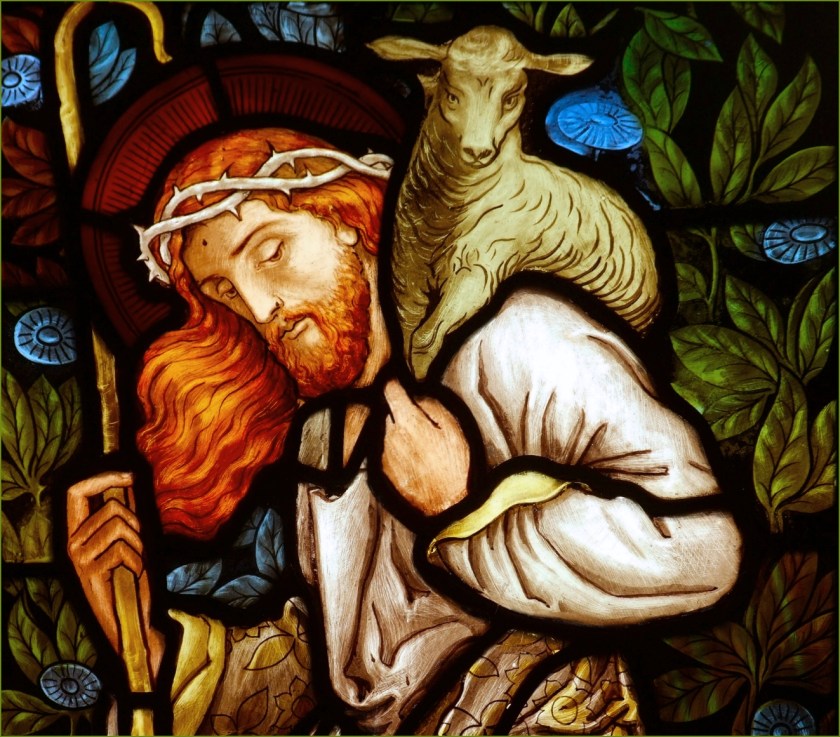
Getting to Know Your “Sheepiness”

I am the good shepherd. I know my sheep, and they know me. 

–John 10:14

The shepherds of Israel have a custom of marking their sheep to make them distinct from each other.  Each bears a unique notch or brand that makes them distinguishable from their companions.  It is not done for aesthetics, but recognition.  Christ gives each person who follows Him a certain recognizable characteristic.  He “knows His sheep.”

He recognizes their faces.  All have a common demeanor, a family resemblance.  No matter where they go, they are marked as His follower.  The Prodigal fed the pigs from his abject poverty, yet he belonged to his Father.  Our voices also mark us, they are recognizable by those who are aware.  When we speak there is a heavenly inflection and tone.  I have a dear friend from Tennesee, and he couldn’t pretend to be from Boston.  You might say we have a believer’s accent that IDs us as His own.

Last of all, He knows us by our hearts.  Peter was one who not only betrayed his Lord, but he betrayed himself.  He was not quite Peter the Rock, but Peter the weak.  Jesus sees our hearts, the flaws and weaknesses are quite obvious to Him.  We may feel like we are damaged goods.  But His power to transform is legendary and without peer.

Jesus knows His sheep, He just does not tend the best, but seeks out the least.  All who are weak and pathetic are cared for with a tender love.  Those of us who are flawed and lame are given preferential treatment, but all are loved, all needs are met.

We have no power without Jesus as our Shepherd to lead  us.  We cannot manage on our own.  Solitary sheep are nothing more than a wooly snack for predators, or they will fall desperately seeking pasture.  I encourage each to merge with a local flock, a group of imperfect believers who are following the Shepherd of love.

“The LORD is my shepherd, I shall not be in want.

 2 He makes me lie down in green pastures,
       he leads me beside quiet waters,

 3 he restores my soul.
       He guides me in paths of righteousness
       for his name’s sake.”

 Psalm 23:1-3

ybic, Bryan

Kissing Twisted Lips

God accommodates Himself to our ‘sickness’.  We find that He has this beautiful quality about Him, that He becomes quite tender and gentle around any spiritual disease.

In his book Mortal Lessons (Touchstone Books, 1987) physician Richard Selzer describes a scene in a hospital room after he had performed surgery on a young woman’s face:

“I stand by the bed where the young woman lies . . . her face, postoperative . . . her mouth twisted in palsy . . . clownish. A tiny twig of the facial nerve, one of the muscles of her mouth, has been severed. She will be that way from now on. I had followed with religious fervor the curve of her flesh, I promise you that. Nevertheless, to remove the tumor in her cheek, I had cut this little nerve. Her young husband is in the room. He stands on the opposite side of the bed, and together they seem to be in a world all their own in the evening lamplight . . . isolated from me . . .private.

Who are they? I ask myself . . . he and this wry mouth I have made, who gaze at and touch each other so generously. The young woman speaks. “Will my mouth always be like this?” she asks. “Yes,” I say, “it will. It is because the nerve was cut.” She nods and is silent. But the young man smiles. “I like it,” he says, “it’s kind of cute.” All at once I know who he is. I understand, and I lower my gaze. One is not bold in an encounter with the divine. Unmindful, he bends to kiss her crooked mouth, and I am so close I can see how he twists his own lips to accommodate to hers. . . to show her that their kiss still works

This is who Jesus has always been. And if you think you are getting to be a great kisser or are looking desirable, I feel sorry for you. He wraps himself around our hurts, our brokenness and our ugly, ever-present sin. Those of you who want to draw big, dark lines between my humanity and my sin, go right ahead, but I’m not joining you. It’s all ME. And I need Jesus so much to love me like I really am: brokenness, memories, wounds, sins, addictions, lies, death, fear….all of it. Take all it, Lord Jesus. If I don’t present this broken, messed up person to Jesus, my faith is dishonest, and my understanding of it will become a way of continuing the ruse and pretense of being “good.”

Now I want to talk about why this is important. We must begin to accept who we are, and bring a halt to the sad and repeated phenomenon of lives that are crumbling into pieces because the only Christian experience they know about is one that is a lie. We are infected with something that isn’t the Gospel, but a version of a religious life; an entirely untruthful version that drives genuine believers into the pit of despair and depression because, contrary to the truth, God is “against” them, rather than for them.

The verse says, “When I am weak, then I am strong- in Jesus.” It does not say “When I am strong, then I am strong, and you’ll know because Jesus will get all the credit.” Let me use two examples, and I hope neither will be offensive to those who might read and feel they recognize the persons described.

Many years ago, I knew a man who was a vibrant and very public Christian witness. He was involved in the “lay renewal” movement in the Southern Baptist Convention, which involved a lot of giving testimonies of “what God was doing in your life.” (A phrase I could do without.) He was well-known for being a better speaker than most preachers, and he was an impressive and persuasive lay speaker. His enthusiasm for Christ was convincing.

He was also known to be a serial adulterer. Over and over, he strayed from his marriage vows, and scandalized his church and its witness in the community. When confronted, his response was predictable. He would visit the Church of Total Victory Now, and return claiming to have been delivered of the “demons of lust” that had caused him to sin. Life would go on. As far as I know, the cycle continued, unabated, for all the time I knew about him.

I understand that the church today needs- desperately- to hear experiential testimonies of the power of the Gospel. I understand that it is not good news to say we are broken and are going to stay that way. I know there will be little enthusiasm for saying sanctification consists, in large measure, in seeing our sin, and acknowledging what it is and how deep and extensive it has marred us. I doubt that the ‘triumphalists’ will agree with me that the fight of faith is not a victory party, but a bloody war on a battlefield that resembles Omaha Beach more than a Beach party.

I write this piece particularly concerned for leaders, parents, pastors and teachers. I am moved and distressed that so many of them, most of all, are unable to admit their humanity, and their brokenness. In silence, they carry the secret, then stand in the place of public leadership and present a Gospel that is true, but a Christian experience that is far from true.

Then, from time to time, they fall. Into adultery, like the pastor of one of our state’s largest churches. A wonderful man, who kept a mistress for years rather than admit a problem millions of us share: faulty, imperfect marriages. Where is he now, I wonder? And where are so many others I’ve known and heard of who fell under the same weight? Their lives are lost to the cause of the Kingdom because they are just like the rest of us?

By the way, I’m not rejecting Biblical standards for leadership. I am suggesting we need a Biblical view of humanity when we read those passages. Otherwise we are going to turn statements like “rules his household well” into a disqualification to every human being on the planet.

I hear of those who are depressed. Where do they turn for help? How do they admit their hurt? It seems so “unChristian” to admit depression, yet it is a reality for millions and millions of human beings. Porn addiction. Food addiction. Rage addiction. Obsessive needs for control. Chronic lying and dishonesty. How many pastors and Christian leaders live with these human frailties and flaws, and never seek help because they can’t admit what we all know is true about all of us? They speak of salvation, love and Jesus, but inside they feel like the damned.

Multiply this by the hundreds of millions of broken Christians. They are merely human, but their church says they must be more than human to be good Christians. They cannot speak of or even acknowledge their troubled lives. Their marriages are wounded. Their children are hurting. They are filled with fear and the sins of the flesh. They are depressed and addicted, yet they can only approach the church with the lie that all is well, and if it becomes apparent that all is not well, they avoid the church.

I do not blame the church for this situation. It is always human nature to avoid the mirror and prefer the self-portrait. I blame all of us who know better. We know this is not the message of the Gospels, the Bible or of Jesus. But we  every one of us is afraid to live otherwise. What if someone knew we were not a good Christian? Ah…what if…what if….

I close with a something I have said many times before. The Prodigal son, there on his knees, his father’s touch upon him, was not a “good” or “victorious” Christian. He was broken. A failure. He wasn’t even good at being honest. He wanted religion more than grace. His father baptized him in mercy, and resurrected him in grace. His brokenness was wrapped up in the robe and the embrace of God.

Why do we want to be better than that boy? Why do we make the older brother the goal of Christian experience? Why do we want to add our own addition to the parable, where the prodigal straightens out and becomes a successful youth speaker, writing books and doing youth revivals?

Lutheran writer Herman Sasse, in a meditation on Luther’s last words, “We are beggars. This is true,” puts it perfectly:

Luther asserted the very opposite: “Christ dwells only with sinners.” For the sinner and for the sinner alone is His table set. There we receive His true body and His true blood “for the forgiveness of sins” and this holds true even if forgiveness has already been received in Absolution. That here Scripture is completely on the side of Luther needs no further demonstration. Every page of the New Testament is indeed testimony of the Christ whose proper office it is “to save sinners”, “to seek and to save the lost”. And the entire saving work of Jesus, from the days when He was in Galilee and, to the amazement and alarm of the Pharisees, ate with tax collectors and sinners; to the moment when he, in contradiction with the principles of every rational morality, promised paradise to the thief on the cross, yes, His entire life on earth, from the cradle to the Cross, is one, unique grand demonstration of a wonder beyond all reason: The miracle of divine forgiveness, of the justification of the sinner. “Christ dwells only in sinners’.

***** 


Most of this is past of an old post from the blog of the “Internet Monk” and has been repeated here for your edification.

This blog can be read in its entirity at :  http://www.internetmonk.com/archive/imonk-101-when-i-am-weak-why-we-must-embrace-our-brokenness-and-never-be-good-christians

The Internet Monk’s website is really engaging and diverse and I strongly suggest visiting it.

 ybic, Bryan